



New Swedish passenger catamaran will run on hydrogen
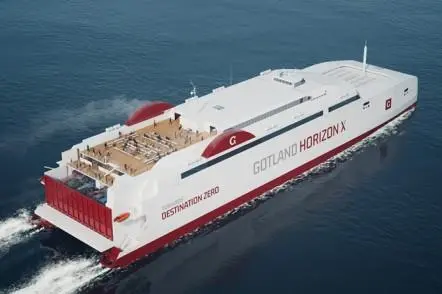
The 130-metre high-speed catamaran will be able to travel at 35 knots, carry 1,650 passengers and have space for 450 passenger cars. Serving the Gotland route during the summer months, the vessel will be able to make the trip between the Baltic island of Gotland and the Swedish mainland in under three hours.
The ship is designed to be powered by compressed hydrogen, with water vapour as the primary component of emissions. It will have a multi-fuel, twin gas turbine, combined cycle solution that can also be powered by other fossil-free fuels including methanol, e-methanol or biogas. With a relatively simple adaptation of the turbines, it is possible to change the fuel from hydrogen to both gas and liquid fuels, says Gotlandsbolaget. It is also possible to mix hydrogen gas with, for example, biogas. The power output of the combined cycle solution is expected to be about 31MW although the system supplier has not yet been chosen.
The technical development work is being led by Gotland Tech Development, and Christer Bruzelius, Senior Partner & Project Owner Gotland Tech Development, says that gas turbines are normally very responsive to load changes. “We have chosen a gas turbine concept because we believe this will be the quickest path for reaching 100% hydrogen operation together with a multifuel solution with the gas turbines possible to operate on several different fossil free fuel types.”
The key component for achieving good system efficiency is to run the gas turbines in combined cycle and to recycle the exhaust heat from the gas turbine, he says. With the combined cycle, the warm exhaust from the gas turbine goes through an exhaust gas boiler creating steam that goes through a steam turbine generating electricity led back to the gearbox through an electrical motor (PTI).
The conceptual design handles the compressed hydrogen tanks in a dedicated place on the foredeck. The fuel system will be built up around the tanks and leading down to the gas turbines in each hull of the catamaran. “The rules from class are not in place, so we will work to gain approval in principle from class. Several Hazard evaluations will be necessary to carry out during detailed design of the fuel system,” Bruzelius says.
“Hydrogen refuelling poses some challenges when designing the system. We foresee filling in both ports for Gotland Horizon X, where we will build a compressor station, buffer tanks, cooling unit and a filling post connected with the vessel.”
He says: “The ship’s design is based on Gotland’s and our passengers’ needs to be able to travel with a short crossing time and at competitive prices, without negatively impacting the climate or the environment. In order to minimise the energy requirement and obtain a high degree of efficiency, we develop energy-efficient hulls, minimise weight, optimise energy consumers on board and streamlines operations and flows throughout the vessel. Austal is a leader in the development of large catamarans, and they are an excellent partner to take Horizon X forward.”
The work to develop all the necessary technology is ongoing and the ambition is that the Gotland Horizon X will be ordered no later than 2025 to be put into service no later than 2030.
Gotlandsbolaget launched the Gotland Horizon X concept in October 2022. The vessel is the world’s first large-scale hydrogen-powered catamaran, and the second in Gotlandsbolaget’s Horizon Series. Gotlandsbolaget has previously presented a large ropax, Gotland Horizon, with room for 1,900 passengers and 600 cars in 2021. The aim is to have this ship in service by 2030 as well. The main engine concept with gas turbines in combined cycle is the same for both vessels.
Gotlandsbolaget’s goal is for Gotland traffic to be climate-neutral by 2045. The first concept ship was formulated back in 2009 with a clear ambition to achieve fossil-free crossings between Gotland and the Swedish mainland. Since then, the company have worked tirelessly to reduce its climate footprint. “The Horizon series is our most ambitious step so far – a step that we consider vital not only for us, but for society as a whole.”
Ongoing work includes investing in next-generation technology and fuel, infrastructure for green energy, and the long-term development of vessel destinations.
Related Articles
 AMMONIA
 HYDROGEN
 HYDROGEN