



NEWCASTLEMAX TRANSITION TO LNG FUEL
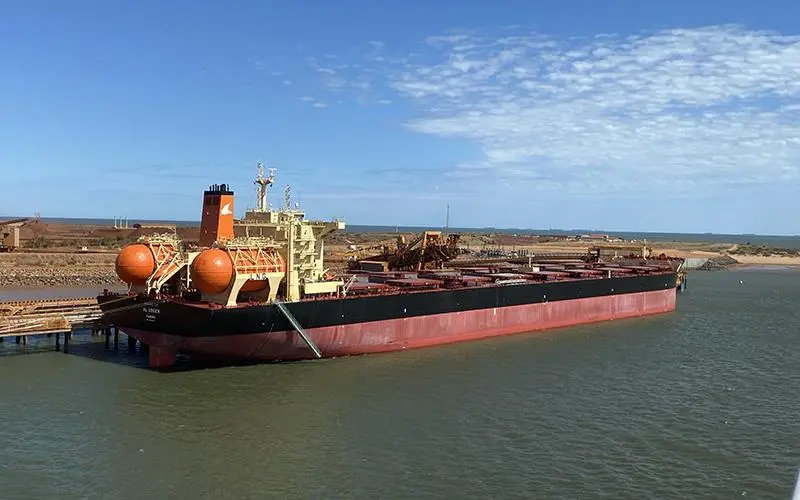
South Korea’s shipping and shipbuilding sectors have opened a new chapter in deep-sea bulk carrier design and trading through the completion of a pair of LNG-fuelled newbuilds of 180,000dwt. The Newcastlemax-class HL Eco and HL Green are the largest bulkers commissioned to date with the capability to use LNG as the primary fuel.
Powered by dual-fuel machinery throughout, covering both propulsion and auxiliary systems, each 292m bulker is expected to make about 10 round-voyages per annum between Australia and South Korea. The prospective impact in terms of emission reduction is substantial, as operation in gas mode with the type of engines installed promises the virtual elimination of SOx and particulate matter (PM), and up to 85% less NOx and a 30% curtailment of CO2 compared to existing mainstays of the trade.
Constructed by Hyundai Samho Heavy Industries (HSHI) to the order of Seoul-based H-Line, the HL Eco and HL Green reportedly commanded a per-ship price of around US$62 million, reflecting the significant premium entailed with a dual-fuel specification relative to conventional powering arrangements. Indicative of the cost gap, brokers currently put the representative newbuild price for ‘standard’ Newcastlemax bulkers at about US$48 million, down somewhat from the US$50 million or so that pertained when the H-Line tonnage was ordered in October 2018.
Acknowledging the extra cost burden associated with building gas-fuelled ships, the Korean government has proved supportive to the marine industries by incentivising domestic investment in such tonnage from home yards.
H-Line’s initiative in committing to LNG power for large bulkers has been followed by a succession of LNG-fuelled newbuild projects in the Newcastlemax sector by owners worldwide, for raw material flows into the east Asian industrial powerhouses of South Korea, Japan and China. A particularly important development came last September when Australian miner BHP awarded Eastern Pacific Shipping a five-year timecharter contract covering five LNG-fuelled, 209,000dwt Newcastlemax newbuild bulkers to carry iron ore from Western Australia to China.
The H-Line ships made their debut on the Australian coast during January. On her maiden voyage, HL Green put in to Port Hedland, Western Australia, to take on iron ore, while HL Eco shipped a cargo of Hunter Valley coal via Port Waratah’s facilities in Newcastle, New South Wales. In both cases, the destination on the Korean peninsula was Gwangyang, the site of one of POSCO’s steelmaking complexes.
South Korea had put down a marker for the industry in 2018 when Hyundai Mipo Dockyard (HMD) delivered the 50,000dwt LNG dual-fuelled bulker Ilshin Green Iris into the coastwise traffic carrying limestone under POSCO charter.
Ilshin Green Iris had been built to dual Korean Register of Shipping (KR)/Lloyd’s Register (LR) class, HSHI parent Hyundai Heavy Industries signed a joint development agreement with LR in 2017 for the design of LNG-fuelled bulkers in the 180,000dwt category. HL Eco and HL Green have come into being under dual class assignment, although in this case with DNV notations alongside those of KR.
Each of the new vessels is equipped with two Korean-manufactured, 1,600m3 Type C LNG fuel tanks, among the most capacious at sea to date. The tanks were fabricated using POSCO’s 9% nickel steel, ensuring the requisite containment temperature of minus 163degC.
POSCO has provided the industry with another option by developing a high-manganese steel that can be used in the production of LNG fuel tanks. The company’s austenitic manganese tank technology had its initial application in the Ilshin Green Iris. The high manganese-content (26%) steel offers benefits in weldability and cost-efficiency relative to nickel, while affording comparable quality. The extended product range is salient to POSCO’s preparations for an expected surge in demand for LNG tank material during the next few years as more and more shipowners and operators turn to LNG-fuelled vessels.
POSCO’s involvement in the H-Line bulker newbuilds otherwise entailed the supply of 42,000 tonnes of steel plate for hull construction.
Whereas Korea’s milestone LNG-fuelled bulker Ilshin Green Iris had provided a showcase for MAN’s ME-GI high-pressure DF propulsion engine technology, H-Line’s Newcastlemax duo employs low-pressure DF two-stroke machinery from the Winterthur Gas & Diesel (WinGD) stable. Each vessel’s six-cylinder X72DF engine achieves Tier III compliance in gas mode without extra measures, and is rated for a maximum continuous output of 16,180kW at 72.5rpm. The engines were produced at the Ulsan works of licensee HHI.
The auxiliary outfit comprises three aggregates based on dual-fuel prime movers from HHI’s in-house HiMSEN four-stroke range. The engines are of the H22CDF type in five-cylinder layout, driving 1,262kVA gensets. Both the oil/gas-fuelled main boiler and the economiser are of Alfa Laval (Aalborg) design.
H-Line awarded HSHI a repeat contract in July 2019, such that third and fourth examples of the HL Eco type are to be handed over by the end of March 2022. Two newbuild membrane-type LNG carriers are also on the books at the Yeongam-Samho yard to H-Line account, and are scheduled to enter service during the early part of 2022.
The H-Line fleet comprises over 40 bulkers and seven LNG tankers. Most of the bulk carriers are engaged in the transportation of raw materials for long-term clients POSCO and Korea Electric Power Corporation (KEPCO). The highest-capacity units are the very large ore carriers (VLOCs) HL Tubarao and HL Brazil.
Split off from bankrupt Hanjin Shipping in 2014, H-Line had been Hanjin’s bulk cargo division and was acquired by South Korean private equity firm Hahn & Co. As the controlling shareholder, Hahn & Co subsequently augmented H-Line’s interests and scope through the purchase and assimilation in 2016 of Hyundai Merchant Marine’s dry bulker operations. The LNG carriers deployed by H-Line serve traffic flows from Indonesia, Oman and Qatar under long-term KOGAS contracts.
PRINCIPAL PARTICULARS – HL Eco/HL Green
|
Length overall |
291.9m |
|
Length bp |
287.0m |
|
Breadth, moulded |
45.0m |
|
Depth |
24.8m |
|
Draught |
18.0m |
|
Gross tonnage |
97,000gt |
|
Deadweight |
179,650t |
|
Cargo holds |
9 |
|
Propulsion + auxiliary engines |
LNG dual-fuel |
|
Main engine power |
16,180kW |
|
Speed |
14.5kts |
|
Main gensets |
3 x 1,262kVA |
|
Class (dual) |
KRS/DNV |
|
Flag |
Panama |
Related Articles
 PROPULSION
 GENERAL NEWS
 HYDROGEN