



No laughing (gas) matter: Schneiter targets zero N2O in new X-DFA

In an exclusive interview with The Motorship in April, Dominik Schneiter provided a broad overview of the progress of WinGD’s methanol and ammonia engine development programmes, both of which expect to deliver their first engines for shop tests around June 2025.
Schneiter also explained that WinGD was expected to almost eliminate fugitive nitrous oxide (N2O) emissions from its new X-DF-A ammonia dual-fuel engine without the need for an aftertreatment system.
Combustion tests for WinGD’s Ammonia Engine
Before the modelled emissions profile can be validated, the first single cylinder combustion tests would need to begin on WinGD’s X-DF-A ammonia dual-fuel engine. The dedicated single cylinder engine (SCE) tests are expected to begin at WinGD’s Winterthur facility “towards the end of 2023 or at the beginning of 2024”.
The SCE test bench is currently being commissioned, operating on diesel, and will subsequently be converted to operate on ammonia.
NH3 combustion modelling
In parallel, Schneiter’s colleagues have been conducting specific combustion tests on WinGD’s spray combustion chamber since early 2023 to obtain detailed data about how ammonia combusts in 2-stroke relevant conditions.
The data from the specific combustion tests has been used to refine simulations of the combustion of ammonia in the test engine, which has helped WinGD to calibrate its own simulation models.
Schneiter concluded by explaining how the essential fuel injection modelling work that was being conducted at Winterthur was contributing to the refinement of engine management models for operating on different alternative fuels.
“The simulation models are actually being put into the engine controls and monitors.”
“All of the simulations that we have built for these new fuels, which have been developed from our combustion modelling, will also be represented in the engine control system and in the Digital Expert system, to monitor these engines continuously.”
Pilot fuel expectations
As Schneiter previously discussed with The Motorship in 2022, the modelling work was expected to contribute to decisions around pilot fuel and the engine’s expected greenhouse gas emissions profile.
Schneiter was delighted to confirm that the WinGD X-DF-A engine is expected to “clearly stay below 5% pilot fuel rate, which has been the target from the beginning.”
Schneiter also reiterated that WinGD’s X-DF-A engine was being developed with the intention of eventually operating on pure ammonia fuel in a liquid state when it was operating in dual-fuel mode.
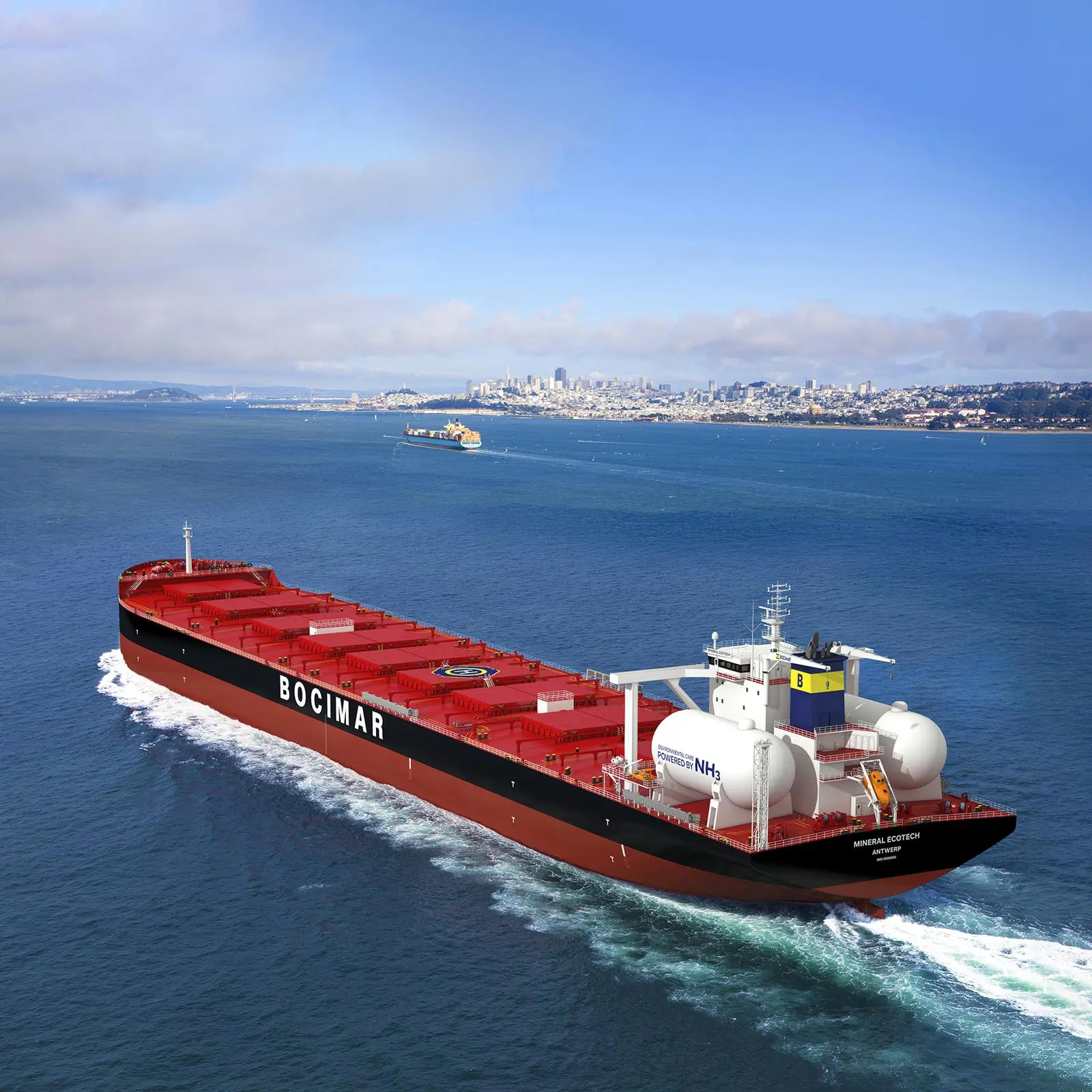
Schneiter noted that WinGD had discounted operating on ammonia/LNG blends owing to “the difficulty of installing multiple fuel tanks, and fuel supply systems, with different pressure levels, and different volume flows. In our eyes, it would only make sense if you operated on gaseous ammonia onboard, which is a space challenge.”
One of the specific challenges of developing a two-stroke combustion model was the absence of pre-existing datasets covering the ignition and combustion behaviour of the fuel. “So the [tests in the spray combustion chamber] have been the base of all our development. And we have already seen very good results.”
The most exciting development related to the engine’s expected greenhouse gas emissions profile. Schneiter noted that the potential for ammonia DF engines to produce fugitive nitrous oxide (N2O) emissions had been identified as a potential threat to the environmental emissions advantage of operating on ammonia as fuel, owing to its significantly higher greenhouse gas warming potential (GWP) than CO2.
“The target is clearly [to eliminate fugitive N2O emissions] and… the spray combustion chamber tests have demonstrated that we can manage [within the combustion chamber] without the need for an after-treatment system.”
A separate area of focus related to the interaction between the ammonia fuel and the two-stroke engine’s lubrication systems.
Schneiter recognised that the potential ingress of ammonia into the lube oil, with resulting toxicity and related issues, had been identified as a potential risk. However, he stressed that design differences between two-stroke and four-stroke engines mitigated the risk somewhat.
“The stuffing box [in two-stroke engines] actually separates the conversion area with the piston line from the lube oil, so we have a natural barrier where we can detect some leakages. So that is of course something we need to monitor and will be detected by gas detectors in the piston underside.”
Monitoring would also be applied in the neutral space from the stuffing box to make sure there are no ammonia leakages down to the system oil in the crankcase.
Turning to the cylinder oil, WinGD has established a target to make sure that the ammonia is burned before it hits the liner wall where the cylinder oil is sitting. Advanced monitoring techniques are being considered to identify a circumstance where ammonia contaminates the cylinder lube oil.
“The additive majors supplying the lubricant suppliers are actually considering the cylinder lube oil as another measure to control ammonia. So in case [ammonia contamination occurs], we would have a monitoring system in place that would release additives that can protect the engine to a certain extent or act as a catalyst to convert ammonia to reduce its effects.”
Schneiter noted that this approach is currently being analysed in detail in joint development studies with classification societies as well.
Initial Engine Bore Targets
WinGD has plans to extend the range of its methanol and ammonia engines to different bore sizes once the initial development of the alternative fuel engines is completed in 2025.
The engine designer is opting to launch 92 and 82-bore versions of the methanol engine first as this is where the company is seeing the largest demand, and the largest orders in terms of kilowatt capacity.
For the dual-fuel methanol engine, WinGD was planning to deliver the first 92-bore engine to market as part of a project for the Chinese liner operator and ship owner COSCO by June 2025.
Schneiter noted that the market demand for methanol engines is “huge”, reflecting the importance of green solutions for shipowners at the moment. “We can provide the technology, the question is always when they need it.”
In parallel with the first newbuilding, WinGD was planning to introduce a conversion solution for existing X92B engines to market “more or less concurrently” with the addition of the first methanol engine in 2025. “We have seen a lot of interest in methanol solutions from the container segment, where there are a number of large container vessels on order with delivery dates in 2024, 2025 and even 2026. Many of the owners are enquiring about potentially converting these vessels to methanol dual-fuel engines.”
The company plans to extend the methanol portfolio subsequently to smaller engine bore sizes based on WinGD’s assessment of the segments that are likely to see the greatest commercial activity. The final decisions to expand the engine portfolio will ultimately depend on customer interest.
“Ordering activity for larger container vessels has slowed since 2021 and 2022, although there are still some orders coming in. All the feeders will need to be changed next, with the 7000-8000 teu vessels likely to be followed by 3000-4000 teu feeders.
“However, projects for smaller size feeders ranging in size from 1000 teu up to 1500 and 2000 teu are also arriving, which means we have to complete the portfolio.”
Ammonia engine
The expansion of the ammonia engine portfolio will likely be slower, focused on developing smaller bore engine following the development of the 52-bore engine, which would be the same as WinGD’s second test engine at Winterthur. “Once the first research engine is running, you will also have the first commercial solution available.”
WinGD is also developing a second bore size for the ammonia engine, as part of a collaboration with CMB, the Belgian ship owner, on a series of ten ammonia-fuelled 210,000 dwt bulk carriers. The shop test of the first of the series 72-bore engines for the bulk carriers is expected to occur in mid 2025.
“Looking ahead, we will scale up from the 52-bore to the 72-bore following the same incremental approach that we used with LNG previously. It took us longer to scale up from 72 bore to 80 and 92 bore.” Schneiter emphasised that the engine designer was not planning to commit to the development of a 92 bore X-DF-A engine until it had gained operational experience from the 72-bore engine.
Related Articles
 2-STROKE & 4-STROKE
 2-STROKE & 4-STROKE
 2-STROKE & 4-STROKE