



Noise and vibration attenuation in pipework systems
Not only does noise and vibration decrease the lifetime of the system but they are also key elements in the comfort of passengers and crew. Avoiding the causes is therefore a high priority in shipbuilding.
All piping systems carry vibration generated by equipment. In addition, some movement can be expected from pressure thrusts during operation, and even greater movement during the startup and shutdown of equipment due to the use of resilient pipe hangers and supports, and equipment mountings. The piping system must be made flexible enough to permit equipment movement, or thermal expansion/contraction without reducing the performance of vibration isolators, and to prevent damaging stresses at connections.
In mechanical rooms, pumps, chillers, fans and boilers frequently create noise and vibration which can be difficult to contain. For example, oscillatory forces can be generated due to the lack of balance of rotating components, e.g. pump vanes. This can be reduced by ‘field balancing’; however this calls for specialised equipment, which makes it difficult, expensive and impractical.
Independent tests
Faced with the need to diminish noise and vibration from equipment connected to the circulation system, designers have traditionally specified elastomeric flexible arch connectors. However, independent tests have demonstrated that couplings are far more effective at reducing noise and vibration.
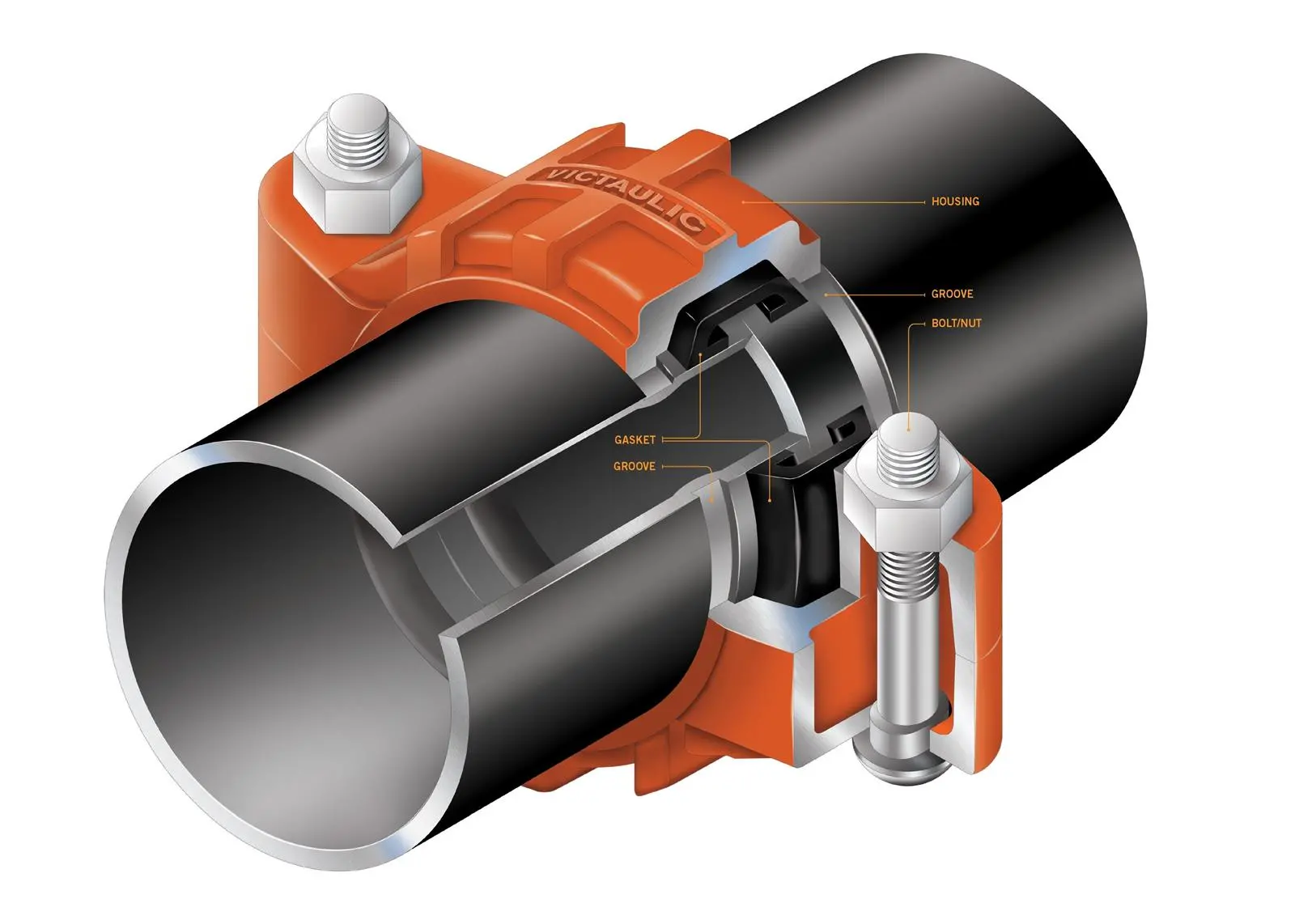
When the structure of a grooved pipe coupling is examined, it is easy to see why it effectively reduces sound transmission. The resilient elastomeric gasket, contained inside the internal cavity of the ductile iron housing, creates a discontinuity similar to that of a flex connector. The material from which the gasket is made also serves to absorb vibration.
The key distinctions of a grooved pipe joint over a flexible connector are inherent in the proprietary design of the coupling. Its construction enables the gasket to seal against the pipe, while the ductile iron housing provides both space for the elastomeric material to flex and containment to prevent overstretching. Overall, the coupling works to create a permanent leak-tight seal with no need for additional reinforcement. Additionally, ductile iron has vibration dampening qualities of its own, so the external housing also serves to absorb sound.
Nutech Testing Corporation/SE Laboratories in the USA applied a vertical acceleration to one end of a pipe assembly, measured the responses and compared the performance of Victaulic couplings and elastomeric flexible arch connectors. The results showed that Victaulic couplings displayed better vibration isolation and attenuation characteristics.
For any given pipe diameter, vibration isolation increases as the number of couplings increases (i.e. less vibration is transmitted with each additional coupling), regardless of whether flexible or rigid couplings are used. Victaulic considers that the best arrangement is to place three flexible couplings close to the source of vibration. This can be achieved in a variety of ways. The use of additional couplings – whether flexible or rigid – in the system will further reduce the transmission of vibration.
Victaulic says that these test results substantiate the use of its flexible couplings for pump or equipment connections, not only because of their claimed superior attenuation characteristics, but also because of their ability to accommodate misalignments and reduce stresses at pump or equipment connections.
Applications
Victaulic says that it has secured IACS approvals for a complete range of products, from couplings and fittings to valves and mechanical tees, giving users confidence in their performance. A variety of vessels have discovered benefits that arise from using the technology for class 2 and 3 piping systems, and for class 1 systems outside category A areas. Typical applications include sea and fresh water cooling, lube oil, fire and deck wash, and bilge systems. In addition, the same technology can be employed for class 1 and 2 FiFi systems on tugs and support vessels.
The company believes that this method is particularly suited for use with ballast water treatment systems – both for new systems and, more importantly, for retrofits ahead of the IMO convention which is expected to come into force in 2014. Here grooved pipe joining provides a solution for owners and yards faced with the challenges of modifying existing systems in confined spaces: it reduces the on-board footprint, can be used safely without hotworks or cumbersome welding equipment and requires no pre-engineering.
For joining medium- to large-diameter pipes between 350mm and 1524mm Victaulic has developed the Advanced Groove System (AGS). The AGS coupling employs a patented wedge-shaped roll groove which is deeper and wider, and a wider gasket which gives contact over a larger area for improved sealing. The AGS pipe joint is designed with features that combine to offer enhanced strength and reliability, with a claimed 40% increase in end-load carrying capabilities compared with other joining methods.
Victaulic was established in 1919, and since then has established a strong position in production of grooved mechanical couplings and pipe-joining systems for demanding market applications. Claimed benefits of the system include increased safety, reliability and maximum efficiency. The company has 15 manufacturing facilities, 28 branches worldwide and more than 900 active global patents. The products are used in industries including oil and gas, chemical, mining, power generation, water and wastewater treatment, military and marine, commercial building and fire protection.
Related Articles
 PROPULSION
 GENERAL NEWS
 HYDROGEN