



Nordic Eco Class from ascendant Indian yard
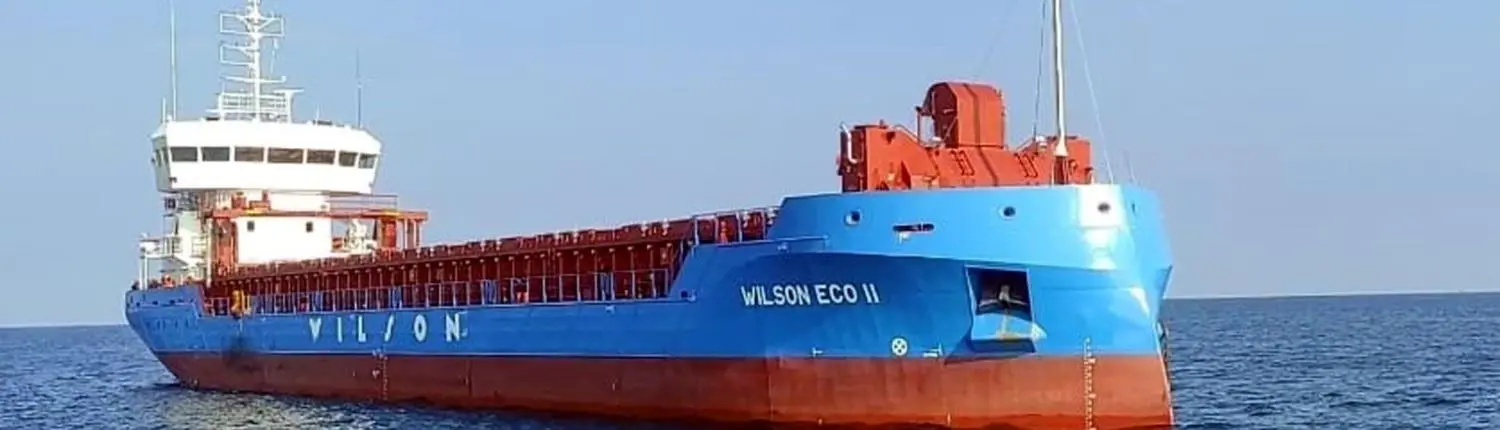
The entry into service last summer of the 89m Wilson Eco I signalled the opening phase in a programme of 14 newbuilds placed with Udupi Cochin Shipyard (UCSL) by Bergen-based short-sea specialist Wilson ASA.
Constructed to a Bureau Veritas-classed design developed by Conoship International of the Netherlands, Wilson Eco I gave first form to a six-ship class of 3,800dwt singledecker capable of accessing small ports and waterways throughout northern Europe, and catering to the region’s manifold trades in bulk and packaged goods. She has subsequently been joined by sisterships Wilson Eco II and Wilson Eco III, with the fourth, fifth and sixth of the breed due at regular intervals up to mid-2026.
The same design concept has been applied to a follow-on series of eight 100m vessels of 6,300dwt also booked by Wilson at UCSL.
A multi high-speed diesel generator power configuration is at the heart of the respective CIP3800 and CIP6300 designs, achieving both fuel efficiency and operational versatility. In the case of the 3,800dwt type fronted by Wilson Eco I, the arrangements result in a score 30% below the required Energy Efficiency Design Index (EEDI), reflecting significant reductions in estimated greenhouse gas (GHG) emissions per transported cargo unit.
Moreover, preparation has been made on the lead vessel and all subsequent sisters for the installation of a wind-assisted system. It is expected that the new and forthcoming fleet entrants will remain carbon intensity indicator (CII)-compliant for years without modifications.
In fact, a tenet of the Conoship CIP philosophy as applied to the Norwegian company’s fleet modernisation and development project in India is one of design suitability for economically-viable upgrading over the years, so as to accommodate new technologies and alternative fuels.
Design details
The modular design and build approach encapsulated by the CIP3800 breed (as with the CIP6300) facilitates future adaptations, thereby extending vessel lifespan and enabling operators to quickly respond to changing regulatory requirements, embrace new systems, and potentially gain a fresh competitive edge.
Adopting standardised modules for power, control and wind-assistance shortens construction time and reduces integration risks while providing an easier pathway to the use of emergent fuels and technologies. Thus, the incorporation of wind propulsion foundations and cableways into the basic design affords a ready platform for a future retrofit. In the case of the Wilson Eco I coaster class, two Econowind VentoFoil units may be mounted on the fo’c’sle, while the provision in the 6,300dwt design is for three assemblies along the port side.
The chosen power solution from D&A Electric of Ridderkerk is representative of an era of change within the short-sea community, albeit still favouring well-proven, rugged components within more innovative systems. The arrangements in the Wilson Eco I entail a pair of electric propulsion motors, each of 375kW effect, energised by three generators driven by Volvo Penta D13C3-B diesel engines of 384kW apiece, incorporating SCR.
In concert with the economic advantages of the multiple power unit/diesel-electric setup, enabling power settings and machinery usage to be closely matched throughout the ship’s operating profile to actual load demand, high efficiency is promoted by the use of a large-diameter propeller in combination with the tried-and-tested ConoDuctTail aftship form and optimised hull lines. The reverse rake bow form makes for improved seakeeping and speed maintenance in adverse conditions. The frequency-controlled power train regulates the speed of the propeller according to variables such as load factor, water depth and navigation route.
The diesel-electric architecture is tuned for wave-condition efficiency, and promises improved habitability due to lower noise levels as well as environmental benefits.
Service speed is around 10 knots, which is sufficient for the preponderance of short-sea bulk traffic. Incremental gains in speed penalise fuel consumption, a factor which has always demanded pragmatism on the part of operators engaged in a sector of the shipping business long characterised by slim margins.
Wilson Eco I embodies a single hold, extending for around 61m of the ship’s length, conducive to both heavier and light cargoes and bearing certification for ammonium nitrate and packaged goods. The box-like shape and high coamings render a volume of 196,000ft3 (5,550m3), by both grain and bale measurements, and intake flexibility and cargo security is increased by the availability of two movable bulkheads. The capacity attributed to the subsequent vessels is 195,290ft3 (5,530m3).
As confirmed by the relevant BV notation, the coasters are suited to cargo handling at ‘drying’ berths.
The sextet of 3,800dwt vessels will be followed by production of the eight larger traders of 6,300dwt, with targeted completion of the entire programme by the end of 2028. This the CIP6300 design is expected to make its debut with the Norwegian owner during the second half of 2026, the lead ship to be named Wilson Energy I.
Besides readiness for wind energy at a larger scale than in the 3,800dwt coasters, the specification for the larger ships features a higher power concentration through four diesel generator aggregates, each of around 415kW, feeding a pair of 650kW electro-propulsion motors. Within main dimensions of 100m x 15.85m, the single hold offers a volume of some 316,300ft3 (8,960m3), suited to the widest variety of both heavy and light cargoes.
Capacity for wind-propulsion
The provision for VentoFoil auxiliary wind propulsion in the Wilson Eco generation had been preceded in 2025 by the company’s nomination of the system as part of the retrofit of a vessel adapted for shipments of liquid pitch.
The 4,000dwt, 2012-built Wilson Eyde is assigned to the transportation of pitch, a vital component in producing carbon anodes for aluminium smelting, from European suppliers to Hydro’s facilities in Norway. On the return leg, the ship carries bulk cargo, maximising utilisation. Besides the VentoFoil outfit, the vessel incorporates artificial intelligence (AI) fuel optimisation technology.
Prior to the roll-out of the Wilson Eco class, the company’s preceding newbuild additions had been a series of 4,200dwt Hanse Eco coasters constructed by Dayang Offshore of China in 2022 and 2023, secured on long-term lease from German owner Arkon Shipping. Signifying a key stage in the drive for both heightened competitiveness and sustainability, the five-ship flotilla led by Wilson Flex 1 had put down a new marker for efficiency, promising fuel savings of about 20% relative to comparable capacity vessels.
In keeping with the Flex designation, trading versatility was enhanced by the adoption of the open-hatch concept plus a bridge-forward configuration, features introduced for the first time in the fleet, allowing the loading of larger units. Main power is delivered by a six-cylinder DZC medium-speed diesel from the ABC range, and using SCR technology to ensure Tier III compliance.
As with the current influx of newbuilds, the Hanse Eco breed reflected the particular Dutch capability to interpret European short-sea owners’ requirements, by embracing a blueprint developed by Groot Ship Design.
In the latest transaction, the choice of an Indian contractor for the Wilson Eco generation is further testament to Indian shipbuilding’s rising profile among European clients for smaller types of tonnage. Prior to its takeover by Cochin Shipyard and renaming in 2022, UCSL was the privately-owned company Tebma Shipyards. The UCSL yard’s central feature is a 165m x 46m x 30m covered shed, and a transfer bay and winch-assisted cradle system for launching vessels of up to 90m x 20m, with investments ongoing.
The Cochin Shipyard group ranks as one of India’s top 10 public sector undertakings. The scale and nature of the Norwegian deal is indicative of a broader national intent wherein shipbuilding is now rated by government as a strategic economic priority. 2025 has seen a raft of further Indian successes on the export market, one such example being Cochin’s contract from UK interests for an 85m battery-electric, service operation vessel (SOV).
The extent and nature of Wilson’s programme in India denotes not only a strengthening of the fleet and operational flexibility, but a major step in acting on the company’s commitment to reducing its environmental footprint against each ton of cargo transported. At the present time, the organisation has some 135 vessels under its wing, spanning the 1,500-8,500dwt band, and comprised predominantly of dry cargo carriers, lifting a combined 15m tonnes per annum on intra-European voyages under both contracts of affreightment and spot fixtures.
The company is accordingly the largest within its segment, and views the business as a vital part of the European industry value chain. While headquartered in Bergen, branch offices are located at Mo i Rana, Rotterdam, Reykjavik and Duisburg, with crewing offices in Arkhangelsk (Russia) and Odesa (Ukraine).
Main particulars
| Length overall | 89.43m |
|---|---|
|
Length bp |
84.19m |
|
Breadth, moulded |
13.20m |
|
Depth, moulded |
7.20m |
|
Draught, summer |
5.25m |
|
Deadweight, summer |
3,797t |
|
Draught, winter |
5.14m |
|
Deadweight, winter |
3,674t |
|
Draught, maximum |
5.25m |
|
Deadweight, maximum |
3,800t |
|
Gross tonnage |
2,800t |
|
Hold capacity |
196,000ft3/5,550m3 |
|
Propulsion system |
Diesel-electric |
|
Main generators |
3 x 384kW |
|
Propulsion motors |
2 x 375kW |
|
Speed |
10.3kn |
|
Bow thruster |
250kW |
|
Class |
BV |
|
Class notations |
+1 Hull + Mach, AUT-UMS, Mon-Shaft, StrengthBottom, Open-Hatch, Inwatersurvey |
|
Complement |
7 |
|
Flag/Registry |
NIS/Bergen |
Related Articles
 PROPULSION
 GENERAL NEWS
 HYDROGEN