



Norwegian yards seek salvation in expedition cruising
The collapse in oil prices over the past two years has hit the owners of offshore vessels hard. Across Norway, more than 100 offshore vessels are currently laid up (as of September) as a result of reduced chartering from oil companies, with owners projecting that they will not see a market for out of use platform supply vessels until beyond 2020.
The slowdown has inevitably hit Norwegian yards previously focused on supplying offshore vessels. “We haven’t taken an offshore order in the past year,” admits Holger Dilling, executive vice president, investor relations and business development Asia at Vard – although the company has taken three oil & gas related orders, winning a contract to build 15 module carriers for Topaz Energy and Marine in May, three slightly wider module carriers for Kazakhstan-based shipping company Kazmortransflot in August and securing two further vessels for Topaz in September.
It’s a similar situation at rival Havyard, where just one of five deliveries last year was an offshore vessel. That ship, the ice-breaking Havyard 843 anchor handling tug supply/platform support vessel Aleut, almost threatened to bankrupt the yard when Russian owner Femco struggled to complete financing for the vessel due to a combination of the collapsing rouble and the depressed oil market. It has since been delivered and is on charter with Gasprom.
Local competitors Ulstein and (to a lesser extent) Kleven are also being hit and – like Vard and Havyard – have begun diversifying into other markets. One such market is offshore wind farms. Ulstein for example, has recently delivered service operation vessels (SOVs) for Siem Offshore (the 74m loa Siem Moxie) and Bernhard Schulte Offshore (the 88m loa Windea La Cour, with sister ship Windea Leibniz scheduled for delivery early next year). Meanwhile Havyard last year delivered the second pair of four Havyard 832 SOVs to Esvagt, destined for a contract with Siemens.
It is a sign of how far the offshore wind industry has come that there appears to be a greater appetite for newbuild SOVs than for converted PSVs, even at a time when PSVs are laying idle. This is a result of both the typically high cost of conversion, and a market structure where big wind energy providers can take their pick from vessel providers desperate for business.
“It is cut-throat market dominated by a few big players,” says Håvard Ulstein, managing director of Island Offshore (owner of a large PSV fleet). “And of course you need money for conversions. For us the wind market has been a tremendous disappointment this year.”
On the cost of conversion, Lars Conradi Andersen, sales director at Havyard, adds: “We are talking to shipowners, but it seems like there is a gap between what they realistically want to spend
and what it will cost. SOVs are quite sophisticated vessels with higher demands for noise and vibrations, one-man cabins, so it’s a huge rebuild. It would probably cost about NOK100 million to be able to build a conversion like the Esvagt vessels. So we are keen on these jobs but it depends on how the ship owner values the vessel.”
Ulstein Ship Design has been addressing the high cost of converting PSVs for the wind market. The philosophy, according to chief designer Øyvind Gjerde Kamsvåg, is to minimise structural work and focus on top-side installations including cranes, helidecks and walk-to-work apparatus.
“The cost depends on the amount of work,” explains Kamsvåg, “but there is a relatively low threshold for entering the construction market if you are just talking about adding a crane. We are trying to offer low-key, top-side conversions to avoid any difficulties with financing.”
Offshore wind is providing some relief for hard hit yards, as is the booming fishing and aquaculture market. But as Havyard’s Andersen notes: “You never earn money on fishery vessels. It’s a bread and butter thing, we always want to build those vessels, but you cannot survive on fisheries alone.”
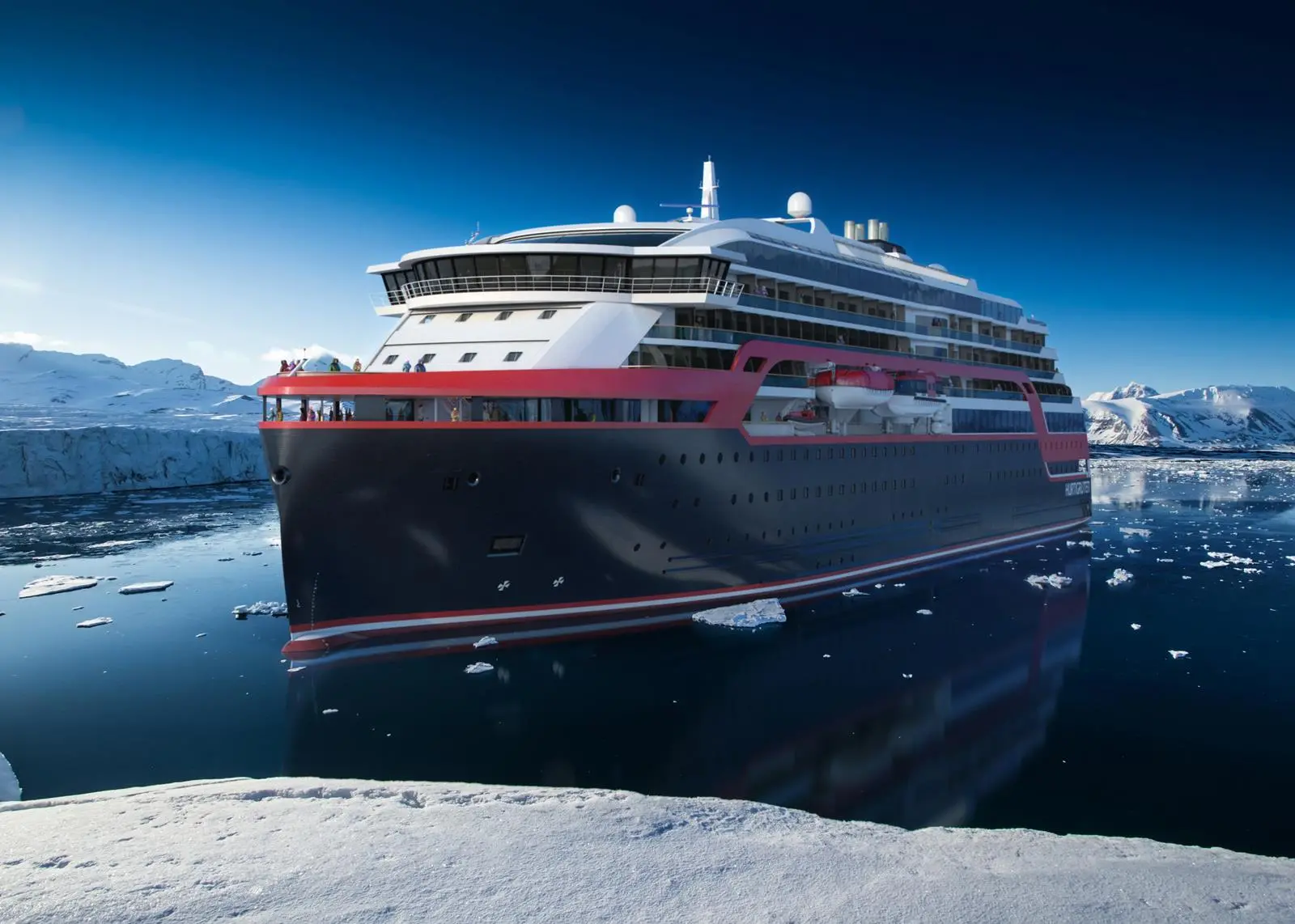
While Norwegian yards have long been builders of many of these vessel types, one relatively new niche is emerging. The past few months have seen orders for a total of eight expedition cruise vessels. These vessels – small (500 or so passenger) ships designed for usually luxurious travel to little visited places such as the polar regions – have offered a much-needed financial boost for two yard groups: Kleven, which will build two ferry/polar cruise ships for Norwegian operator Hurtigruten; and Vard, which has won contracts with French cruiseline Ponant (four ships) and Hapag-Lloyd Cruises (two ships).
Expedition opportunity
Despite being a new vessel type for these yards, perhaps the orders are not all that surprising. While Hurtigruten scouted several international ship builders for its vessels, it has eventually opted for a company that will be able to see the ships operating past its office windows. And Vard was inevitably helped in securing its contracts by the ties with its main shareholder, cruise ship building specialist Fincantieri – as well as by the fact that with a record cruise order book, Fincantieri has limited (if any) capacity for new orders for the next several years.
The glut of orders at conventional cruise ship builders partially explains why Norway’s yards are exploring the segment. But there are also synergies with their hitherto staple diet of offshore vessels, as Steven Sawhill, principal consultant, Arctic operations & technology, DNV GL explains: “The expedition cruise market certainly fits in well with the evolution from fishing vessels through to offshore vessels in this region. The size of the vessels is quite comparable. They are similarly sophisticated vessels, albeit in a different way. So there are some new things to learn but it fits in well with their profile. The polar aspect also fits uniquely into their abilities.”
Recent developments at some Norwegian yards point towards a willingness to adapt to capture this new market. In preparation for its newbuilding contracts Vard, for example, has increased its ship design workforce based in Aalesund. Its team has been boosted by around 30% to 80 staff. The company has also re-organised its Norwegian yards to deliver on the new contracts, while hull blocks for the vessels will be delivered from its Romanian yard.
Preparations are underway elsewhere too. Ulstein is at an earlier stage than Vard, having yet to win any orders. But its design team are now marketing expedition cruise concepts. Among them are the 165m loa Ulstein 183 ‘Discovery’. Ulstein’s Kamsvåg notes the crossover between offshore and small cruise vessels, but also highlights the areas in which the company has had to bolster its capabilities. One area is the high level of interior design required for what will be luxurious passenger vessels. To this end Ulstein is collaborating with several high-end interior designers for its concepts.
Reality check
Not all the region’s yards are targeting the expedition cruise sector. Havyard, which has spent the last three years prototyping new vessels in a variety of segments, has discounted the idea of pushing into the cruise market. It is, according to Andersen, simply too small a niche to accommodate all the players currently interested.
That raises the critical question about the potential size of the market. If it really is going to be just under a decade before newbuilding of offshore vessels reaches any significant volume, will there be enough expedition cruise orders to keep Norway’s yards busy?
It seems unlikely. Although figures are hard to find, Kamsvåg believes there are just 40-50 vessels globally. Assuming the growth he projects of up to 20% a year, that is still only a maximum of 20 vessels a year – hardly a major market.
That may not be the end of the story though, says DNV GL’s Sawmill: “The existing market is generally very old vessels, so once you start bringing in some very new ones, what does that do to the old ones, their ability to continue to draw passengers? If you have US$30,000 to spend would you go on a new vessel or an old one? I think there’s some expectation that the new entrants will lead to some renewal of the fleet.”
But even with that renewal, there is unlikely to be enough work for all the yards circling the sector. The early winners – principally Vard and Kleven – have a head start which the likes of Ulstein and others must now chase down. But for the majority, the route through the depression in offshore orders is likely to be found in that same adaptability and versatility with which Norway’s shipbuilders moved from fishing vessels to OSVs more than thirty years ago.
Related Articles
 PROPULSION
 GENERAL NEWS
 HYDROGEN