



Ocean-going oil spill vessels
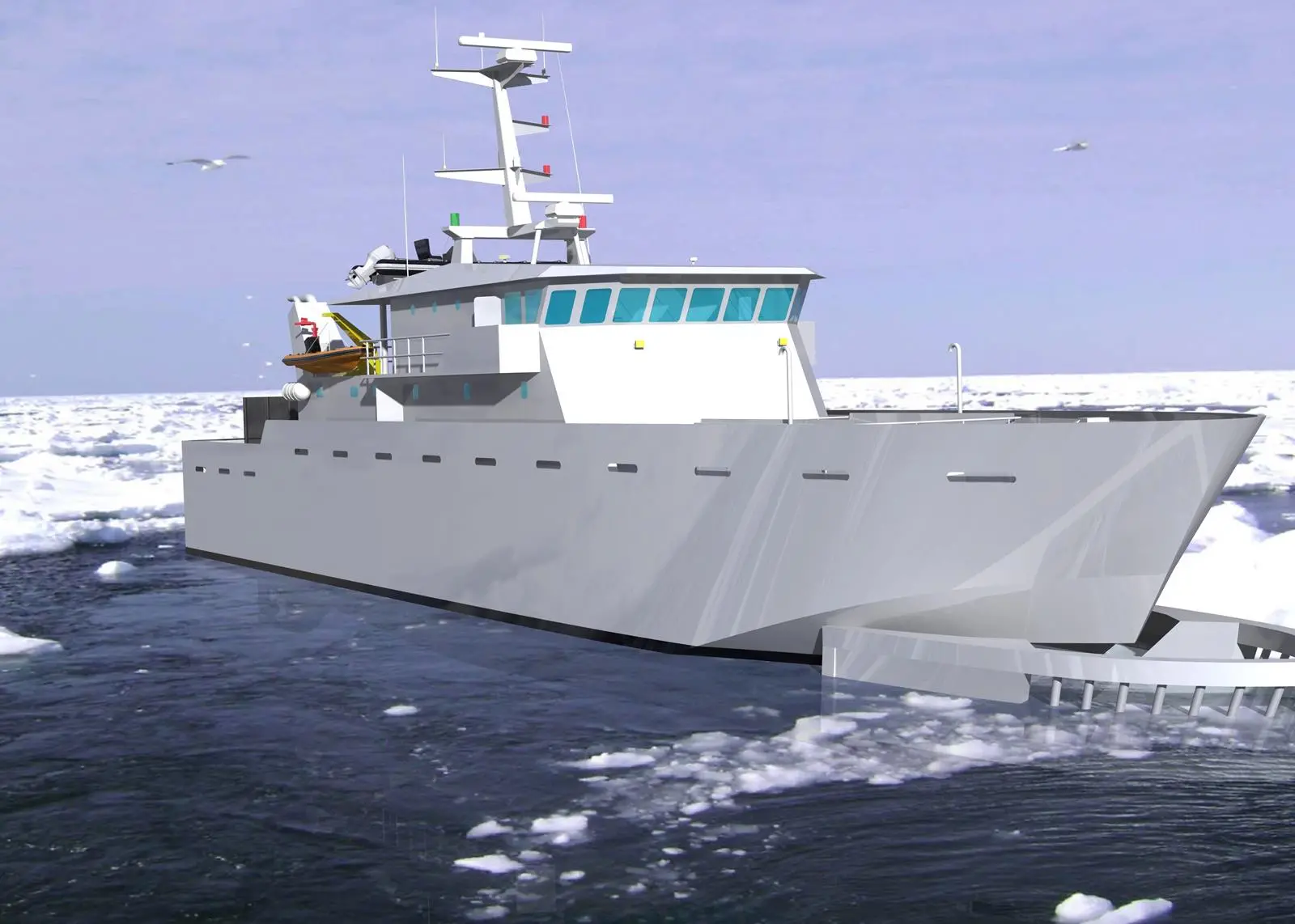
Previously the Ecoceane range focused on vessels for harbour use and the company has built over 50 of these designs that have been delivered to 23 different countries. Paimpol-based Ecoceane introduced its Workglop range of catamaran clean up vessels last year; these too were designed primarily for harbour use. The new range, known as Spillglop, features larger ocean-going vessels.
The concept behind the Spillglop range bases the oil recovery systems on a vessel with a ship-shaped hull, giving it good seaworthiness to cope with rough seas. Ecoceane claims that these vessels can operate in winds of force 5 to 6 and carry out the recovery work at speeds of 4 to 5 knots. This means that the smallest of the range, the Spillglop 180, can sweep an area of 35,000m² per hour and the largest, the Spillglop 460, can sweep 60,000m² per hour. Once collected, the oil and emulsions are separated out and the oil can then be transferred to a tanker vessel following astern.
Because these larger vessels are not economically viable to stand by for oil recovery work alone, the designs have been developed so that the vessels can undertake a variety of other tasks. These can include survey operations, underwater work, and buoy servicing. The largest in the range has accommodation for up to 24 personnel and can be equipped with a laboratory. Fire-fighting equipment and equipment for dealing with chemical spills can also be fitted.
Both of the larger designs in the new range are ice-classed by Bureau Veritas. For this work the collection booms at the bow are fitted with a deflector that pushes the main blocks of ice away, allowing the contaminated water to flow into the recovery area. The recovered oil can be heated to aid transfer.
Because oil recovery may have to take place in areas that are dangerous for personnel to work outside the vessels can be fitted with a decontamination air lock with a shower. The living quarters and the wheelhouse are sealed and kept under pressure and all of the recovery operations can be conducted without the crew having to go on deck.
The task of separating the recovered oil and water takes place within an onboard tank. The oil and water separate according to gravity and a pump equipped with floats maintains position at the oil/water separation zone with its intake in the oil section to ensure that only oil is transferred.
The largest of the new Spillglop range is 45m long vessel with the others being 25m and 18m. Ecoceane has its own shipyard in Northern France where the vessels are constructed primarily in steel. One of the smaller Spillglop vessels was used for oil recover on the ‘Deepwater Horizon’ spill.
Related Articles
 PROPULSION
 GENERAL NEWS
 HYDROGEN