



Old fashioned skills needed
It seems that colliding challenges are pushing owners to reevaluate their stance on training.
Pjotr van Schothorst of VStep explains there are a number of owners who are “uncomfortable” about relying totally on training and assessment by external facilities. He puts it as diplomatically as he can: “In certain regions there’s been some political or financial entanglement with training providers, so the final evaluation of skills has been found to be less than satisfactory – to the point it’s been even noted at IMO level.”
Another factor has been the realisation that offshore support operations have specific challenges to overcome, signalled by some recent requests for OSV simulators to train “old fashioned mariner skills” says Mr van Schothorst: “While OSV operators find that their crews are very clear and focused on the technical aspects of dynamic positioning, they don’t always have the ability to manoeuvre the vessel that well in manual mode.”
Captain Torry of London Offshore Consultants agrees about the necessity of basic skills: “If people aren’t used to driving the vessel manually, they may not be versed in how to react in the event of a malfunction and this can be the moment you really need to respond pretty quickly.” Although many people assume that DP is ‘bullet proof’, Capt Torry points out: “Dynamic Positioning is like all computer based systems, it is susceptible to failure, either through climatic conditions masking a signal or because of a software error. And when it does, it can be quite dramatic.”
However, Mr van Schothorst explains that it isn’t just system failure that creates issues: challenges arise outside DP mode when, for example, an OSV is making the initial approach in heavy seas while being caught by cross winds angled to the current.
He says: “There are stories from the field where inexperienced captains simply refused to do certain jobs under testing conditions, choosing to wait it out instead.” A reasonable enough response if the captain didn’t feel entirely comfortable, but, as Mr van Schothorst points out, “these delays can put up costs to the tune of an extra US$30,000 per day”, so increased competence has a direct effect on the bottom line.
However, it has not always been easy to train niche operations for extremes. The problem has historically been that traditional simulators are big set ups and a little inflexible, Mr van Schothorst says: “These big installations certainly draw a lot of attention, but going back ten years, OSV training typically wasn’t addressed as the aft bridge wasn’t replicated.” Although there have been some changes since then, he believes owners are ready for more affordable facilities, installed on their own turf.
“I see the future developing in a similar vein to the airlines,” says Mr van Schothorst, “the main, external training and validation systems are still in place but industry players who want to make absolutely sure of their crew’s abilities now provide in-house facilities tailored to their own technology.”
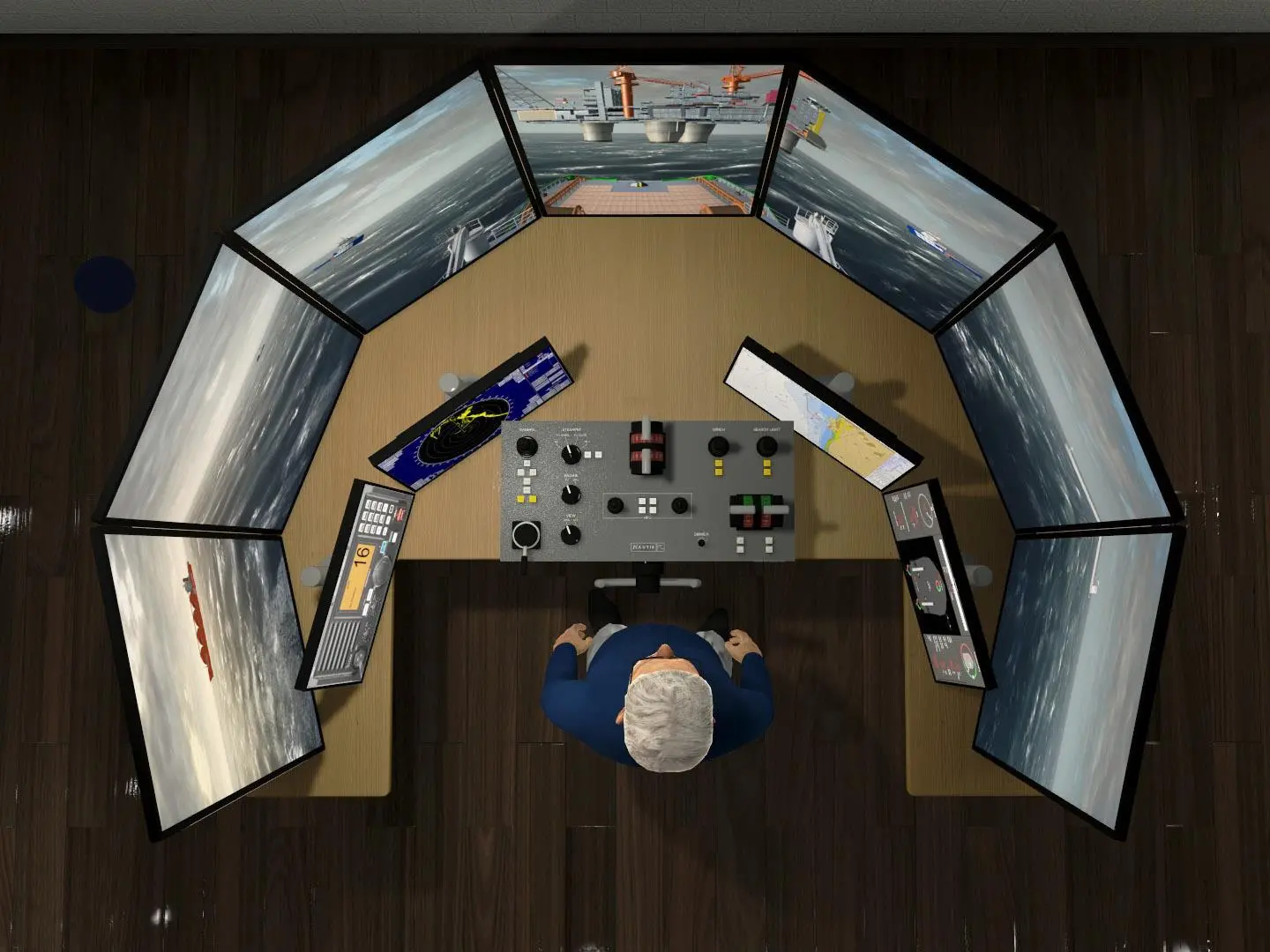
What VStep has done for the industry “is downsize the setup and installation costs” he says. The company supplies the clever part of the system, but the rest of the kit is available pretty much off the shelf which both lowers the initial price and makes it a lot easier to maintain, especially as companies aren’t tied in to specialist contracts. For example, Uniwise Thailand’s recent training installation was able to utilise seven, locally sourced and comparatively inexpensive 40 inch screens, run by a single PC using two graphics cards.
Further, when it comes to the interface, he explains that real joysticks and controls are simply over-engineered for training purpose as these have been designed for operations in harsh environments, involving waterproofing and buffering against temperature variations. “This simply isn’t needed in the classroom,” he says, “You can get look-and-feel alike controls that are adequate for training purposes for a fraction of the price.” Plus of course if the cost drops, it’s possible to afford more training stations.
“The bottom line for fleet owners is basically that they cannot rely on the new generation of mariners to come with a complete skill set. However, it no longer costs millions to provide a practical training base.” A very useful innovation in the circumstances concludes Mr van Schothorst.
Related Articles
 PROPULSION
 GENERAL NEWS
 HYDROGEN