



OLDENDORFF MAINTAINS ECO FLEET INVESTMENT
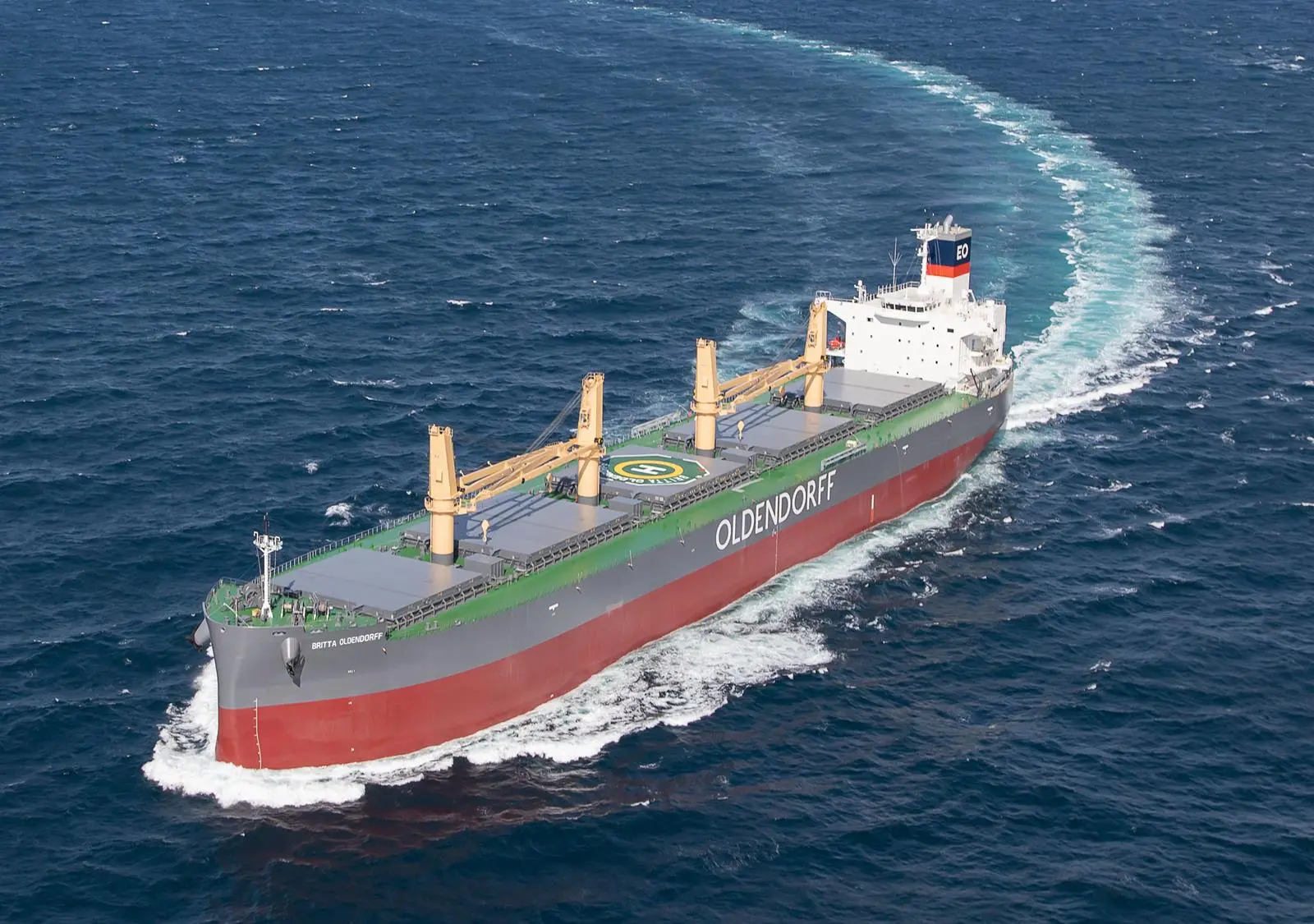
The 63,000dwt Britta Oldendorff is the last of a trio of geared Ultramax bulkers ordered from the prolific Japanese yard, and the 100,000dwt Diane Oldendorff is the second of a pair of post-Panamax newbuilds. While the Ultramax series derives from Oshima’s popular 62,000dwt design, the D-class, post-Panamax tonnage represents a new development, claimed to embody the most economical hull form in its size category.
Family-owned Oldendorff maintains a vigorous investment programme, drawing on Chinese, South Korean and Japanese production, ensuring a low average age and increasing environmental credentials among a diversified fleet of owned and chartered bulkers numbering more than 700.
Both the new Ultramax and post-Panamax additions follow Oshima’s fuel-conserving, super-eco design concept, incorporating enhancements including exhaust gas cleaning plant and ballast water systems.
Britta Oldendorff provides a 79,500m3 grain-equivalent cargo capacity in five holds within a length overall of marginally less than 200m and at the former Panamax breadth of 32.2m. The hold tank tops are strengthened for heavy cargo and are plumbed by four 30t deck cranes mounted along the centreline.
Primary power is engendered by an MAN six-cylinder diesel of the S50ME-C series specified for a 7,220kW output at 94rpm and manufactured by licensee Kawasaki Heavy Industries. Compliance with the most stringent sulphur emission regulations is ensured through the adoption of a scrubber system supplied by the Norwegian company Yara Marine.
The auxiliary outfit, sized for the self-sustaining cargo working arrangements in addition to all other shipboard services, takes the form of four gensets of an aggregate 2,295kVA.
The two preceding vessels in the contract, Beate Oldendorff and Benjamin Oldendorff, were commissioned during the spring.
The gearless Diane Oldendorff, which has been constructed to a post-Panamax beam of 38m on a length overall of 235m, offers a 115,356m3 cargo intake in seven holds for a full-load summer draught of 15m.
MAN power is employed in the shape of a six-cylinder model of the ‘long-legged’ G60ME-C design. Produced at the Tamano complex of Mitsui Engineering & Shipbuilding, the engine has been delivered at its L4 rating, turning out 1,500kW per cylinder at 72rpm, providing 9,000kW for propulsion. Indicative of the potential of the 600mm-bore two-stroke type, the G60ME-C has a nominal MCR of 2,840kW/cyl at 103rpm.
As endorsed in the raft of ClassNK notations, the installation in the Oldendorff 100,000-tonner is served by a scrubber. Four diesel gensets provide a total 2,650kVA.
The Portuguese flag, with Madeira as port of registry, has been favoured for the new ships.
The Luebeck-headquartered owner and operator’s commitment to environmental principles is a beacon for the bulker sector. Last November, Oldendorff Carriers signed a research agreement with the Center for Bits & Atoms(CBA) at Massachusetts Institute of Technology(MIT), to investigate ‘disruptive’ improvements in ship design and propulsion so as to achieve IMO 2030/2050 requirements.
The initial emphasis is on enhancing hydrodynamic efficiency, building on work conducted by CBA with the aerospace and automotive industries. This will look beyond traditional naval architecture, towards a deeper integration of form and function.
As a further expression of intent in the called-for energy transition, and representing a pioneering move in the bulkship sector, the company has nominated electric propulsion systems for two 21,000dwt newbuilds under construction in China. The self-unloading vessels ordered from Chengxi Shipyard have been designed for a transhipment role in northern Vietnam, and will each be fitted with two 1.9MW Azipod electric propulsors.
The outstanding orderbook for Oldendorff Carriers features four 209,000dwt Newcastlemax bulkers from Jiangsu New Hantong Ship Heavy Industry. The Hantong yard is also completing the final units in a series of 11 Kamsarmax bulkers of 81,600dwt booked for the fleet on either an owned, timecharter or bareboat basis.
Related Articles
 PROPULSION
 GENERAL NEWS
 HYDROGEN