



Oldendorff tests wind propulsion on bulkers
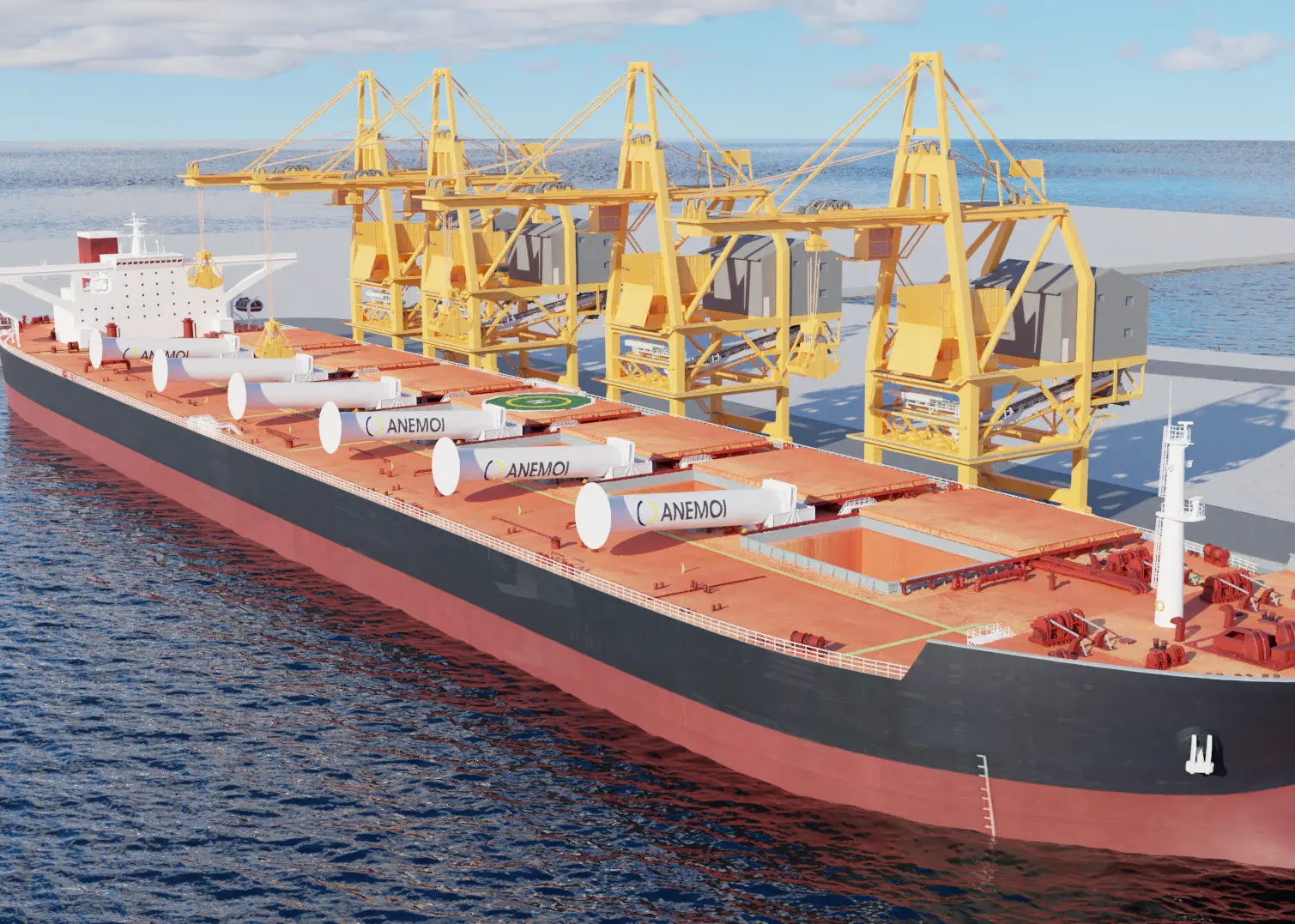
Germany-based Oldendorff signed a joint development programme which Innovation Director Torsten Barenthin said “seeks to achieve a comprehensive functional application of wind technology that returns environmental and commercial benefits throughout our vessels’ entire life cycle”.
Oldendorff moves 300 million tons of bulk cargo a year and is responsible for some 700 vessels. It signed the development deal with rotor sail manufacturer Anemoi Marine Technologies, ship design concern Shanghai Merchant Ship Design and Research Institute and Lloyd’s Register.
For completion in 2022, the project covers the installation of foldable Anemoi vertical rotors on the deck of a 207,000 dwt Oldendorff Newcastlemax Class bulker and the testing of the wind propulsion system on long-haul voyages. Drawings of the ship to be used show six installed rotor sails.
Anemoi COO Nick Contopoulos said rotors were “a key solution to reducing energy consumption and harmful emissions in the bulk sector”. LR COO Mark Darley said the need to decarbonise the shipping industry was becoming more pressing and that the new development marked “an important milestone on the journey” towards that goal. SDARI Chief Engineer Wang Gang Yi echoed that, saying Oldendorff was showing the maritime community it was serious about making shipping sustainable and competitive.
At Oldendorff itself, Torsten Barenthin said: “Once the design and study phases have been concluded, the results obtained will determine whether we proceed with the installation of the wind rotor technology aboard one of our vessels”.
Likely to make a decision sooner than Oldendorff however on expanded big-ship rotor sail use is German-Danish ferry concern Scandlines. Already a step further on in the application of wind assisted technology, Scandlines’ hybrid ferry Copenhagen has been using a single rotor sail plant since last May. The 30 x 5m unit, was installed in Rostock by Finnish wind drive specialists Norsepower.
Copenhagen is one of two identical 169.5m, 5,088dwt, 21 knot hybrids with Mak M32C engines and Scandlines told this correspondent last year that a second such rotor sail installation would be considered on sister ship Berlin “if the experience is good”.
The Motorship has now been told that an evaluation of the Copenhagen installation is still not due until later this year – after a full year of operation. “However the first results are positive”, Scandlines spokeswoman Anette Ustrup Svendsen told this correspondent.
Related Articles
 PROPULSION
 GENERAL NEWS
 HYDROGEN