



On board testing delivers data needed to clean up ships
As increasingly strict government and international maritime regulations are phased in to reduce harmful emissions produced by large tonnage ships, the need for on board, in-use testing services capable of delivering the accurate, continuous emissions data needed has also arisen.
The primary regulatory agencies driving this change include the U.S. Environmental Protection Agency (EPA), International Maritime Organization (IMO) with its MARPOL guidelines, and the California Air Resources Board (CARB). CARB, in particular, has taken a leadership role with some of the most stringent emission reduction measures and deadlines. This is not surprising, given that Southern California ports handle 40% of all national consumer imports. As a result, the Port of Long Beach and Port of Los Angeles are among the nation’s highest polluters.
According to the South Coast Air Quality Management District (SCAQMD) oceangoing vessels are among the largest sources of nitrogen oxides (NOx), emitting more than all power plants and refineries in the area combined. And as foreign trade grows, more containers, more generators and larger engines all result in growing pollution from shipping and port operations as a percentage of total emissions. Beside California, other areas such as the US. East Coast ports and the Great Lakes suffer from the same issues.
In ports, terminal owners have worked to retrofit and clean up port ground and cargo moving equipment and turned to alternative fuel, electric and hybrid trucks, trains and tugboats. Now, the focus is turning to cleaning up large ocean going vessels, their main diesel engines and many auxiliaries. Cruise ships, in particular, can have a total of 20-30 diesel engines. Diesel emissions from cruise ships while at port are a significant source of air pollution, with one-third of the total occurring while idling at berth.
These efforts will require retrofitting existing engines with aftermarket emissions control products or replacement with newer, low emission “green” engines.
Although this sounds simple enough, and is similar to the paths taken by other industries targeted by the EPA to clean up diesel engines, the absence of testing services and products specific to the shipping industry has been a roadblock to progress.
Until recently, a comprehensive testing service that meets the requirements of every existing regulation has not been available to shipping companies. Neither have the commercial devices required to conduct the testing.
There are several handheld diesel engine testing devices approved by the EPA on the market, but most do not meet all the regulations of ISO 8178 testing required by CARB, EPA and IMO. Many are electrochemical-based analysers, as opposed to the chemiluminescent detectors outlined in the test protocol. Many cannot be calibrated, another ISO 8178 requirement.
To meet all regulations laid out by CARB, IMO and EPA, an on board testing service would not just be a snapshot of engine performance, but would have to include ongoing ‘in-use’ performance testing over time to meet ISO 8178 testing protocols. Such monitoring is required by both EPA and CARB to demonstrate performance over an established period of time.
This is where difficulty comes in, says Mark Adair, an emissions control product expert for the past 28 years. In a career that began as a diesel engine mechanic in West Coast ports, Adair has worked both from the verification and laboratory test cell side of emission control with all types of diesel powered machines, including large tonnage ships.
“The type of technologies used to clean up other industries will essentially be same we will use to clean up ships,” says Adair. “The difference is all those emission control technologies were developed in laboratory test cells under controlled conditions with engines removed from equipment and sent to the lab. You can’t pull an engine off the ship.”
This essentially means the testing service has to include devices that remain on a ship over time, constantly monitoring emissions ideally with minimal disruption to ships’ crew and limited access to the ship itself.
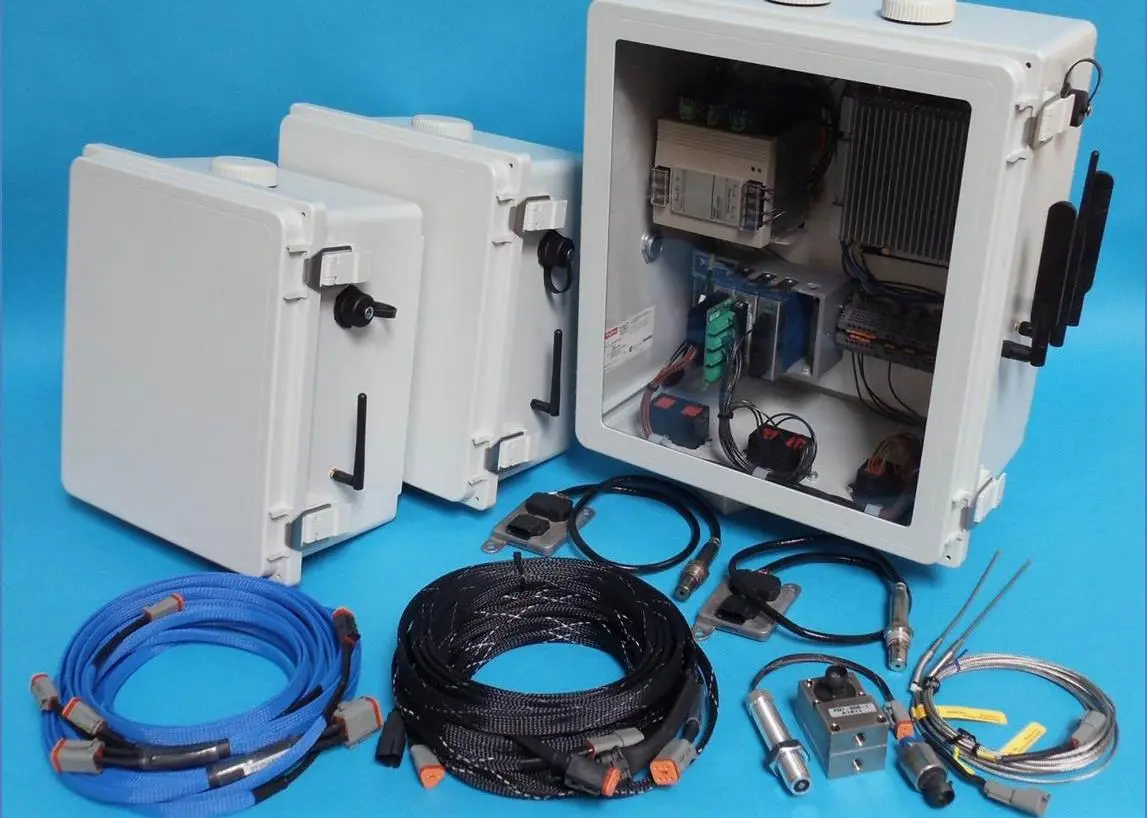
GreenLink Systems, a company that produces emission monitoring and control products for heavy duty diesel engines, is now offering a comprehensive on-board emissions testing (OBET) service along with the commercial testing products required to conduct such tests.
According to GreenLink, OBET is the only service currently available that provides CARB, IMO and EPA ‘acceptable emissions data’ that also meets the ISO 8178 standards. It can be used to perform the international air pollution prevention (IAPP) engine re-certification required by the IMO and the EPA.
The OBET testing service employs commercial testing products from GreenLink Systems to perform these tests: an emission testing unit (ETU) and a continuous NOx emissions monitoring unit (EMU) that remains on the vessel over time. Information from these units is relayed wirelessly via built-in 4G wireless modems to a secure, online database accessible over the Internet.
The ETU measures eight gaseous emissions, including Hydrocarbons (HC), Nitrogen oxide, (NOx), Nitric Oxide (NO), Nitrogen dioxide (NO2), Oxygen (O2), Carbon dioxide (CO2), Carbon Monoxide (CO) and Sulphur dioxide (SO2). Sulphur dioxide monitoring is particularly significant as it can also be used by shipping companies to monitor emissions during fuel switching operations.
A key advantage is that the ETU does not need a laboratory technician to perform analyser calibrations since it is programmed to run in an automatic calibration mode. It can be operated by a crew member after initial set up.
Sensors for the EMU are installed directly on the engine and exhaust system. The EMU remains on the engine to measure, record and transmit data continuously, with new updates uploaded every few seconds.
The GreenLink Systems EMU is claimed to be the first unit on the market that meets the IMO NOx technical code requirements for all on board maritime engines, including auxiliary engines.
The continuous monitoring unit has been designed with both upstream and downstream sensors to satisfy CARB’s Title 13 Div. 3 verification procedure, Warranty and In-use Compliance Requirements for In-Use Strategies to Control emissions from Diesel Engines. This procedure calls for measurements of exhaust before and after treatment by a NOx emission reduction device while establishing in-use performance and durability over an established time period.
According to the procedure, “…the mass emissions of NOx both upstream and downstream of the aftertreatment device must be measured and recorded over the entire demonstration period.”
The document goes on to outline that data must be recorded at intervals no greater than 10s, must include accurate date and time stamps that correspond with engine operation, and must be submitted electronically – all factors addressed by the device.
According to Adair, a testing system that transmits data wirelessly with remote access capabilities is critical to reduce the time, crew labour costs, equipment transportation and access to a ship that may only be infrequently docked.
Emissions data is acquired and uploaded in a secure database that can be accessed via the Internet. The emission data assists in bookkeeping and reporting required by the regulatory agencies, reducing costs.
“The goal is to eliminate the need to go back on board the ship repeatedly after the equipment is installed,” says Adair. “With wireless transmission of data and remote access you don’t have to go on board the ship. You can conduct tests, calibrate equipment, change settings and even troubleshoot using a laptop or Smartphone anywhere.”
The ability to monitor results is particularly important during the durability step of CARB’s verification process. Emissions control products for diesel generators are required, for example, to be tested over a period of 500 operating hours, a task that could take six months on board a vessel. A failure, due to human error or the engine itself, would require re-starting the durability test from scratch. Instead of discovering this after the 500 hours had elapsed, sporadic tests run while the equipment is on board would indicate the need to re-start the test from shore, saving valuable time.
On board testing services that meet the requirements of all existing regulations will benefit shipping companies by enabling independent, private testing to establish a baseline of existing engine performance – both for the main engines and for auxiliary systems, all of which contribute to the ship’s total emissions. This baseline could be used to determine how much improvement will be required in the coming years or to identify which engines are contributing the most pollution and need repair.
Testing services can play a key role in identifying emerging emission control technologies that can be retrofitted. Shipowners are constantly plied with new products that claim to significantly reduce emissions. A testing service that can measure emissions before and after the device will allow ship owners to separate emission control products that work as advertised from those that don’t.
Testing is also critical to the manufacturers of the emission control products themselves. To obtain verification as a CARB-approved product, an emission control product manufacturer must present preliminary test data to demonstrate the viability of the product. Then, they must secure the cooperation of a willing ship to test the product in-use where multiple baseline and post treatment tests must be conducted. Establishing product durability is another key step in the process, requiring in-use testing over an established period of time.
Although regulatory compliance is a primary driver, many shipping companies see useful competitive and even PR advantages to being at the forefront of the ‘green fleet’ movement. Finally, proactive fleets can take advantage of potential grant funds from local, state and federal agencies such as the EPA for air emission reductions that go beyond current regulatory requirements.
Related Articles
 ALTERNATIVE FUELS & LUBRICANTS
 FUELS & LUBRICANTS