



Optimising yesterday’s trade winds to achieve emissions reductions
The last few months have seen a sea change in industry perceptions of wind-assisted propulsion. Wind had captured imaginations outside the industry, raising images of a more adventurous era of wind-powered seafaring utilising an obvious abundant power source. For those within the industry, it was a more nuanced proposition. We recognise wind propulsion is much more about reducing fuel consumption and minimising carbon emissions as one of many emissions-reducing technologies. One example of such a technology is the Flettner rotor, which relies on the Magnus effect to create thrust and reduce fuel emissions. Maersk recently announced that a year-long trial of rotor sails aboard the Maersk Pelican had achieved fuel savings of 8.2% over the course of a year, equivalent to 1,400 tonnes of CO2.
Maximising the benefits of wind propulsion is a complex process, and highly depends on a range of factors, such as weather routing, vessel operations, and engine profile. As such, an integral part of making wind propulsion effective is digital; simulating voyages and applying data to understand when and where it makes the most sense to use this technology. In a market like shipping, where margins are tight, and economic incentives are often misaligned (for instance, charterers will likely pay for fuel, and may not necessarily see a long-term return on investment for lower carbon technology), it’s essential to be able to validate wind propulsion technology and advise owners on where it can add value.
NAPA has a long history of this and was the first to validate Norsepower’s savings in its initial years of operation.
Over the last year we have collaborated closely with C-Job Naval Architects, to help the industry better understand the dynamics behind wind propulsion. Our research, during which C-Job used NAPA’s weather routing software NAPA Voyage Optimisation, revealed rotor sails could deliver fuel savings of up to 20% on deep sea routes, compared with 5% recorded in the North and Baltic seas.
Voyage optimisation can maximise the benefit of Flettner rotors by forecasting when it is worth deviating from straight-line sailing into areas with strong winds. This is especially true on the open ocean.
In addition, voyage simulation, when taken alongside weather forecasts, information about currents and tides and historic statistical climate data, can collectively work to predict which routes are most advantageous when using rotor sails.
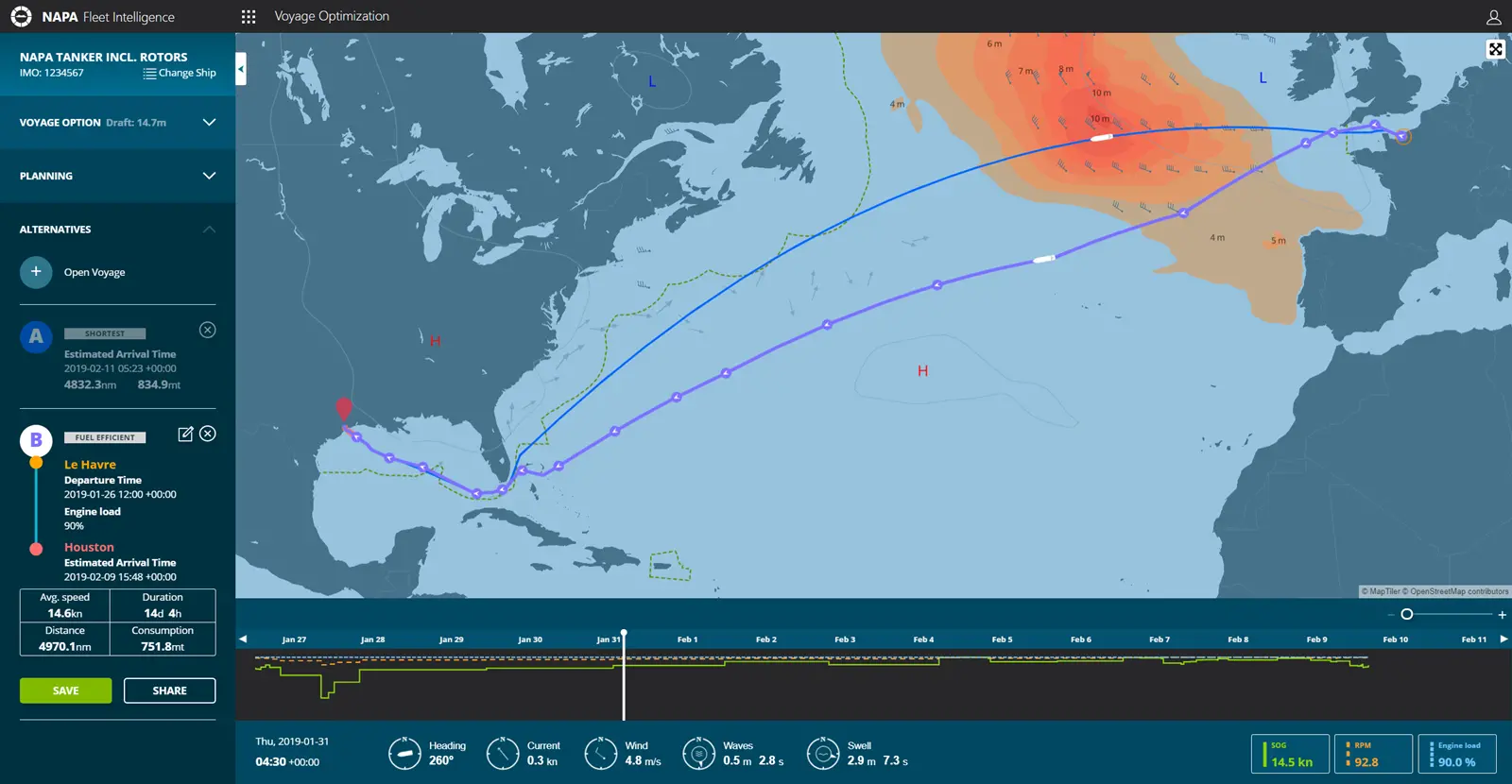
For example, containerships making transatlantic crossings from DP World London Gateway need to decide whether pass through the English Channel or go north round Scotland. Further choices apply in the Atlantic between the great circle route across the Atlantic, taking the shortest course between two points on the surface of the globe, or travelling further south to the Azores and picking up winds there.
Our research shows a midsize tanker sailing from Le Havre to Houston, equipped with two 30-metre high rotors, could save 80 tonnes of fuel (10%) on a voyage by maximising the wind benefit, as opposed to simply taking the shortest route. The vessel would even arrive one and a half days earlier when running under the same main engine load.
Just as yachts in the Volvo Ocean Race sail closely to Brazil to pick up the strongest winds when on the leg from Europe to South Africa, we expect ore carriers, with rotor sails, travelling on the front haul route from Brazil to Asia could benefit strongly from the same effects. This research suggests that all vessels can benefit from maximising the wind effect: companies using Flettner rotors could find themselves travelling on 19th century sailing routes.
Another aim of our research is to optimise ship designs for Flettner rotors, particularly newbuildings, in order to maximise savings. Current engine design applies a sea-margin – i.e., we over design the engine to be able to sail in adverse weather conditions. However, it would be possible to reduce installed engine capacity by understanding route specific requirements. In turn, reducing main engine size could pay much of the cost of fitting rotors.
The example shown uses an engine load of 90%. Other considerations factored into the plan include directionality of shipping lanes, improved routing in open sea areas, and the ability to restrict routes based on combined wave height. Thanks to advances in big data, and the ability to combine multiple datasets, we’re able to combine the most important aspects from real-life voyages and factor these into our models. Overall, it’s a perfect example of how hardware innovation, software and modelling expertise can work collaboratively if shipping is to meet its GHG reduction targets for 2050.
Related Articles
 ENERGY SAVING DEVICES
 LNG
LNG
 ALTERNATIVE FUELS & LUBRICANTS