



PEAK SHAVING EFFICIENCIES ON UECC HYBRID PCTC
The vessels are being built by China Ship Building Trading and Jiangnan Shipyard Group, with the design work done in conjunction with DNV and ship Designer Shanghai Merchant Ship Design & Research Institute (SDARI). The first vessel is scheduled for delivery later this year, with the other two following next year.
The energy storage system (ESS) system will be charged by a permanent magnet, directly driven shaft generator or dual fuel generators. The ESS won’t normally need charging in port, as the energy management system will automatically interface to AIS and voyage routing systems to ensure it is charged and ready for use when it is needed to power the bow thruster for harbour manoeuvring or supplying the ships’ general power demand.
As part of the total power system, which includes a WinGD 6RT-Flex50DF dual-fuel engine, a controllable pitch propeller, a bulb rudder, two dual-fuel gensets and a dual-fuel boiler, the ESS will provide power to the main switchboard, peak shaving capabilities for the main engine and auxiliaries and offer black-out prevention. The vessels will only require two auxiliaries, as the ESS and the shaft generator eliminate the need for one more that would otherwise have been required. The highly-efficient design means that ESS is expected to have a payback time of five years.
The vessels will achieve DNV’s Battery Safety notation. WE Tech of Finland is providing its WE Drive direct drive permanent magnet shaft generator, the DC-link power distribution system and the ESS, with Corvus Energy providing the battery package. Kongsberg Maritime is providing the energy management system which acts as a supervisory and control system for the overall production and consumption of energy onboard the vessels, ensuring flexibility and optimal operations at sea, in port and during manoeuvring.
The capacity of the battery is based on the design of the hybrid solution for operation of these short sea vessels, says UECC Head of Ship Management, Jan Thore Foss. The battery capacity has been sized to optimise utilisation, based on detailed modelling of the vessels’ expected operational profile, to maximise the economics of the installation. Furthermore, the vessels will be shore-power ready. Availability of the service is expected to grow and will provide power whilst the vessels are alongside in port to reduce SOx and NOx emissions and PM.
MARKET EDGE
UECC, jointly owned by NYK and Wallenius Lines, is a leading short-sea operator and logistics provider for the transportation of cars, vans and high and heavy cargo in Europe and currently has operates a fleet of 18 purpose-built vessels. The new vessels are part of a fleet renewal program designed to boost environmental performance. They will sail predominately in the UECC Atlantic trade and will meet the Tier 3 IMO NOx emission limitations coming into force for the Baltic and the North Sea for newbuildings with keel laid on or after 1 January 2021.
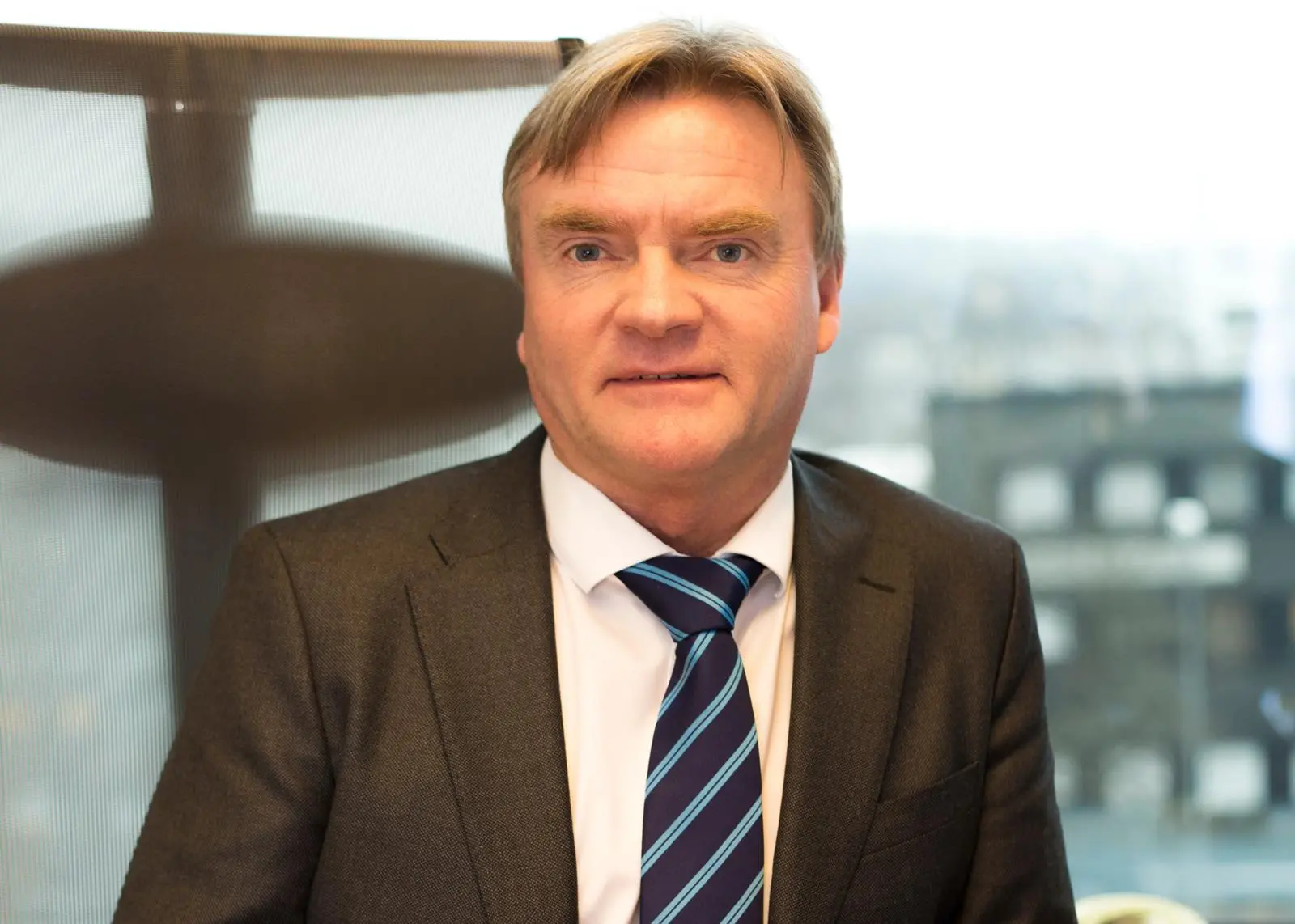
UECC ceo Glenn Edvardsen is proud of the vessels’ pioneering design, which is an integral part of the improved efficiency. “We have done extensive model testing to achieve the very best hull performance, so we believe it’s an improved design compared to other PCTCs today,” says Edvardsen. The vessels won’t have conventional bulbous bow as a sharper waterline at various drafts is better suited to the sea conditions. Their pioneering design will take UECC beyond the IMO target of 40% reduction in carbon intensity by 2030 through the combination of optimal hull design and the LNG battery hybrid solution.
“Added to that, LNG is currently the most environmentally friendly marine fuel there is. It has been for some years already. And, of course the battery installation will further reduce the emissions, he says.
“In our market, in our region, UECC is currently the only shipping company that is actually investing in environmentally friendly and sustainable newbuilds. So, we have big hopes that they will bring a lot to the marketplace by providing help to the customers to lower their emissions. Everybody is interested in lowering emissions in their logistic chains, and we are there for them.”
At a time when many financial institutions are paying considerable attention to the environmental credentials of newbuilding projects, the highly efficient PCTC newbuildings secured green financing from Svenska SkeppsHypotek. As the project met green criteria, the loans were offered at a reduced cost.
CARGO FLEXIBILITY
The new vessels will have a length overall of 169 metres and a width of 28 metres. They will have a car carrying capacity of 3,600 units on 10 cargo decks, two of them hoistable using electric hoists from TTS/MacGregor. The vessels will have a quarter ramp of 160 metric tons safe working load and a side ramp of 20 metric tons safe working load and can accommodate cargo units up to 5.2 meters high. This will make the vessels extremely flexible, enabling them to accommodate a multitude of high and heavy, breakbulk and mobile loading platform (mafi) cargoes, which are cargo segments, in addition to cars, that UECC has built a significant portfolio for over the years since its establishment in 1990.
THE LNG ADVANTAGE
UECC’s two existing LNG-fuelled vessels Auto Eco and Auto Energy are the biggest 1A super Finnish/Swedish ice classed PCTCs and the first PCTCs in the world capable of operating on LNG. They are capable of sailing a 14-day round trip in the Baltic solely on LNG, storing approximately 800cbm in a cylindrical Type C tank, and were the first clients of the world’s first seagoing LNG bunkering vessel, ENGIE Zeebrugge, which is home ported at Zeebrugge.
Edvardsen is confident of on-going ready access to LNG bunkering services in Europe, and he anticipates that LNG will remain competitive in price. “We have seen that LNG fuel has become very competitive in terms of pricing,” he says. “As we’re moving ahead, we will really improve environmental performance, so we’re very excited.”
NEW FUELS
“We are very keen to move on with dual fuel engine technology, not only because of LNG,” says Foss. “In the future we will be in a good position because we can also run on biogas and low emission fuels. As we speak, we are testing alternative fuels. Last year, for example, UECC trialled GoodFuels’ biofuel oil on the AutoSky. The fuel was bunkered at Rotterdam and tested successfully on the vessel’s normal route between Zeebrugge and the Spanish port of Santander.
UECC is waiting for the right time to switch over to non-fossil fuels, seeing LNG as part of a roadmap that will lead to zero emissions. “We are continuing on that journey, blending in biogas, which reduces the CO2 even further than what we will be achieving with the LNG battery hybrid solution,” says Edvardsen. “That’s the beauty with the dual-fuel setup. We are able to burn many other alternative fuels as they become available and are sustainable. We’re not stuck with LNG. LNG is what we are using today, because it is the most environmentally friendly marine fuel available on the market.”
Foss adds: “We have to keep our eyes open for new future technologies. Our mission is always to be a leading provider of sustainable short sea transportation in Europe, and to achieve that mission, we have to operate a sophisticated fleet.” Asked if he anticipated challenges with the newbuildings, Foss says: “It’s not new technology as such, it’s just the combining of everything which make it very special and efficient. But of course, to be at the front and to be pioneering, there are sometimes things you don’t expect. We’re willing to take on that risk. The experience we have from the existing vessels is that dual-fuel operation really pays off. So, we are ready to take the challenges if they come.”
Related Articles
 PROPULSION
 GENERAL NEWS
 HYDROGEN