



Philly yard delivers LNG-ready US tankers
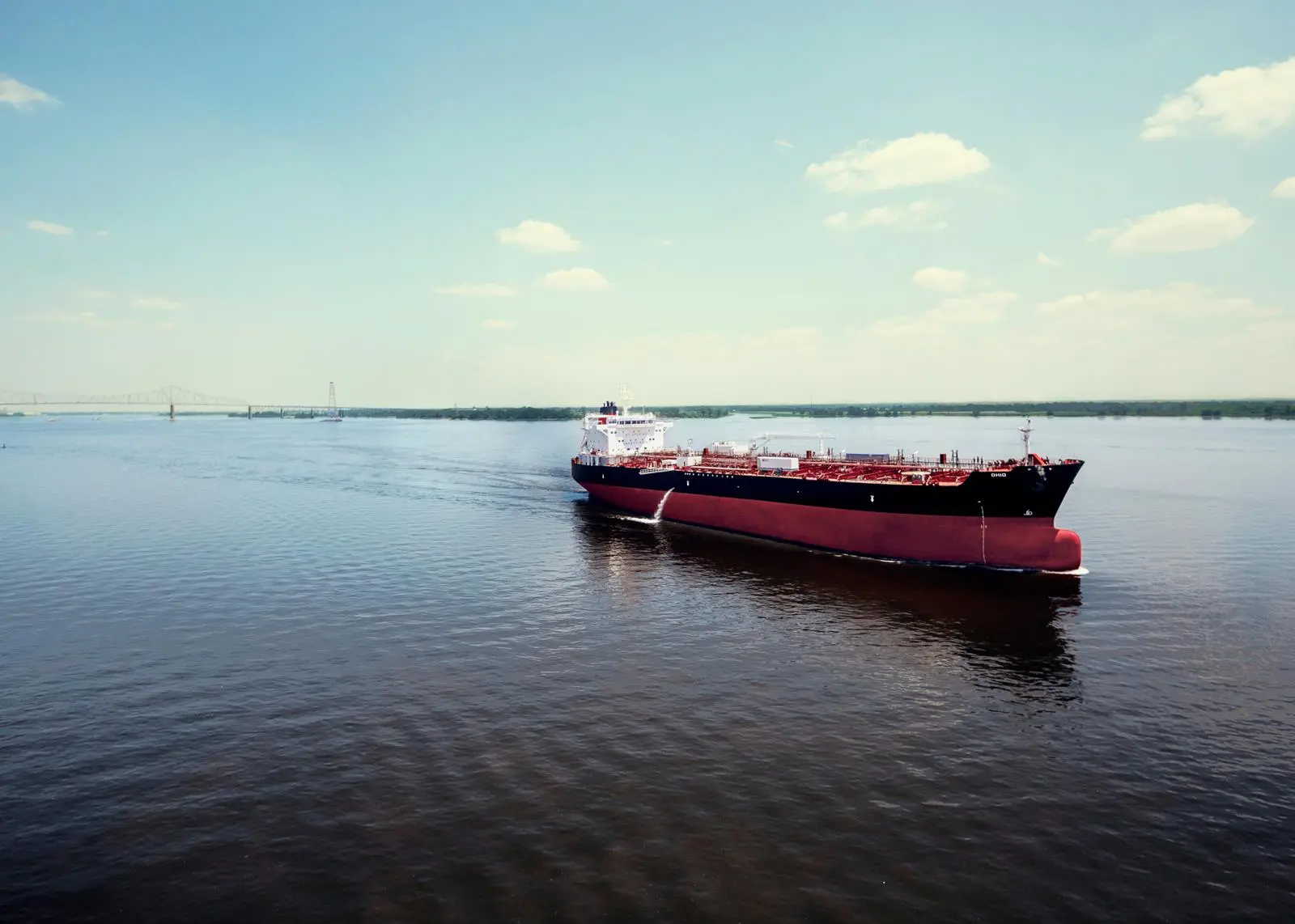
Jacksonville-based Crowley Maritime Corp has put down a fresh marker for US-flag Jones Act shipping by commissioning the first two vessels in a new generation of product tankers designed and prepared for possible future operation on LNG fuel.
Use of clean-burning LNG as fuel is an attractive option, in a US context, for ensuring compliance with IMO Emission Control Area (ECA) criteria. To date, only the North American ECA, within which the tankers will operate, and the US Caribbean Sea ECA, have been designated for control of SOx, NOx and particulate matter.
Crowley’s debut MT50-class vessel, the 50,000dwt Ohio, was phased into the home trade after handover during October. Second-of-class Texas followed in December, and will typically be employed in the traffic from the US Gulf coast to ports to Florida, mainly Port Everglades and Tampa, and occasionally Jacksonville. Shipbuilding contractor Philly Shipyard, the former Aker Philadelphia Shipyard, has third and fourth Crowley newbuilds in hand for delivery this year.
The MT50 type is based on a design from Hyundai Mipo Dockyard (HMD), among the world’s top echelon of constructors of product carrier tonnage, albeit as part of a much wider portfolio.
HMD and the US yard had previously collaborated in the construction of 14 product tankers of the MT46 Veteran class, produced at Philadelphia for US owners between 2007 and 2013. In fact, the last two ships in that earlier programme were commissioned into the Crowley fleet as the 45,800dwt sisters Pennsylvania and Florida, both recently sold to Kinder Morgan.
Cargo flexibility
The latest design embodied in the Ohio and Texas marries cargo carrying flexibility, for crude oil and IMO Type 2 chemicals as well as refined products, with a raft of fuel saving features. The MT50 tankers are broadly similar to the earlier 14, aside from extra steelweight to meet new regulations, various production-led design changes, and the provisions for LNG fuel. From a shipping perspective, there is a pronounced advance in that they are over 20% more fuel efficient.
The cargo section offers a total loading capacity of 337,000 barrels, or about 54,000m3, and is divided by a centreline bulkhead to create six pairs of cargo tanks. Each of the 12 tank compartments is fitted with a Framo SD200 vertical, centrifugal cargo pump powered by a hydraulic motor. The stainless steel pumps are individually rated at 600m3 per hour, and the system as a whole has a maximum discharge or loading rate of 3,600m3/h. The renowned Norwegian make is now an Alfa Laval brand.
The deck gear comprises a 10t hose handling crane at the midships manifold, two Aker Pusnes (now MacGregor Pusnes) combined anchor windlass/mooring winches and six double-drum mooring winches.
The MAN ME-series electronically-controlled, two-stroke main engine was built under licence in South Korea by Hyundai Heavy Industries (HHI). The six-cylinder, S50ME-B9 diesel provides direct drive to a four-bladed, fixed-pitch propeller of 6.6m diameter, also
sourced from HHI.
While the engine model’s nominal maximum continuous rating (MCR) is 10,680kW at 117rpm, the specified rating for each of the tankers is 8,200kW at 99rpm. With the machinery operating at a normal continuous rating of 6,175kW at 90.1rpm, ship service speed is about 14.5 knots at the design laden draught.
Energy saving duct
An important energy saving feature is the Mewis Duct, positioned immediately forward of the propeller, and which has the effect of maximising flow and increasing thrust in relation to power.
The device was developed for full-form ships to provide either fuel savings at a given speed or, alternatively, to allow the vessel to proceed faster at a given power level. It consists of two fixed elements, whereby the duct straightens and accelerates the wake into the propeller, with the integral fin system engendering a pre-swirl to the ship wake, boosting thrust by reducing losses in the propeller slipstream.
The three diesel generator aggregates employ MaK 6M20C engines, yielding 830kW apiece at 900rpm. The voltages for the main consumers are 440V and 220V, 60Hz.
The four-ship series has been assigned to ABS class and is the first to adopt the society’s LNG-Ready approval for potential operation on LNG fuel in the future.
ABS published the Guide for LNG Fuel Ready Vessels in 2014. The LNG-Ready endorsements allow shipowners and yards the flexibility to limit initial investment outlay while planning for future conversion to dual-fuel or gas-powered machinery. By achieving compliance with the Guide, Crowley has the option to adapt the product tankers for LNG-fuelled propulsion at a later date, having already been granted a conceptual review.
Rob Grune, Crowley’s senior vice president and general manager, petroleum services, said the company was proud to be the first to receive this designation from ABS. “As our business continues to shape itself to better meet the requirements of our customers, these vessels that stand ready and able to operate on a cleaner, alternative fuel source are our way of anticipating future demands.”
ABS chairman Christopher J.Wiernicki stated: “This milestone builds upon our work to provide owners with the guidance and support they need to move ahead with shipbuilding projects that allow them the flexibility to respond to changes over the lifetime of their vessels.”
Should the company decide to take up the LNG option, the requisite installation will include three 510m3 Type C LNG fuel tanks, to be located on the weatherdeck together with a fuel gas room and port and starboard bunker stations.
Retrofit options
The practical, usable LNG fuel gas storage in the four deck tanks will be 1,375m3, or 90% of the total nominal capacity of 1,530m3. For operating the ship wholly on LNG, this should confer an endurance of approximately 25 days.
To retrofit the ME main engine to ME-GI configuration will necessitate new components in the shape of double-wall gas pipes, electronic gas injection (ELGI) valves, large-volume accumulators, and the associated control and safety system, together with modification of the cylinder cover.
Crowley’s Seattle-domiciled naval architecture and marine engineering consultancy Jensen Maritime was retained to provide construction management services for the series on-site at the Philadelphia yard.
The group’s modernisation and expansion of its shipping interests also embraces two combination container/ro-ro (con-ro) vessels destined for the traffic between Puerto Rico and the US mainland, another sphere of Jones Act trade. The two 26,500dwt newbuilds at VT Halter Marine’s Pascagoula yard are distinguished not only by a bespoke design but also by the nomination of LNG dual-fuel propulsion and auxiliary machinery.
To support Crowley’s LNG needs, contracted fuel supplier Eagle LNG Partners is to establish a natural gas liquefaction plant in Jacksonville. The state-of-the-art facility is slated to be operational by early 2017, ahead of the service entry of the two con-ros, El Coqui and Taino.
Continuity in the workload
Texas became the first vessel handed over by the US shipbuilder under its new identity as Philly Shipyard, the name assumed at the beginning of December 2015 following the divestment of shipping assets. Listed on the Oslo Stock Exchange, ownership of the company remains unchanged, whereby the Aker-controlled investment firm Converto Capital Fund is the majority shareholder.
Contracts for the Crowley quartet were signed in August 2013, at a total value of approximately US$490m. The vessels were to be part of a product tanker operating and chartering joint venture between Crowley, the shipyard and certain affiliates, announced at the time of the order. Aker Philadelphia, as it was then, made a strategic decision to invest US$115m in the series. However, two years later, in September 2015, the shipyard sold its interest in the joint venture to a subsidiary of Marathon Petroleum Corporation.
The current production run in the MT50 tanker programme extends to eight vessels, as the four ships for Crowley are to be followed by a quartet to the account of the Kinder Morgan subsidiary American Petroleum Tankers (APT). The APT series had originally been ordered by Philly Tankers, but the contract was taken over by Kinder Morgan in August last year for an all-in price of US$568m.
The four LNG-ready product tankers for APT are scheduled to be delivered between November 2016 and November 2017, and will be placed in US domestic service. The keel-laying ceremony for the lead vessel from Philadelphia took place in January.
Philly Shipyard’s current workload also encompasses the latest stage of investment by Matson Navigation Co. The contract entails two 3,600 TEU Aloha-class containerships, booked in 2013 at a combined value of US$418m for completion in the third and fourth quarters of 2018.
As the largest Jones Act cellular boxships to date, the 23-knot duo will be utilised for the owner’s service linking the US West Coast with Hawaii, and will be powered by MAN dual-fuel two-stroke machinery. The project constitutes a renewed contractual relationship, since Matson took delivery of four container vessels of 2,500-2,600 TEU from the Philadelphia yard between 2003 and 2006.
PRINCIPAL PARTICULARS – ‘OHIO’
Length overall 183.3m
Length b.p. 174.0m
Breadth, moulded 32.2m
Depth 19.1m
Draught, scantling 13.0m
Deadweight at 13m c. 49,900t
Draught, design 11.0m
Deadweight at 11m c. 39,500t
Gross tonnage c. 29,700t
Cargo tank capacity 54,090m3
Cargo and slops 55,300m3
Main engine power, SMCR 8,200kW
Main engine power, NCR 6,175kW
Service speed (at NCR, design draught and 15% sea margin) Approx. 14.5 knots
Class ABS
Class notations (see box) +A1E, Oil and Chemical Carrier, +AMS, +ACCU, CSR, AB-CM, VEC, UWILD, COW, TCM, CRC, CPS, Enviro, GP, POT, RRDA, SPMA, ESP, IMO Ship Type 2, BWE, BWT, RW
Flag USA
Guide to MT50-class notations
ACCU: Automatic Centralized Control Unmanned;
AMS: Machinery, boilers and systems;
BWE: Ballast water exchange;
BWT: Ballast water treatment system;
COW: Crude oil washing;
CPS: Coating performance standard;
CRC: Crane register certificate;
CSR, AB-CM: Common Structural Rules for double-hull oil tankers;
ENVIRO: Compliant with Marpol Annexes I, II, IV, V and VI;
ESP: Enhanced Survey Program;
GP: Green Passport;
POT: Protection if fuel and lubricating oil tanks;
RRDA: Rapid Response Damage Assessment;
RW: Reduced weight anchors;
TCM: Tailshaft condition monitoring;
SPMA: Single-point mooring;
UWILD: Underwater inspection in lieu of drydocking;
VEC: Vapour emission control.
Related Articles
 PROPULSION
 GENERAL NEWS
 HYDROGEN