



Pieter van Oossanen: Design on the wing
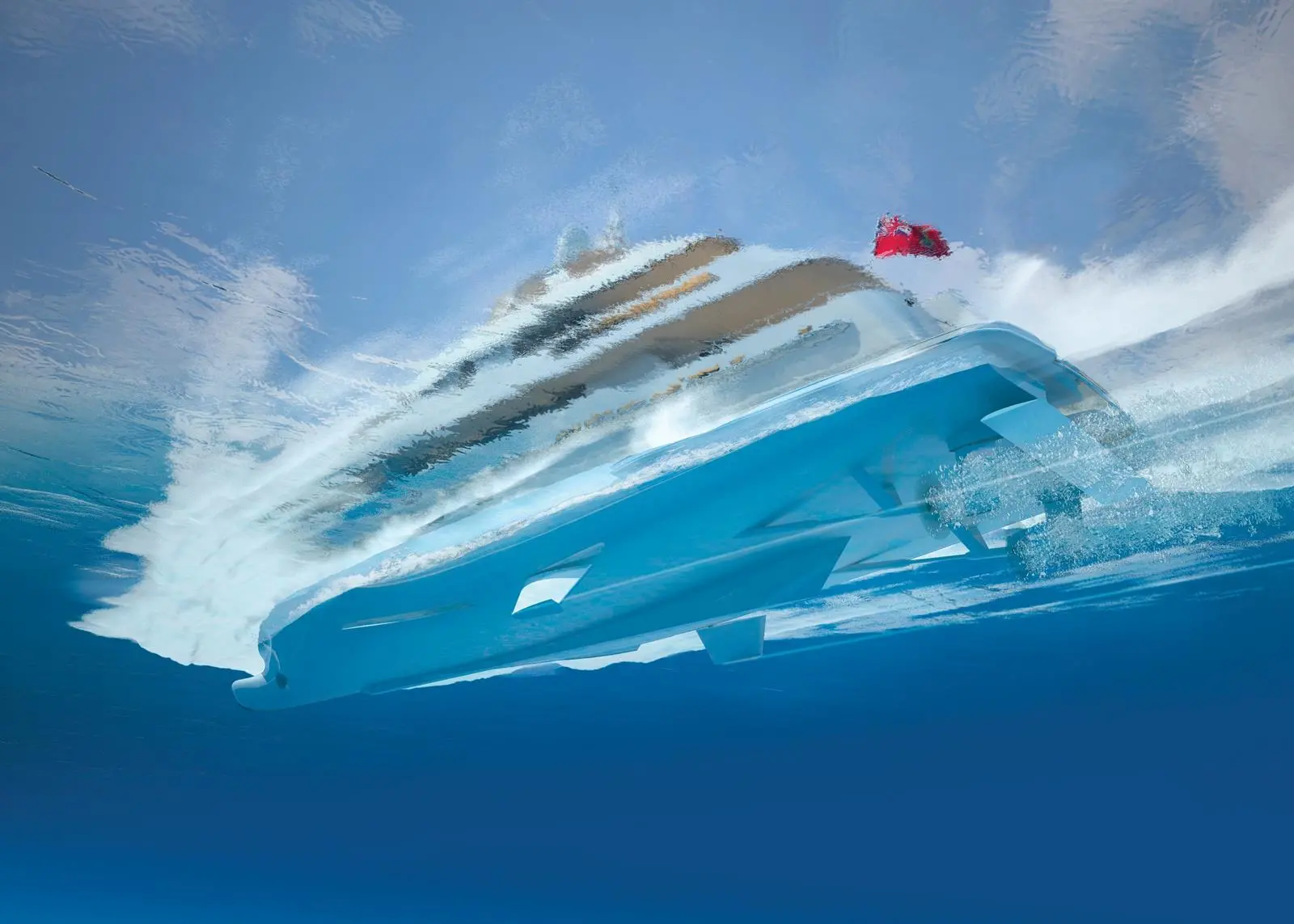
Author of over 100 technical papers, Mr van Oossanen has put some pretty radical forms on the table. Describing himself as “a problem solver” he is no stranger to crossover concepts or, for that matter, controversy: his was the design that broke the mould for the 1983 America’s Cup, creating a new hull type for winner Australia II which paired an ‘upside down’ keel with an aerospace idea: winglets which redistribute the vortex at either the tip of a wing or – in this case – the keel.
So, he hasn’t only seen a lot of change, but been behind a substantial amount of it. After studying naval architecture at Delft back in the 1960s, he got involved with the very organisation that had made him sit up and take notice while resident in Sydney (and prompted a complete family move back from Australia to Europe). Originally the Netherlands Ship Model Basin, it was later reconfigured and renamed Marin with Mr van Oossanen as head of the newly-formed Design-Research Department, responsible for work on early yachts, SWATH, SES and ACV designs. Here he experienced the very beginnings of an industry transformation: “We used to work with slide rules, but one day someone came in holding a calculator: we were told each of us were to have one ‘but do be very careful with them’…”
Certain themes have a habit of returning: in 1989 he set up an independent design office with his son Perry following him into the business and eventually ‘wings’ once again grabbed top billing through the Hull Vane, a type of hydrofoil that doesn’t focus on lift so much as forward thrust.
Like all revolutionary ideas, it wasn’t immediately believed. “I went into the tank-testing unit where I still had friends, but people were saying ‘Pieter, this just isn’t going to work: you can’t get something for nothing’. When we actually measured a substantial forward thrust on the dynamometer I remember the people scratching their heads and going away with their notes… coming back a few hours later and apologising.”
Excitement met… a wall. Despite the sound idea and potentially huge fuel savings “it’s been a long road to where we are now”. He explains: “We initially approached Maersk as we saw they could really use the efficiency on their big ships, but they said no, because it was a prototype. In fact, every time we approached someone, they refused as they didn’t want to be first.”
He understands the business dynamics all too well. While it’s easy to point out that other industries – such as aerospace and automotive – are better at responding to a novel idea, the shipping industry is conservative: partly because of the longstanding culture, and partly because it has pretty narrow profitability. “Even if you can show a potential 5%, 10% or even 20% saving, the margins the owners are playing with are so small they really can’t tolerate a project that risks generating any kind of loss.” So they play safe.
Unfortunately the peaks and troughs of our boom and bust industry don’t lead to fostering innovation. “When everything is going right, people are too busy to innovate, but where you have a financial crisis, the same companies who could then really do with the savings are too busy trying to survive and just don’t have the money.”
So, after these disappointments he went back to the yachting sector which – given that the owners are not short of cash – showed a surprising, “immediate interest on the green savings”. And while there have been setbacks, in the last few years the Hull Vane has picked up speed, jumping across to the offshore sector: a recent fast offshore supply vessel trial showed 12% to 16% savings on shaft power and the owner is presently negotiating costs for the rest of the series.
However, Mr van Oossanen believes there are many answers just waiting to be found, and a lot of new designs will come from the explosion in computing power. “Ten years ago it was all about towing tank tests, and as this is a very expensive exercise only the bare necessities were looked into. But with the coming of computational fluid dynamics – CFD – you can investigate below the waterline, into the pressures and vortices, and even the minor problems get addressed.” He adds that since his company invested in its own CFD system, he has seen “solutions to a lot of things that had been quite baffling – and much better answers”. This has grabbed his imagination and now the company is developing a system which can, by itself, provide an optimised geometry for any given set of parameters.
So he believes that once CFD becomes widespread, rather than people relying on tried-and-trusted, off-the-shelf designs, the industry could benefit from some very efficient, startlingly new ideas. If it is willing to listen.
Related Articles
 ALTERNATIVE FUELS & LUBRICANTS
 ALTERNATIVE FUELS & LUBRICANTS
 OPINION