



Pioneering on board CCS demo delivers promising initial results
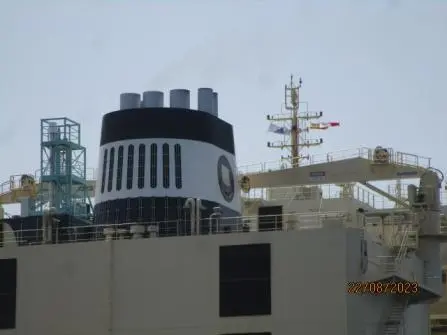
This major milestone marked the first deployment anywhere of a ‘full-chain’ on-board system comprising capture, liquefaction and storage facilities.
This first testing campaign, which concluded mid-February 2024, focused on the performance of the capture system. It ran for over 1,000 hours during which the unit captured up to 250kg of CO2 per day.
The demonstration was conducted using the EverLoNG prototype on board carbon capture system, which was developed in the Netherlands by Carbotreat. The demonstration was carried out on board the SEAPEAK ARWA, an LNG carrier chartered by TotalEnergies. The on board carbon capture system was initially installed in September 2023.
The carbon capture specialist Carbotreat was established in late 2023 as a joint venture following a four-year collaboration between Conoship International, Bouman Industries and TNO (the Netherlands Organisation for Applied Scientific Research).
Initial results are very promising, showing that capture rates of up to 85% are achievable. With further system optimisation to come, researchers are confident of more. Carbotreat previously expressed ambitions to achieve 95% capture rates, with the aspiration of 100% in the future.
As well as assessing the impact of on board carbon capture (or ship-based carbon capture, SBCC) on the ship’s infrastructure and emissions, EverLoNG researchers are studying the effects of motion on CO2 capture rates and of exhaust gas impurities on capture solvent performance.
With a dedicated operator on board to oversee operation of the system, the prototype and vessel designs also enable remote performance monitoring and supervision from shore. This enables a safer and more efficient learning campaign that is providing real-time data that will be shared publicly.
A public webinar on the first testing campaign will follow soon.
Following the SEAPEAK ARWA trial , the SBCC unit will be removed and installed on board the SSCV Sleipnir from Heerema Marine Contractors, where a second campaign of around 500 hours will take place.
The second campaign will see the full CCUS chain in operation. The captured CO2 will be stored on board as a liquid in a container. The container will then be offloaded, and the CO2 transported to an industrial site for utilisation, or stored permanently in the geological subsurface.
EverLoNG project coordinator, Marco Linders of TNO, said: “This first testing campaign really is an example of the EverLoNG project partners pulling together to make things happen. The initial results from the capture unit are very promising and we know that there is more to come. Both this and the second campaign will be important milestones in getting closer to making SBCC a commercial reality. The need to decarbonise the maritime sector is most pressing and there quite simply is no time to waste.”
Related Articles
 CARBON CAPTURE
 CARBON CAPTURE
 ALTERNATIVE FUELS & LUBRICANTS