



Production shift for Australian aluminium ferry technology
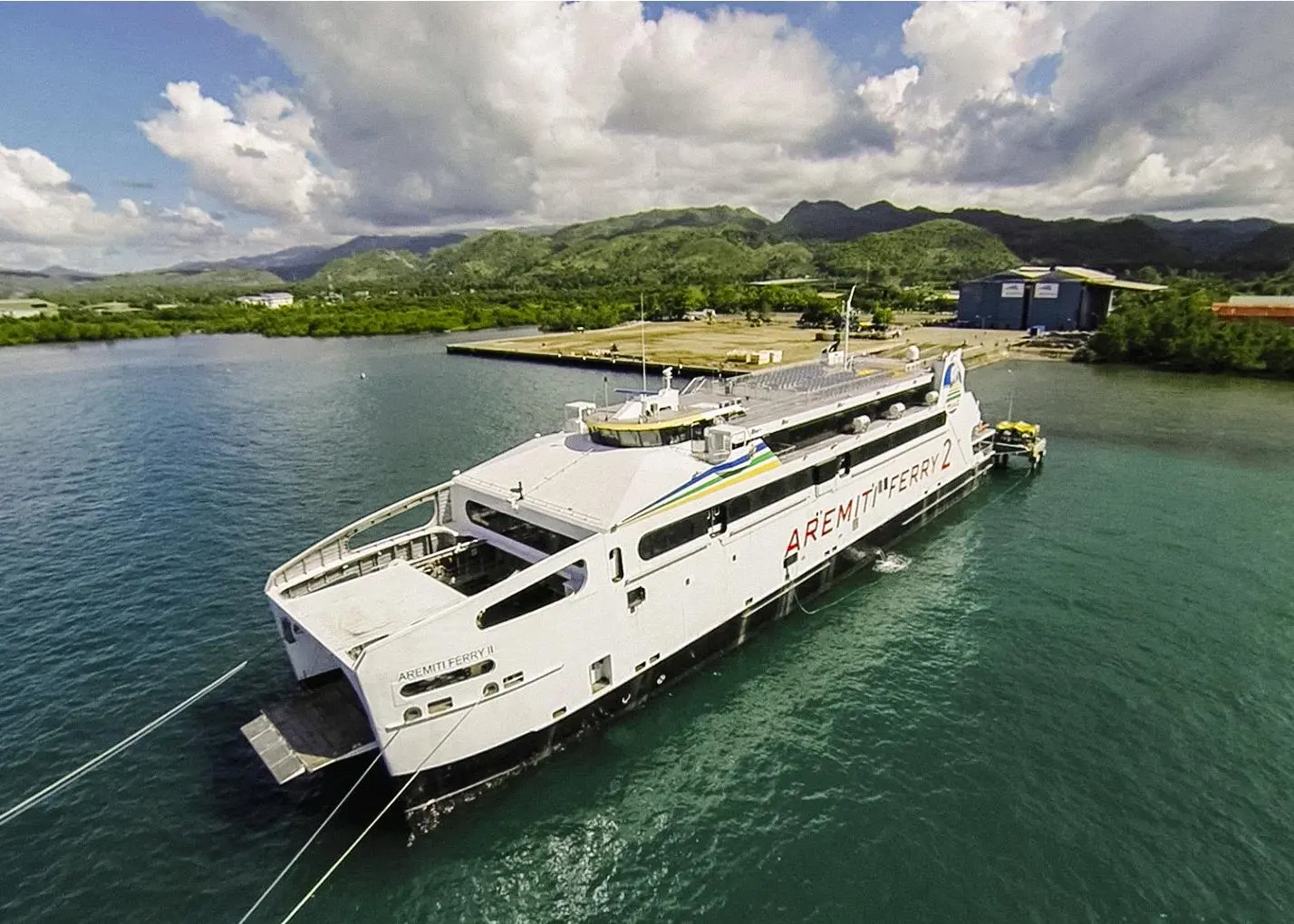
Notwithstanding the expanded group’s more diversified shipbuilding output in recent years and its strengthened position as a global defence contractor, Austal’s lineage in aluminium ferries continues to be extended. An important new reference in the commercial market has been signalled by the introduction into French Polynesian service of the passenger/vehicle catamaran Aremiti Ferry II, representing a design iteration of the enduring Auto Express range.
Particular industrial significance is attached to the construction project by virtue of its fulfilment at the Balamban yard in the Philippines, the former FBMA Marine facility purchased by Austal in November 2011. While the Henderson headquarters yard in Western Australia, the fountainhead of the company’s lightweight ferry technological expertise, is now focused on the defence market, as is the group’s Mobile yard in Alabama, Balamban provides continuity in the building of ferries as well as other types of commercial vessels and craft.
Reckoned to be the largest ferry produced in the Philippines to date, the 80m newbuild for repeat customer SNC Aremiti Ferry arrived in Tahiti just before Christmas 2013 and was quickly phased into duty on the route between Papeete and Moorea. The vessel is the company’s fourth Austal ferry and provides capacity for 967 passengers and 146 cars, or a mix of cars and trucks. Flying the French flag and designed to meet EU domestic voyage rule requirements, she is destined to play a vital infrastructural role in facilitating inter-island trade and personal transport as well as supporting tourism traffic.
While designed, built and classed in accordance with the High Speed Craft (HSC) Code, using a lightweight aluminium alloy structure, Aremiti’s new vessel ranks as a medium speed rather than high speed ferry.
Austal’s Auto Express passenger/vehicle catamarans were typically produced in former years as vessels capable of 35-40 knots, but the changed fuel cost scenario worldwide has fostered demand for vessels engineered to run at more economical speeds. Aremiti Ferry II has a top fully-laden speed of just over 21 knots. Moreover, the upper service speed requirement of 20 knots is achieved with a comparatively modest overall power of 6,080kW. The combination of aluminium construction, low-resistance hull shape and moderate plant output promises through-life operating economy.
Aremiti Ferry II provides a new platform in the South Pacific for MTU high-speed diesel machinery, in the form of a primary power installation based on four 16-cylinder Series 4000 M53R vee-type engines from the IronMen range. Each is rated for a maximum output of 1,520kW and the drive from the plant is through ZF 7640 gearboxes to quadruple Teignbridge fixed pitch propellers. Four spade rudders are fitted and low speed manoeuvrability is enhanced by a 160kW bow tunnel thruster in each hull.
With 6,080kW of power available in total at 100% maximum continuous rating (MCR), the vessel achieves a full load speed of over 21 knots. Operating at 18 knots, the vessel’s fuel consumption is only 850 litre/h, equating to less than one litre of diesel per passenger for a one-hour transit.
Austal claims that the quad propeller/quad rudder system in combination with the bow thrusters confers exceptional manoeuvrability and steering performance equivalent to Auto Express ferries equipped with waterjets, and conferring a similar ability to ‘walk’ the vessel sideways during berthing operations.
The main engines are arranged in pairs, in staggered fashion, in each hull. Four Volvo D9MG generators of 225kWe apiece are also located in pairs in each of the engine rooms.
The layout of the machinery spaces, exhausts and service lines, plus the engine room flooring and structural fire protection reflect design considerations of maintainability and ergonomics. Should engine removal be necessitated, the practicalities are addressed by means of three soft patches per engine room, located above each main engine and pair of generators. Using a purpose-built lifting and removal frame, stored ashore, the propulsion engines can be hoisted up on to the garage deck and out of the vessel.
Austal developed a hard chine symmetrical hull shape specifically for the latest Aremiti project, in the interests of efficient manufacture and ease of through-life maintenance, but also so as to give the lowest possible resistance. As the vessel is designed to continue operating in conditions with a significant wave height of 4m, an Austal ride control system is fitted. This comprises active T-foils under each hull forward and active interceptors aft across each transom, enhancing passenger comfort by reducing vessel motions and also enabling trim to be adjusted in the interests of hydrodynamic efficiency.
Aremiti Ferry II is of drive-through configuration, using axial bow and stern ro-ro ramps which provide 5.5m-wide vehicle lanes for two-abreast loading and unloading. The bow ramp access system incorporates a novel inner bow door design, which independently lowers the bow door as a separate entity flush into a recess in the bow ramp when deployed for loading. The whole thereby forms a single integrated ramp in the deployed position, while maintaining two separate sealing and dogging arrangements to secure the bow for transit.
The main vehicle deck is open apart from structural pillars located along the vessel centreline, affording 950m² for trucks and cars. The capacity for commercial vehicles weighing up to 50t equates to 228 truck lane-metres. A further 725m² for up to 63 cars or packages is provided by hoistable deck sections, as two assemblies port and starboard at mezzanine level. Increased payload scope and flexibility is engendered by the vessel’s certification for certain types of dangerous goods, including flammable gases and liquids, with suitable reductions in passenger numbers. One return service each week between Tahiti and Moorea provides for the carriage of such freight, when the passenger complement is limited to 25.
Passenger accommodation is located on two levels, with 532 seats on the upper deck in two saloons separated by a refreshment outlet and 435 seats on the bridge deck in one spacious lounge. There are 150 external seats on the sun deck. The vessel provides full access for disabled passengers, with a Kone MonoSpace lift serving main, upper and bridge decks, and suitable for use under way at sea, and with dedicated seating, permanent doorway ramps and wide aisles to enable wheelchair access.
IMO’s HSC Code mandates a maximum noise level of 75dB(A) within passenger spaces, and the builder reports that Aremiti Ferry II peaks at below 70dB(A), and that the majority of the bridge deck space registers under 60dB(A).
Designated as Austal Philippines Ship Yard Operations (PSO), the Balamban facility has sharpened the group’s competitiveness on the international commercial market. The Aremiti catamaran was preceded by the completion of a 27m trimaran for the European offshore wind farm service sector at the start of 2013, and a series of catamaran wind farm support vessels is due to be delivered in 2014. The Motorship was advised in mid-February that a number of opportunities for follow-on work were being finalised.
Austal has already spent about A$5million in yard improvements and has undertaken some feasibility studies and planning regarding potential development to increase maximum newbuild vessel size. Aremiti Ferry II is seen as heralding a new generation of medium speed ro-pax ferries.
Meanwhile, the company now looks set to boost its financial coffers by selling the 102m trimaran ferry built at the Henderson yard to Austal’s own account (“for stock”) and completed about four years ago. An option to purchase has been concluded with an unnamed European ferry operator, subject to a number of contractual conditions. The agreement anticipates actual purchase in the final quarter of the 2014 financial year.
The 39-knot vessel, known as Hull 270, is an evolution of the landmark 127m trimaran Benchijigua Express, delivered into Fred. Olsen’s Canary Islands route network in 2005.
PRINCIPAL PARTICULARS – AREMITI FERRY II
Length, overall 79.8m
Length, waterline 75.6m
Breadth, moulded 17.0m
Hull depth, moulded 5.9m
Draught 2.85m
Passenger capacity 967
Vehicle capacity 146 cars or 228 truck lane-metres
Maximum deadweight 480dwt
Fuel capacity 117 tonne
Main engines 4 x MTU 16V4000
Main engine power 4 x 1,520kW
Propulsion 4 x FP propellers
Speed(100% MCR) 20 knots
Class Germanischer Lloyd
Class notations +100A5, RSA(200), HSC-Passenger B, Ro-Ro Type DG, “High-Speed Passenger/Ro-Ro Type”, Machinery +MC, Certified to carry Dangerous Goods of Cat 2.1(except Hydrogen) and Cat 3
Flag France
Related Articles
 PROPULSION
 GENERAL NEWS
 HYDROGEN