



PROJECT PARTNERS DEVELOP TECHNOLOGY FOR THE DECENTRALISATION OF E-FUEL PRODUCTION
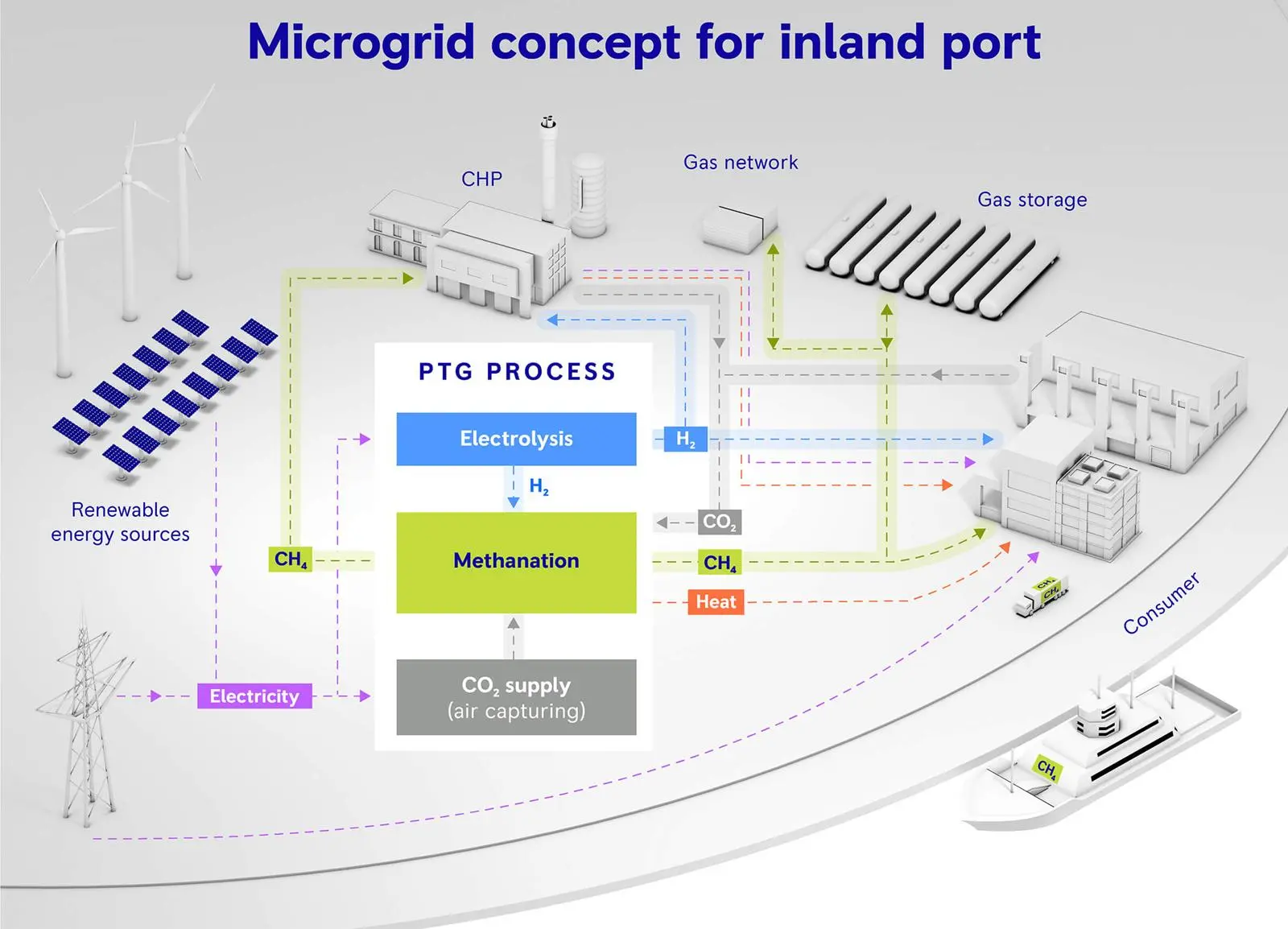
The aim of the MethanQuest project is to facilitate a decentralised approach to e-fuel production – something the project partners see as critical to a successful energy transition. The approach avoids the need for long transport routes for energy and can be adapted to local needs. It is initially being conceptualised as an LNG hub for the Karlsruhe inland port in Germany.
There are 29 partners from research, industry and the energy sector involved, and they have now released interim results on processes for producing hydrogen, methane and methanol from renewables and their use in mobility and power generation.
E-methane is produced in a power-to-gas process using electricity made from renewable sources such as wind or solar. This electrical power is used to break down water into its components (hydrogen and oxygen) via electrolysis. Using the hydrogen, and carbon-dioxide from the air (CO2 capturing) or from biomass, plus further energy input, synthetic fuels such as e-methane, e-diesel and e-methanol can be manufactured thereby facilitating a CO2-neutral energy cycle. Importantly, e-methane is simple to store and use at a later date.
The MethanQuest project, divided into six sub-projects, is being led by DVGW and the Rolls-Royce business unit Power Systems.
MethanFuel – e-fuel production
The MethanFuel group is researching new processes for manufacturing methane out of renewables and is advancing all the technologies involved – from water electrolysis to CO2 extraction and methanation.
AREVA H2Gen and project partners Fraunhofer ISE und iGas Energy have developed a flexible polymer electrolyte membrane (PEM) electrolysis system to produce hydrogen as the first step in power-to-gas production. The 2.3MW PEM electrolysis system is operable at low partial load without the risk of premature wear. This means that the draw-off of electrical power for hydrogen production can be selected according to the current demand and related prices, enabling the system to be deployed economically and used to support power grid stability. The new system is being tested over a period of nine months in the Höchst Industrial Park.
The steps involved in converting the hydrogen into methane have been successfully demonstrated by DVGW and a team from the Karlsruhe Institute of Technology. A long-term experiment has seen the capture of CO2 from the air and used in a new catalytic methanation plant which produces some 10m3 of pure methane per hour and also displays excellent dynamic load behaviour. This is advantageous in managing production during the supply fluctuations caused by renewable electricity generation.
The Technical University of Berlin is looking to the more distant future. To enable hydrogen to be produced in offshore wind parks in very high quantities, it would be highly advantageous if the seawater could be electrolysed directly. This project team has now developed and tested an efficient concept which makes the process feasible without the need to desalinate the seawater in advance.
MethanPower – hydrogen combustion for stationary applications
Coordinated by Rolls-Royce Power Systems, the MethanPower group are investigating a concept involving a large Otto engine fuelled by hydrogen. The aim is for this engine to achieve the power density of a natural gas engine with minimum emissions, therefore opening up the possibility of using previously unharnessed surpluses from renewable energies to stabilize the power grid in a decentralized setting.
In this project, tests are being carried out on 1-cylinder engines. Development work is focusing on fuel injection, combustion and tribological technologies. The target application of MethanPower is stationary gas engines of the Rolls-Royce product MTU Series 4000 (high-speed gas engines with 4.7 litres of displacement per cylinder) for energy supply in a power range of 1 to 2MW.
MethanMare – fuel flexibility for shipping
The sub-project MethanMare is exploring bunker fuels manufactured from renewables. Research has found that with the use of catalytic converters and a new, complex technique for high-pressure gas injection, emissions from a methane-powered ship engine can be lowered by up to 80% compared with those of a conventional gas engine. The systems are being tested for their resistance to aging, and catalyzer regeneration measures are being examined. CO2 emissions could be further reduced by optimizing piston and injector nozzle geometry.
MethanMare is working with MTU Series 4000 marine gas engines, based on the proven MTU diesel engine series 4000 M63 for workboats. The gas engines are already on the market and are offered as an 8-cylinder version with an output of 746kW and a 16-cylinder version with an output of 1,492kW. The gas engines are particularly suitable for tugs, ferries, push boats and special vessels such as research boats. They already fall below the nitrogen oxide limits of the current IMO III emissions directive, even without exhaust gas aftertreatment. The engines emit no sulphur oxides and the particulate mass is below the detection limit.
Metal substrates coated with platinum palladium have been adapted as methane catalysts. Tests have indicated that they can reduce methane emissions in the exhaust gas of lean-burn engines by more than 95% when new. However, the long-term testing that has been started in trial operation shows a faster aging process than expected. Possible measures are still being worked out.
Another promising approach for achieving very low methane emissions is the High Pressure Dual Fuel (HPDF) process, in which natural gas introduced into the combustion chamber under high pressure is ignited on a small amount of diesel fuel. Mixture formation in the combustion chamber and diffusive combustion reduce methane slip to a minimum, while by diesel-engine-based quality control, a high level of efficiency can be achieved even in part-load operation. An advantage over alternative gas engine concepts is the increase in power density achieved by the diesel engine process principle, since knocking combustion is conceptually ruled out. The feasibility of a dual fuel combustion process with high-pressure gas is largely determined by the injection system and in particular the injector.
CO2 emissions have been further reduced by improving the piston and nozzle geometry. By improving the weighting between premixed and diffusive combustion, the duration of combustion was shortened while taking emission values into account, resulting in an improvement in efficiency.
Additionally, tests have shown that methanol combustion in large high-speed engines gives rise to low contaminant emissions (nitrogen oxides and particulates) and zero methane emissions. The extent to which the new technologies researched in MethanMare will be used will be assessed after the project is completed.
MethanCar – Ford testing engine
MethanCar project partners are working on engines capable of combusting renewable gas highly efficiently without producing harmful by-products. A car engine powered by methane which was built under the leadership of Ford is currently being put through its paces. The primary focus lies on achieving high efficiency and on developing exhaust after-treatment strategies for the Otto engine.
MethanGrid – LNG hub concept for Rhine port
The MethanGrid group has conceptualized an LNG hub for the Karlsruhe inland port which takes the form of a multi-functional system of e-methane storage and distribution. Firstly, the hub secures the supply of LNG to ships navigating the Rhine at a regional level. The hub can also be used to supply trucks and larger distribution points with LNG and also to support the high-pressure gas network in Baden-Württemberg for peak load coverage.
In collaboration with Rolls-Royce Power Systems and other partners, the DVGW Research Center has also developed a complete locally coupled energy supply system for the Karlsruhe inland port facility. Electricity, gas, heating, industry and transport sectors are coupled together using the microgrid so that the available energy, including renewables, can be optimally exploited. The microgrid is currently being tested in simulated scenarios using real data from the port facility and other components. This will enable the final development of a concept that is practical to implement.
MethanSys – nationwide solutions
The interim results provided by the MethanSys sub-project show how possible developments in e-methane across the whole of Germany’s energy system can be comprehensively modelled and evaluated in the context of existing gas infrastructure.
Now in its final year, the three-year MethanQuest project has been funded by the German Federal Ministry for Economic Affairs and Energy. The MethanQuest research group aims to initiate a follow-up project focusing on hydrogen and methanol for the industrialization of hydrogen combined heat and power plants and the production of hydrogen. A project outline has already been submitted for funding.
Related Articles
 ALTERNATIVE FUELS & LUBRICANTS
 ALTERNATIVE FUELS & LUBRICANTS
 ALTERNATIVE FUELS & LUBRICANTS