



Putting Antwerp at the heart of the hydrogen economy
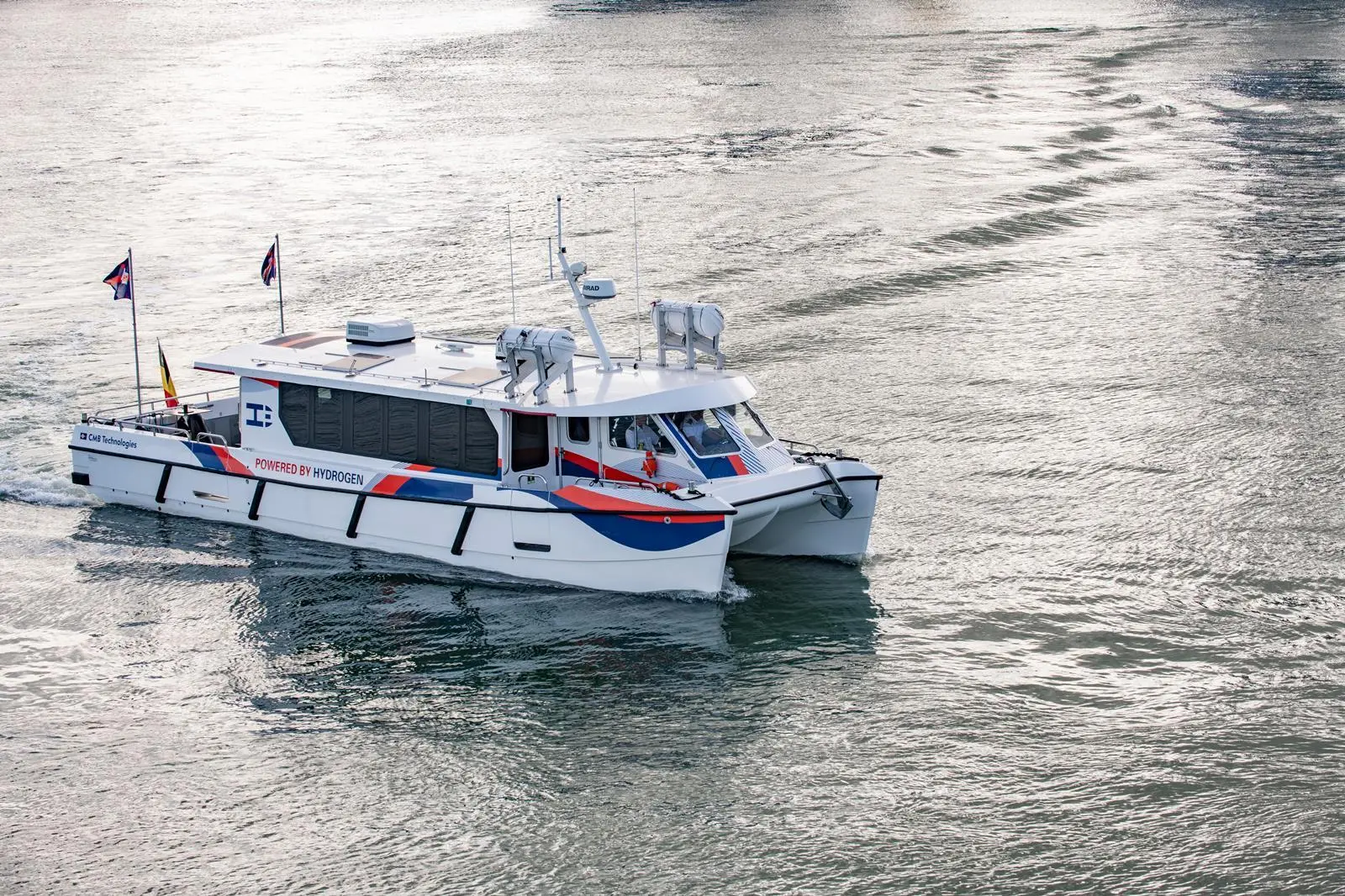
Antwerp-based ship owner Compagnie Maritime Belge (CMB) selected the development of hydrogen-fuelled engines as a way to make a mark in the maritime sector several years ago. The Generation X aged owners of the company decided that technological innovation was to be their route to gaining a competitive edge.
The decision to focus on hydrogen-fuelled engine development was influenced by the company’s location: Antwerp itself is home to a number of industrial manufacturers who produce hydrogen as a by-product of their industrial processes, and accounts for some 10-15% of the European Union’s overall hydrogen production.
CMB’s R&D Manager Roy Campe explained to the Motorship that the technical challenges of working with hydrogen meant engine manufacturers took a wait-and-see approach to CMB’s research efforts until the launch of the Hydroville.
CMB has recently acquired its collaborator on the Hydroville development project, UK-based engine designer Revolve Technologies Limited (RTL). RTL has been developing high-speed hydrogen-fuelled engines for the road transport market for over 10 years.
“By buying RTL, we have acquired a lot of research experience into how we can successfully produce hydrogen-fuelled engines. But there were still a lot of differences between high-speed engines and medium-speed engines. It’s a different league – and marine development cycles tend to be shorter than four-year automotive cycle, as every ship can represent a new prototype opportunity.”
BeHydro
In 2018, CMB established a joint venture with Belgium-based engine designer and licensee ABC Engines. The joint venture, BeHydro, was focused on the development of medium-speed hydrogen combustion engines.
The focus on short timescales and incremental advances continues to characterise CMB’s approach, Campe noted. “Our timeframes and objectives are comparatively modest, and we have a preference for working with small numbers of collaborators”, Campe said. Unlike other transport industries where years of testing on test tracks are required for series production, a shorter timeframe from design to market is possible in shipping.
He cited the development of the Hydroville, a separate project to develop a crew transfer vessel, and a further project to develop a service operational vessel or a tug boat as progressively larger vessels.
The possibility of developing individual vessels with different fuel types also meant that incremental growth in demand for hydrogen as an energy vector was also possible. Logistical barriers to expanding demand were less of an obstacle, unlike road transport where the need to develop a nationwide network of refuelling stations is a factor.
“Who knows? Perhaps we could see the development of a hydrogen-fuelled dredger, a patrol boat, tug boat, or SOV and the development of demand for hydrogen refuelling in a number of ports around the North Sea – Rotterdam, Zeebrugge, Ostend – perhaps even Southampton. Before you know it, the steady growth of hydrogen bunkering would mean that a hydrogen-fuelled container feeder might not even be such a large step.”
BeHydro partner ABC Engines has a preference for comparatively simple design configurations, favouring ease of maintenance and reliability. Such an approach could also be seen in the current hydrogen engine development. Campe noted that ABC Engines and CMB were initially developing dual-fuel engines using compressed hydrogen. Research into the use of liquefied hydrogen for storage purposes was continuing.
Hydrogen logistics
The initial focus of the project was on developing an engine for a crew transfer vessel servicing one of the offshore wind farms in the North Sea. Campe estimated that a hydrogen-fuelled CTV would be cheaper compared to an LNG-fuelled vessel while emissions savings compared favourably with LNG-fuelled alternatives.
Such vessels have relatively low fuel requirements, which Campe estimates at 150-200kg/day. Refuelling could be undertaken overnight, while the use of swap tanks could simplify the process further.
“Generating hydrogen or hydrogen-based fuels from idled offshore wind capacity is already under discussion: with another 50GW of wind power set to be installed in the North Sea alone in the next few years, there will be no shortage of hydrogen. We just need the electrolyzer capacity.”
The advantage of adopting compressed hydrogen as a fuel is that it removes the additional safety and bunkering regulatory issues associated with the use of liquefied hydrogen. The supply chain costs of using compressed hydrogen are largely determined by the cost of cleaning and compressing pure hydrogen into pressurised bottles.
“At this early stage, hydrogen is readily available at a relatively low cost near Antwerp. Consistent demand and cost differentials from transportation mean we expect hydrogen suppliers to be interested in supplying us”, Campe noted.
The Motorship notes that industrial gases producer Air Liquide had helped meet the hydrogen requirements of CMB’s previous hydrogen-fuelled vessel, Hydroville, the first sea-going vessel with dual fuel diesel-hydrogen engines.
CMB had previously worked closely with class society Lloyds Register during the Hydroville development project, and LR was continuing to collaborate closely.
Research and development
The engine development was focusing on developing a dual-fuel engine with a pilot fuel injection, while research into a spark-ignited pure gas engine operating on hydrogen was continuing.
In common with other engine manufacturers who are conducting research into hydrogen, Campe noted that the hydrogen injection must be done carefully higher combustion chamber temperatures and pressures requires in the cylinder. He also noted that tight control over lean air-fuel mixtures reduced excessively fast burning (and also limited the production of NOx emissions).
The joint venture had successfully tested concentrations of hydrogen of up to 85% at the medium-speed mono-cylinder set up at the combustion research centre at WTZ Roßlau in Germany. “We have gone as high as 92% on a high-speed engine”, Campe added.
The company had adjusted the valve timing, and tested different designs in order to optimize the engine for high hydrogen displacement ratios and high efficiency during the single-cylinder tests.
ABC Engines has established research links with Ghent University’s Transport Technology group, which has advanced engine simulation experience, while Ghent University also has a Combustion Chamber 1, known as GUCCI. The constant volume combustion chamber enables visualisation of fuel spray and combustion characteristics under engine-like conditions.
This has been a particular advantage during the development of the hydrogen engine, in which pre-ignition and knocking have been particular challenges. This complicated engine control and risked shortening the interval between services.
ABC Engines presented a technical paper at the 2019 CIMAC conference in Vancouver, in which the company discussed particular issues with hot spots on the piston and cylinder head triggering pre-ignition.
ABC Engines has expertise in managing gases of low calorific value and fluctuating ignition quality which it developed during its previous LNG dual-fuel engine development projects. Campe noted that the project had not experienced significant fluctuations in hydrogen quality.
ABC Engines’ close ties with turbocharger designer and licensee KBB Turbo were also useful during the development. “Managing the changes to turbocharging is a particular area of focus for the development of the hydrogen engine. We’ve spent the past year looking at valve timing, variable compression ratios and a number of other issues on the single-cylinder test engine.”
However, Campe noted that the development project was choosing to favour reliability over unproven technological solutions. “We are using proven technology because we are putting safety at the heart of what we are doing”.
ABC Engines was currently building a full-scale test engine at its research centre in Ghent. Full-scale tests of the new hydrogen dual-fuel engine were due to begin in January 2020, with the test engine expected to be market ready by mid-2020.
Commercial plans
BeHydro aimed to commercially launch its first hydrogen medium speed engine by summer 2020. The engines under development ranged from 0.8 MW to 2.8 MW and were expected to be available in 6, 8, 12 and 16 cylinder configurations.
BeHydro engines could operate as marine auxiliary engines, or as stationary generators for electricity generation, Campe noted. But the immediate market opportunity is in smaller-sized vessels in Northwest Europe. “We’re mainly looking at commercial vessels – tugs, barges and crew transfer vessels.”
“The offshore energy market is going to grow rapidly, and there will be demand for low-emission vessels from wind energy companies”, Campe said.
Related Articles
 ALTERNATIVE FUELS & LUBRICANTS
 ALTERNATIVE FUELS & LUBRICANTS
 ALTERNATIVE FUELS & LUBRICANTS