



Raising the pressure
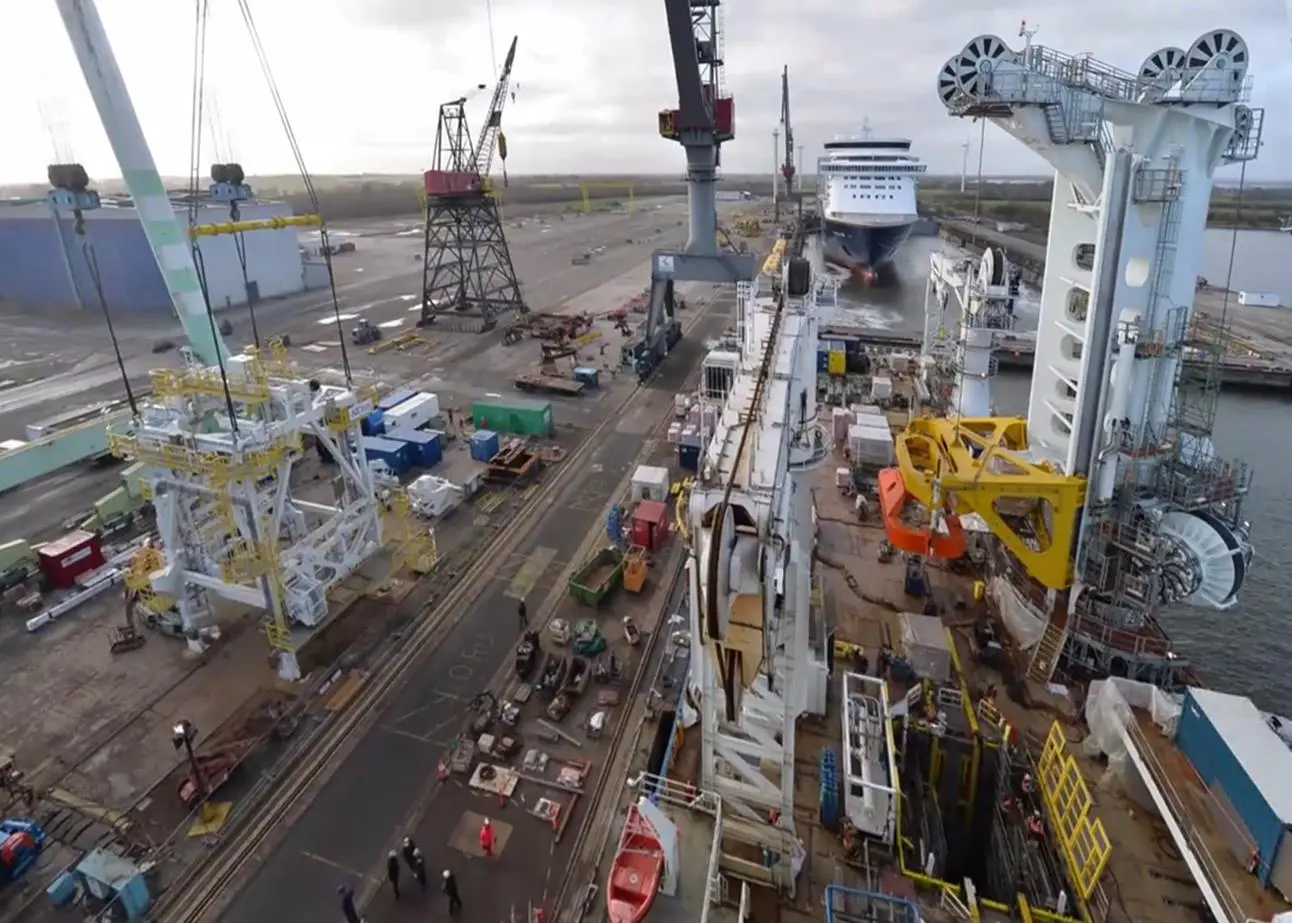
While there’s been other, smaller installations, Statoil’s Asgard subsea processing station is really pushing the boundaries of new technology. It’s therefore no surprise that while the footprint was by necessity kept contained, the pieces evolved with increasingly dense engineering: some modules putting on half as much weight again from the original specification and a few getting close to tipping the 400 tonne mark.
And at this kind of size, deployment just doesn’t come that easy explained Harald Bakke of Technip at the recent OSV & Subsea Conference in Oslo, especially when lined up with the other requirements: sinking (literally) that much money into it means keeping regularity of production at the 96% level, necessitating maintenance all year round, including during the harsh North Sea winter months.
“As a result we have to be able to install – and retrieve – 400 tonne modules in seas up to Hs 4.5,” explained Mr Bakke, pointing out that this sea state means 9m high waves. “While doing this with a crane might not present a problem in Hs 1 or maybe 2, in Hs 4.5 you just can’t do it. So, we had to find a completely new solution.”
Further, with all the different equipment that needed to find space onboard, it had to be a large, capable vessel: the DP3 multipurpose North Sea Giant from North Sea Shipping, at 160m long fitted the bill; moreover it had propellers and thrusters tailor-made for answering a wide variety of demands.
The largest element of this project was a special handling system (SPS) to install the biggest modules. “Basically it sits around a kingpost, welded to the vessel on the port side…. The entire structure revolves round this post on slewing gears,” he explained. On each side is a 270 tonne main lift winch; these are connected to the adapter frame and guide rail (which runs through the vessel from top to bottom) controlling the module and limiting movement in harsh weather.
“It’s a little difficult to grasp the scale but at 30m tall, it’s huge, with a weight of about 1,000 tonnes. Of course if you are going to put that onto a ship, reinforcement is necessary due to the magnitude of the loads,” he said, adding that an internal, supporting structure was installed through a cut-out in the hull.
Interestingly the superstructure was fabricated in one piece – including winches, gearing and so on – before sliding it over the sturdy kingpost using Denmark’s Fayard facility and it’s capable, 1,000 tonne gantry crane. “Essential for getting this work completed,” added Mr Bakke.
The whole thing passed muster, with the SPS successful in load tests at 462 tonnes.
However while the SPS is the more dramatic beast, there was a need for other equipment, more modest in scale but just as necessary to deploy the smaller parcels. Therefore the 70 tonne module handling system (MHS) “is really the workhorse” said Mr Bakke. It sits over the midships moonpool and it’s open fore and aft which allows it to work from skidding pallets on the decks in front and behind: “This gives it huge deck area to play with.”
There’s also another piece of interesting equipment: the Subsea Process Intervention System (SPIS) which is necessary when removing a defective module: it can test valves and flush a system through to get rid of both hydrocarbons and seawater – as this simply will make a module unwieldy to lift.
However, the power remained an issue, pushing Technip into finding a novel solution. Three new HPUs were installed to power the hydrodynamic winches, generating close to 3,000kW, giving a flow of 5,000 litres per minute. But in extreme cases with the equipment being used in tandem, the draw may reach five or six times this amount: “We knew we couldn’t cover it simply by installing more HPUs as it would take a massive amount of power, so what was needed was a way to store energy during the pay-out cycle and then gather it in again during the yield cycle.” A hydraulic regeneration solution was found which takes on about 70% of the requirement, though not a completely new concept, it was probably the first very large scale application.
With all this on deck and the addition of two work ROVs the nice, empty vessel that Technip started with “is now pretty full”, admitted Mr Bakke.
While the main task is to support the Asgard subsea compression technology and this will keep the vessel busy for 2015, it’s difficult to know in advance exactly how much of the time the upcoming maintenance rounds will utilise the vessel, although it’s doubtful it will be for 365 days a year. So it’s important that the vessel retains some flexibility.
Firstly, the deck gear is removable explained Mr Bakke, and it can all be used in different combinations. Secondly, the SHS has an adapter which can interface with a number of modules and already comes with half a dozen different frames – but it can also deploy something like a huge basket over the side with components that won’t fit through the moonpool. Further, the SPIS looks like being popular because if there’s one recurrent theme common to brownfield sites, it’s a need to prevent hydrocarbon spills.
More, because of the Giant’s scale, it can get more equipment into the field and stay out longer, making the most of smaller windows of operation and gaining a margin in what is still, despite everything, a time sensitive market.
And lastly, although the wholesale nature of the work meant there had to be new class verification tests for the vessel and it has changed its behaviour quite distinctly, interestingly, Mr Bakke said the handling is sometimes “actually for the better”, according to crew reports.
By Stevie Knight
Related Articles
 PROPULSION
 GENERAL NEWS
 HYDROGEN