



Reduced weight vehicle carrier from Croatia
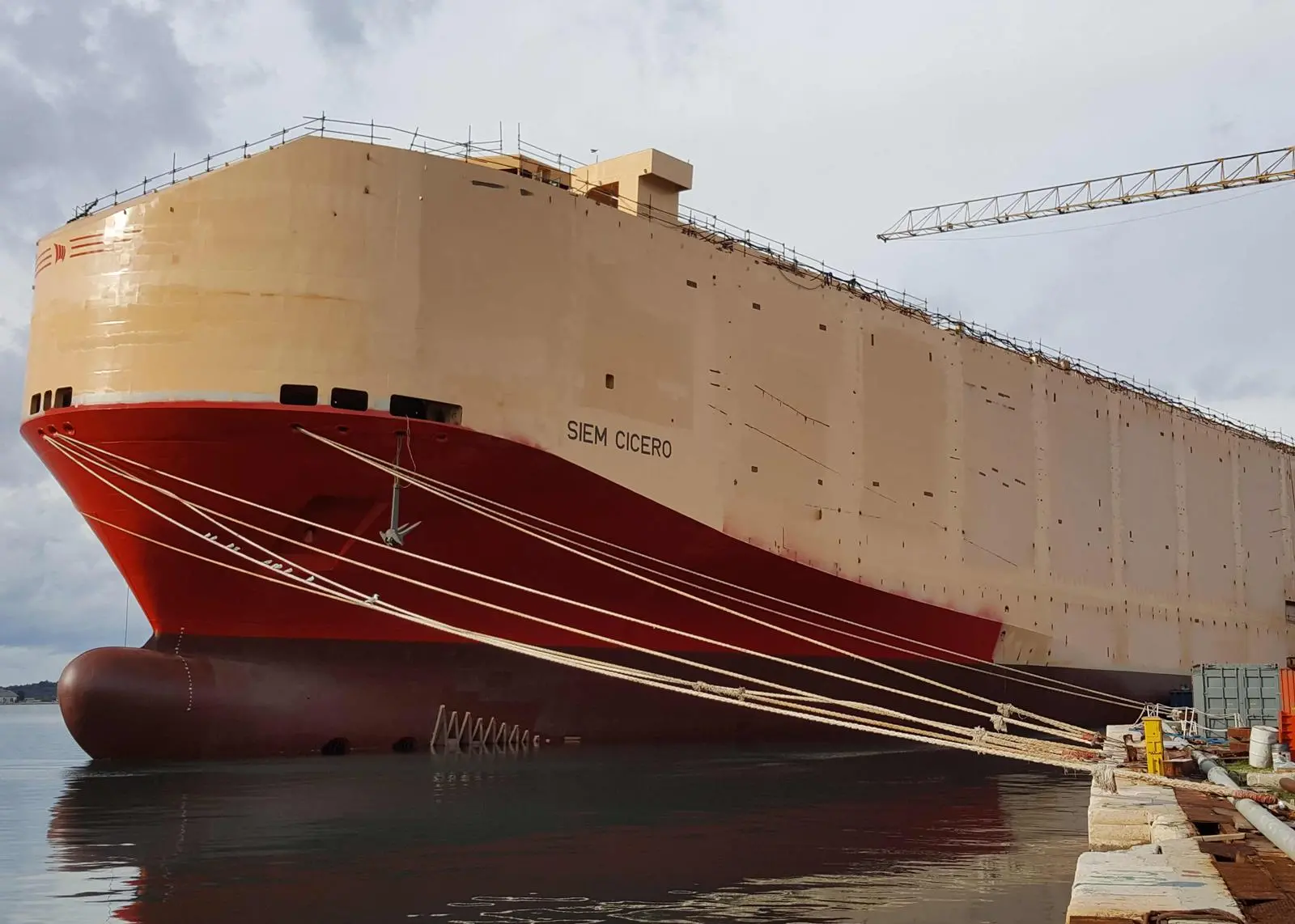
Siem Cicero is the first in a series of three ordered by London-based Siem Car Carriers for deployment in the company’s transatlantic service linking Germany with North America and Mexico. The Croatian yard ranks as Europe’s most prolific builder of PCTCs.
As Siem’s North Atlantic traffic is underpinned by shipments of cars and sports utility vehicles (SUVs) for the Volkswagen (VW) Group, the vessels are optimised for a 6,900 car-equivalent unit (CEU) intake on 13 decks, of which three are hoistable. Siem Cicero loaded her first cargo during July in Emden for delivery to the US and Mexican markets. Emden is VW’s home port in its logistics chain.
By employing a sandwich composite for the top three decks, using lightweight Divinycell-core panels developed by the Swedish company Diab International, it is claimed that a 25% weight saving amounting to 200t has been obtained in relation to traditional steel decks. This solution has also improved stability, requiring less ballast water to be carried, and is expected to result in a reduction of about 4% in fuel consumption.
An associated gain is the fact that the Siem Cicero can operate at a somewhat lighter draught than comparable PCTCs. Although the vessel and her two sister newbuilds have been assigned to North Atlantic duty, the overall hull length, at a shade under 200m, affords greater worldwide trading flexibility as the maximum for Japanese loading terminals.
Siem Cicero provides a new showcase for the use of composite components in large commercial ships. Diab and Uljanik are collaborating to explore the wider possibilities for the technology, including superstructures as well as decks, and other types of vessel besides vehicle carriers and ro-ros.
The main engine is a seven-cylinder model of MAN’s electronically-controlled S50ME-B two-stroke, rated at 11,200kW and affording the ship a speed of 18.5 knots. The retained value of the shipbuilding deal to the Croatian contractor has been enhanced through production of the machinery under licence at Uljanik’s diesel engine works.
As the ship is subject to the exacting sulphur limits applicable within the North American Emission Control Area (ECA), the owner specified aftertreatment plant in the form of the Alfa-Laval PureSOx system. A hybrid version has been adopted, which affords operating versatility in either open or closed loop configuration, the latter mode having the added benefit of enabling strict US regulations to be met concerning wash water discharge.
The ship’s design is a derivation of that used for two PCTCs currently chartered by Siem and delivered by Uljanik in 2007 to PD Gram of Norway. At the time of their completion, the 13-deck Hoegh Bangkok and Hoegh Delhi had topped the Panamax stakes with a capacity of 6,947 CEU.
Siem Car Carriers’ Atlantic service calls at Emden, Halifax (Nova Scotia), Davisville (Rhode Island), Jacksonville (Florida), Houston (Texas) and Veracruz (Mexico).
PRINCIPAL PARTICULARS—SIEM CICERO
|
Length overall |
199.9m |
|
Length, b.p. |
188.7m |
|
Breadth, moulded |
32.3m |
|
Depth |
32.1m |
|
Draught |
8.8m |
|
Gross tonnage |
56,677t |
|
Deadweight |
17,416t |
|
Cargo capacity |
6,900CEU |
|
No. of decks |
13 |
|
Main engine power |
11,200kW |
|
Speed |
18.5kts |
|
Class |
Bureau Veritas |
|
Flag |
Liberia |
Related Articles
 PROPULSION
 GENERAL NEWS
 HYDROGEN