



Reliable and safe LNG supply for ships
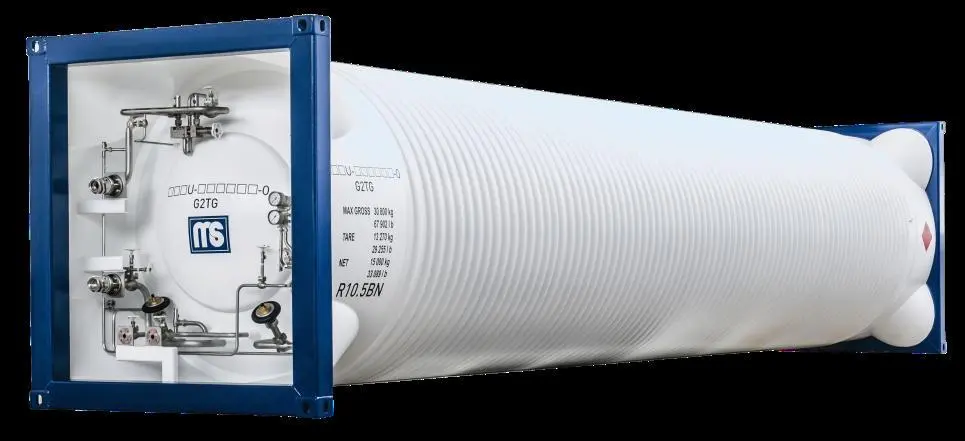
The mobile LNG tank, with the dimensions of a standard 40ft shipping container, addresses two of the main issues concerning the use of LNG as marine fuel: the limited availability due to the lack of infrastructure, and the difficulty of accommodating fuel storage onboard, particularly with existing ship designs.
According to Marine Service, LNG is considered as one of the most promising alternatives on a worldwide basis for the conventional oil-fired diesel propulsion used in shipping – in particular regarding the intensification of the emission directive in ECAs that enters into force in 2015. One of the key problems regarding the adoption of the environmentally sound gaseous fuel is the infrastructural limitation outside the Scandinavian countries.
“Worldwide there are only a few LNG bunker facilities outside of Norway. Ships that use LNG as fuel today are facing considerable impairments”, says Jörg Redlin, director marketing and LNG division at Marine Service. “With regard to the multi-million investments, that need to be done to provide LNG fuelled ships a global infrastructure next to the conventional bunker facilities, we suppose this process to extend beyond 2015.”
Until such time as a viable bunkering infrastructure for LNG fuel can be established, the Marine Service LNG fuel tank container is intended to provide a practical and technically reliable alternative. “The container can be understood as a replaceable and rechargeable battery”, explains Mr Redlin. “The LNG fuel tank containers can be loaded aboard like every other IMDG container. Ships using these containers achieve independence of the availability of LNG bunker facilities.”
After filling the container within the safe environment of a LNG terminal with suitable facilities and trained personnel, the LNG fuel tank containers can be transported to their destination ports by sea, rail or road. “Thanks the vacuum insulation the containers can be stored intermediately up to 80 days, before the pressure inside the container reaches the set value of the safety vent.”
The structural design and construction allows the stacking of containers up to six high.
Another key issue for ship owners is the cost of modification of existing fleets – even assuming the basic ship design will permit such modifications. While conversion of the propulsion system is comparatively simple, Marine Service says that the integration of separate LNG tanks is a challenging and cost-intensive mission.
At present there are 30 LNG fuelled ships in operation, mostly in Norway, plus the LNG carriers that are fuelled by LNG, normally using the boil-off gas. That means, the majority of the world fleet will need to be modified in some way to comply with the ECA directives regarding emissions. In many cases, the use of gaseous fuel will provide an attractive option if the onboard bunker storage problem can be solved.
Here, Marine Service believes that LNG fuel tank containers provide an attractive solution. Instead of complex modifications to integrate permanently installed tanks in existing ships, fuel tank containers can be stacked on deck and connected with suitable safe couplings to the gas handling system and thence to the fuel system of LNG-burning engine. “The concept of the Marine Service LNG Fuel Gas System is designed
for on-deck stacking due to safety reasons”, says Mr Redlin.
Control and regulation of the correct gas pressure for the propulsion system is managed by a separate control unit, the gas control valve group, supported by a gas handling unit. This unit can be deployed in a separate container and installed next to the LNG fuel tank containers.
The LNG fuel gas system developed by Marine Service was approved in principle by Bureau Veritas in July 2011. “With the LNG fuel tank
container, the safe connections and couplings and the existing infrastructure for IMDG containers, Marine Serivce provides the perfect solution for matching the ECA regulations”, says Mr Redlin.
Related Articles
 ALTERNATIVE FUELS & LUBRICANTS
 FUELS & LUBRICANTS