



Report: VLCC best business case for onboard carbon capture
The report considers a series of case studies and analyses the impacts of full or partial application of OCC on container, bulk and tanker vessels using carbon-based fuels, as part of a newbuild or retrofit.
It concludes that OCC can be applied to all carbon-containing fossil, electro, and biofuels and, as a result, could play a mid- to long-term role in maritime decarbonization. However, the applicability of OCC depends on several factors including OCC technology development, commercial viability, alternative fuel prices and availability, and future emission-related regulatory requirements.
CO2 can be separated or captured both pre- and post-combustion, but the report considered the post-combustion liquid amine absorption method with liquid CO2 storage.
The researchers completed a series of case studies covering the installation of OCC on low sulphur fuel oil (LSFO), LNG and methanol fuelled vessels. While most of the studies focus on newbuild integration, the VLCC case study also includes a study of retrofitting a partial and full OCC system on an existing vessel.
Loss of cargo (volume and weight) when installing an OCC system was an important consideration. In some cases, CO2 storage tanks must be installed in cargo holds, resulting in cargo loss. For this study, loss of cargo weight was calculated as the increase of lightweight due to the carbon capture system plus the weight of captured CO2 minus the weight of consumed fuel.
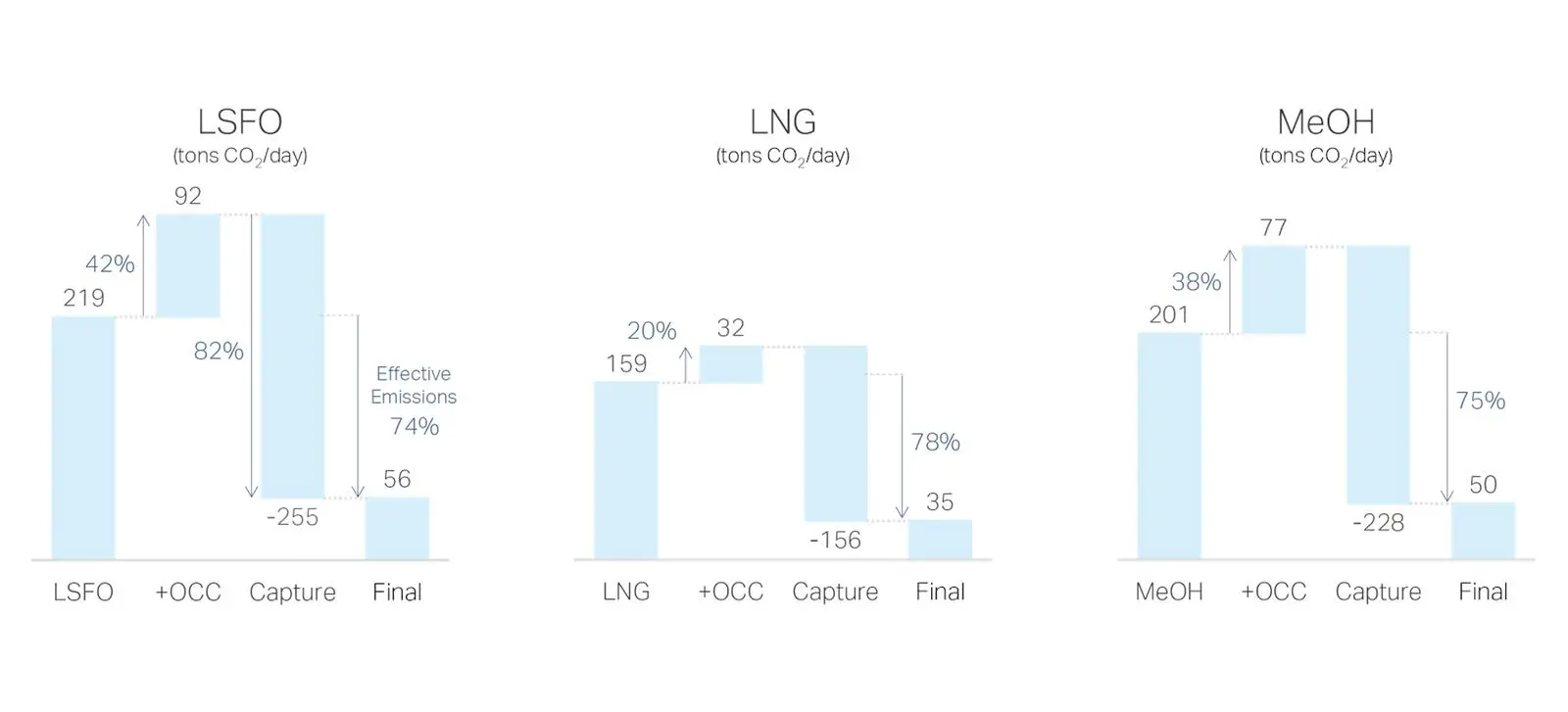
For a VLCC newbuild, the best business case studied, CO2 abatement cost ranges from $220-290/tonCO2 with a tank-to-wake effective CO2 emission reduction of 74-78%. The VLCC’s endurance was based on a Persian Gulf -Japan round trip (13,400nm, 41days) at a speed of 14.5 knots. For the LSFO fuel type, the OCC system increases CO2 emissions by 42% due to the additional energy demand. In the case of LSFO version and maximum carbon capture, about 55% of the additional energy is required for electricity (for circulation pump, liquefaction, etc.) and another 45% for steam (for separation of CO2). With an 82% capture rate, the effective emission reduction compared to the base ship CO2 emissions is 74%, which is like the methanol version at 75% effective emission reduction. The LNG-fuelled version can achieve 78% effective emission reduction due to a lower baseline CO2 emissions and lower additional energy requirements.
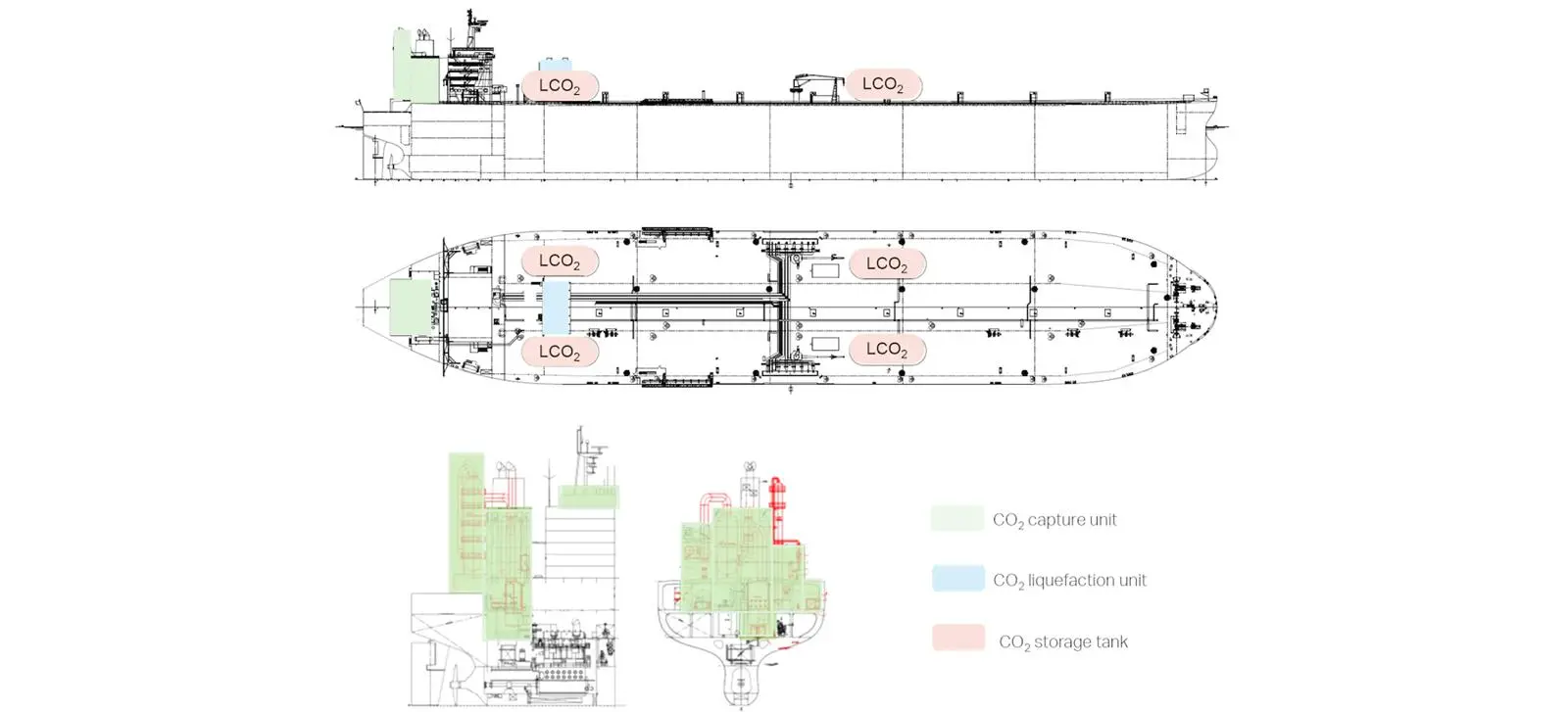
For the VLCC, there is no cargo volume loss, as CO2 tanks can be installed on the deck. To minimize impact on longitudinal strength, two tanks can be located on the forward part of the deck. However, the lightweight increase leads to a deadweight decrease of 3-4% (2,800-3,600 tons). There is a small impact on the vessel’s bending moment that can be mitigated by adjusting loading conditions without strengthening the hull structure. As the CO2 storage tanks are placed on deck, the bridge height needs to be increased 4-5 meters.
An 82,000 DWT bulk carrier has less space for the OCC unit and integration is more challenging. It was difficult to arrange allowing for the main engine part even for 50% performance case. Therefore, one cargo hold was used for the CO2 tanks.
Based on the case studies completed, the report concluded that:
- OCC with chemical absorption is technically feasible and expected to reach commercial availability by 2030,
- Additional OCC energy requirements lead to higher total fuel consumption (up to a 45% increase),
- Potential application of OCC shows the most promise for newbuilds as retrofits are costly and can require major modifications,
- Partial carbon capture typically leads to higher CO2 abatement costs due to high initial CAPEX, and
- OCC on large tankers has the best business cases while small bulk carriers have the most challenges.
The report concludes that although the emissions reduction potential of OCC is significant, currently its CO2 abatement costs are high. Still, with further development OCC could play a role in the mid-term to reduce the emission intensity of existing fossil-fuelled vessels. Further analyses and developments are required to maximize OCC emission reduction and minimize costs, as well as developing business models that would allow utilisation or storage of the carbon captured onboard vessels.
As a continuation of this work, the Center has initiated an onboard carbon capture working group to study additional OCC technologies, applications, and business models.
The report is available here.
Related Articles
 CARBON CAPTURE
 CARBON CAPTURE
 ALTERNATIVE FUELS & LUBRICANTS