



RESILIENT DUTCH PLAY TO STRENGTHS
Innovative inland waterway vessel design and propulsion solutions, and a reinforced competitiveness in mega-yacht production, have also yielded fresh business.
However, heavy losses and severe financial difficulties experienced by some of the sector’s leading names, coupled with the intensification of the Oriental challenge for an ever-widening range of vessels and related systems, have focused minds even more sharply on strategies.
Divergent views have accordingly been expressed within the national maritime cluster as to the future direction for Dutch yards.
Some consider that the emphasis should be placed on the value-adding, specialised equipment and technological elements, making increased recourse to the practice of subcontracting hulls to low wage cost countries. Others contend that maintaining the full shipbuilding capability provides the real basis for vessel quality, industry knowledge, skills and innovation, such that increased endeavours should be applied to raising efficiency and design performance in fields of construction, typically in the under 12,000dwt category, in which the Dutch are expert.
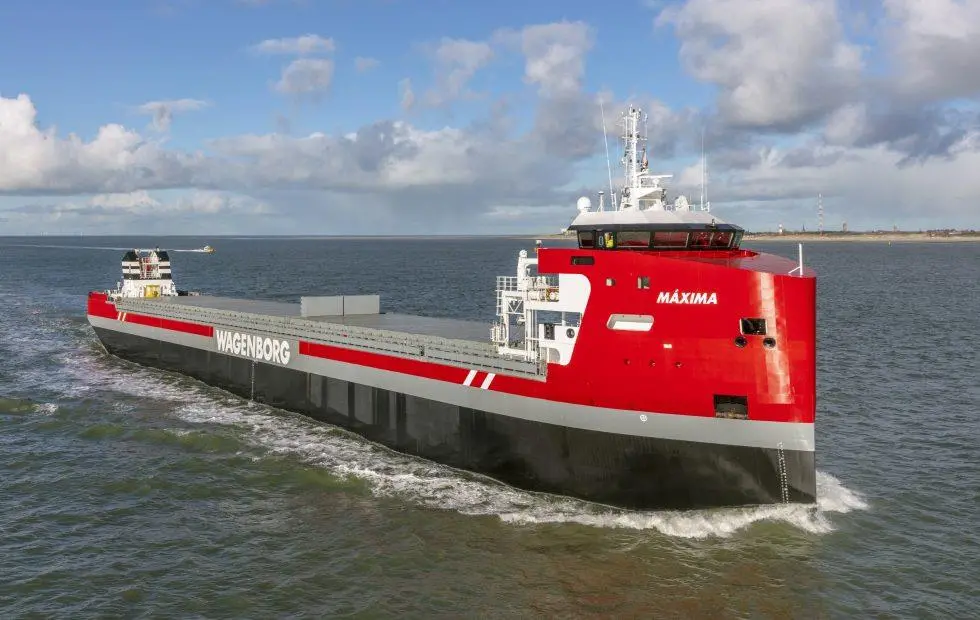
The EasyMax concept of multi-purpose cargo carrier exemplifies the spirit and comprehensive capabilities of the north Netherlands’ maritime industry, blending innovation with pragmatism in the design, construction and equipping of the smaller classes of vessel. The 14,300dwt first-of-class Egbert Wagenborg had set a new record four years ago as the largest ship ever built on the landward side of the sea dyke, within the inland waterway network, giving form to contractual owner Wagenborg Shipping’s principle of “easy to build, easy to operate, easy to load”.
That blueprint has been taken up for a second time and brought to bear as the Maxima, commissioned into the Wagenborg fleet from Royal Niestern Sander in February 2021. Maxima applies all the efficiency and versatility attributes of the lead vessel to the north European short-sea business, and potentially also to North Atlantic trade, with the added distinction of recent certification to CSI 3 standard under the Clean Shipping Index.
The index is an in-depth and holistic labelling system for assessing a vessel’s environmental performance, and for assisting cargo interests in identifying and choosing more ‘sustainable’ shipping alternatives and carriers, and can also serve as a practical tool for differentiating port and fairway dues. For shipping companies prepared to make the requisite commitment, it engenders competitive economic advantage. The CSI ranks vessels on ‘green’ credentials beyond regulatory compliance.
Salient to the grading, fixtures for the new ship have include deliveries of woodchips to HOFOR’s Amagervaerket combined heat and power (CHP) plant in Copenhagen, which is a player in the city’s aims to be CO2-neutral by 2025.
With an installed power just shy of 3,000kW and an aerodynamic hull shape, the 625,000ft3-capacity, 150m Maxima has an extremely low fuel consumption, resulting in over 60% savings in CO2 emissions compared to her peer group.
While shipbuilding contractor Royal Niestern Sander has a long track record in producing optimised tonnage both for short-sea specialists and also the ocean-going, ‘polyvalent’ cargo ship sector, the company has continued to seek business opportunities across a broader sphere, to ensure production continuity and value creation. A current case in point is the repowering and rebuilding of a 79m German ferry with LNG dual-fuel machinery.
The project, backed by public funds from German and EU coffers, plays to Royal Niestern Sander’s dual strengths in shipbuilding and shiprepair. After drydocking, the aft part of the vessel was removed and replaced by a newly constructed stern, incorporating the dual-fuel plant, LNG storage and propulsion system. Following conversion, the Munsterland will emit considerably less CO2 and will be subject to lower hull resistance due to the new shape of the stern, requiring less engine power than before for the equivalent speed.
Also in hand is the construction of a shallow draught, icebreaking ‘walk-to-work’ offshore service vessel, specially designed for year-round operation in the challenging Russian Far East conditions on the east coast of Sakhalin in temperatures as low as minus 30degC. Claimed to be the first of its type worldwide, the newbuild incorporates technology proven in Wagenborg icebreaking support ships, with ice-milling, pulling-type azimuthing main thrusters, and the capability to break through level ice up to 100cm thick.
The vessel will undertake crew transfer services for up to 40 persons at a time from the draught-restricted Nabil Port to offshore platforms, deploying a motion-compensated gangway for transfers.
Builders who have augmented their dry cargo vessel workload so far this year include Royal Bodewes, with seven 6,600dwt coasters booked by Arklow Shipping of Ireland and two 5,000dwt self-dischargers ordered by Norwegian owner Hagland Shipping. VEKA’s Bijlsma Shipyard at Lemmer secured a pair of Bijlsma Trader-series multipurpose cargo vessels for Groningen-based Longship. Ferus Smit, whose prolific headquarters yard is sited on the Winschoterdiep near Groningen, assigned a new contract from Symphony Shipping for two 12,500dwt geared cargo carriers to its German subsidiary at Leer.
Notwithstanding a net loss of EUR 161.5 million (US$196.5m) in 2020, following the EUR 287 million (US$349m) deficit the year before, Damen Shipyards maintains that its financial position is solid, backed by strong growth in the orderbook value to a record EUR 8 billion (US$9.7bn) at the end of last year. The figure is almost double the EUR 3.7 billion (US$4.5bn) at the end of 2019, buoyed by the frigate programme for the German Navy, Concordia Damen’s 40-vessel contract for inland tankers, and a deal entailing the design and construction of the largest-ever Dutch-built mega-yacht, of 120m length.
The group operates 36 shipbuilding and repair yards worldwide, and constitutes a vital part of the Dutch maritime cluster. The trademark production of standardised designs of small vessels and craft has been increasingly complemented by technology-intensive one-off newbuilds and specialised batch output, and the overall, prolific global output year-on-year is reflected in 2020’s delivery of 143 newbuilds. Processes and systems honed in the Netherlands have provided the template for the continuing expansion of shipyard activities and influence overseas.
Damen has this year implemented measures to develop its scope in providing clients with comprehensive financial packages. The creation of a dedicated Financial Services division has been attended by new initiatives in ship leasing, including solutions covering ‘green’ shipping projects.
Also gathering pace is a strategy of transforming the group from a conventional shipbuilder into a digitally-connected shipbuilder, to provide cradle-to-grave vessel lifecycle service. Pivotal to such capability is the Connected Vessel Platform, known as Triton, which collects data from the multiplicity of sensors fitted on Damen-built vessels.
Information relayed to the Connected Vessel Platform includes, for instance, engine performance indicators such as power, speed (rpm), and fuel consumption, data as to fuel, lube oil and fresh water volumes on board, and other operational details. Triton renders ‘smarter’ vessels, and allows remote monitoring. Data can be used to optimise operational efficiency, make the most efficient routings and reduce both fuel consumption and emissions, as well as aid preventative maintenance. Moreover, the system feeds back into newbuild and equipment design.
Denoting a technical milestone, a 135m newbuild of 3,700dwt awarded this year to Concordia Damen is claimed to be the first hydrogen-fuelled inland waterway cargo vessel contracted to date. Ordered by Lenten Scheepvaart with the benefit of a EUR 4 million (US$4.9m) construction subsidy from the Dutch government, and due in 2024, the vessel will be equipped with a proton exchange membrane (PEM)-type fuel cell supplied by Nedstack.
A leading light globally in dredger construction, dredge and offshore technology, Royal IHC was saved from bankruptcy last year through its acquisition and recapitalisation by a consortium of investors, bankers and industry partners, with support from the Dutch government.
There had been widespread concern that the collapse of Royal IHC would have meant a loss of knowledge, expertise and business volume in the Dutch maritime cluster. A particular worry was that the group might have been sold to Chinese interests, resulting in a transfer of specialised technology from the Netherlands.
A plan has been set in train to focus the company on core activities and bring the size of the organisation in line with a more realistic revenue expectation, entailing substantial cuts in the payroll and divestment of a number of engineering businesses. Steady recovery in the dredging market since the second half of 2020 has benefited design and equipment sales, while new endeavours are being made in the offshore mining and naval defence sectors. The 2021 newbuild delivery programme features two 29,190kW rock cutter suction dredgers for the Suez Canal Authority and a 44,180kW cutter suction dredger ordered by DEME of Belgium.
After heavy losses in 2019 and 2020, Royal IHC anticipates “a slightly positive result” for the current year. In building a portfolio for the future, the company recently received approval in principle (AiP) from Bureau Veritas for the design of a hydrogen-fuelled, trailing suction hopper dredger.
Last year, trade association Netherlands Maritime Technology (NMT) called on the Dutch government to take certain steps support the industry, as an important economic generator and export earner for the country.
It recommended more funding for research, development and innovation (RDI), investments for alternative fuels, and contracts for ‘sustainable’ or ‘smart’ ships through state agencies and public operators. The body also advocated enforcement of a “global level playing field”, relative to Asian competition, through unilateral measures and improved access to finance.
Related Articles
 PROPULSION
 GENERAL NEWS
 HYDROGEN