



Revitalisation of Pacific Northwest ferry fleet
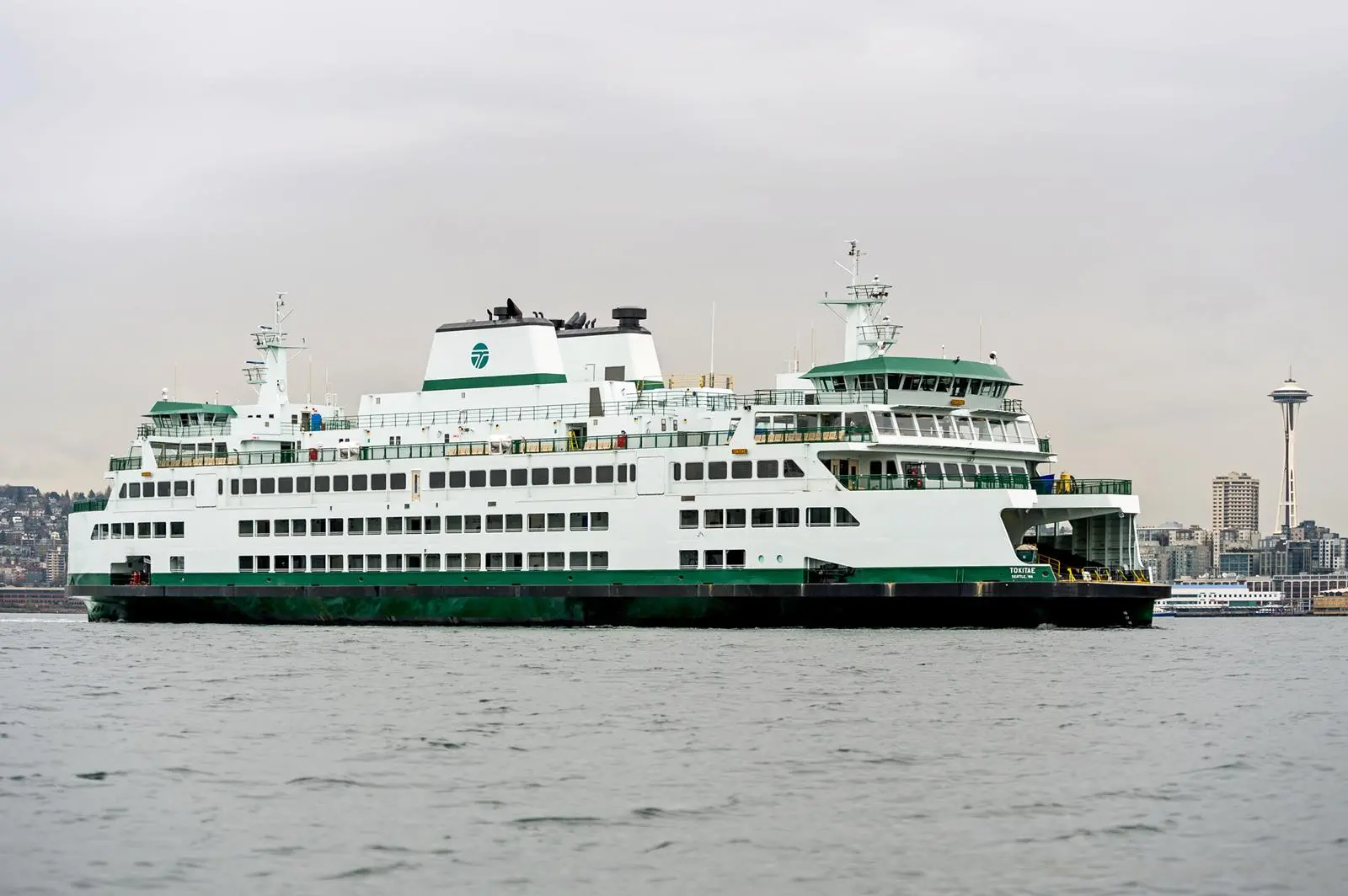
Underscoring both the infrastructural importance of the extensive ferry network in the Puget Sound region and the pressing need to update its fleet, Washington State Ferries (WSF) is ploughing US$393.5 million into a new generation of ‘double-enders’. Designated the Olympic class, the first of the trio, Tokitae, was phased into service in mid-2014, and is set to be followed in early 2015 by sistership Samish. The as yet unnamed third newbuild is expected to be ready for duty by early 2017.
Tokitae has a characteristically high-sided WSF profile, with capacity for 1,500 passengers and 144 cars, and the design concept draws on that of the Issaquah 130 class, which has proven to be the most versatile type hitherto deployed by the company.
The Issaquah 130 type dates from the start of the 1980s, and the ships were rebuilt with an increased 124-car capacity in the 1990s. While there are resemblances in profile and layout, the Olympic class embodies technologies and equipment that assure the requisite, substantial advances in efficiency, productivity and environmental compatibility. The underwater lines have been faired to raise hydrodynamic efficiency, reducing hull resistance and optimising water flow through the propellers.
The Olympic series offers enhanced operational utility, having been designed to allow deployment on most of the routes across Puget Sound and the adjoining waterways. The realisation of the project will enable WSF to put a ferry on standby so as to ensure that services can be maintained in the event of unforeseen circumstances.
The assignment of the shipbuilding project to Vigor Industrial, which purchased Todd Pacific Shipyards in 2011, has provided a major boost to ship construction and subcontracting around the shores of the Sound. Tokitae is testament to the local industry’s skills base and capabilities in specialised shipbuilding, and also to the naval architectural resource, since the design was developed by Seattle-based Guido Perla & Associates.
The superstructure was produced by Nichols Brothers Boat Builders at Freeland, on Whidbey Island, and transferred to main contractor Vigor Fab’s Seattle premises for the intricate job of mating with the hull. Vigor and Nichols Brothers had worked together before on WSF’s three Kwa-di Tabil class, 64-car ferries, delivered in 2010/2011.
The two ro-ro ends of the Tokitae were constructed by Tacoma steel fabricator Jesse Engineering, and delivered to Vigor Fab for integration with the hull. Responsibility for designing and installing lighting, electrical circuits and switchboards, interior communications and bridge electronics was assigned to Eltech, working out of its home base near Seattle’s Fishermen’s Terminal. Final outfitting of the vessel took place in Everett.
Tokitae’s total budgeted cost was put at US$144 million. The cost of the second vessel, Samish, was expected to come down to about US$126.5 million, reflecting experience gained over the course of construction of the lead ship, minimal extra engineering design, reduced contingencies, and the scale economies deriving from serial production. A further reduction is anticipated with the third-of-class, to some US$123 million.
The Olympic class will supersede the Evergreen State-class ferries originally dating from the 1950s, albeit rebuilt in the 1990s. Tokitae has been introduced to the short crossing on Possession Sound connecting Clinton, at the southern end of Whidbey Island, with Mukilteo, on the mainland near Everett. The route is among the busiest in the WSF system, with an especially important commuter role owing to the Mukilteo’s proximity to major industrial and business concerns. Second-of-class Samish has been tipped for deployment on the more northerly operation serving the San Juan Islands, but confirmation of where she will actually serve was still awaited at the time of writing.
The new breed has five continuous decks and no lower hold. The main deck is designated as the lower vehicle deck, and fixed port and starboard side ramps lead from each threshold to the upper vehicle deck. Atop this is the passenger deck, then the sun deck and the navigation bridge deck. The main or lower vehicle deck offers sufficient headroom along and around the centreline for larger vehicles, whereas the upper ro-ro deck, accommodating vehicles on the extreme port and starboard sides of the vessel, is intended mainly for cars and vans.
The bulk of the interior seating capacity for passengers is arranged on the passenger deck, while the surmounting sun deck has open walkways, port and starboard, with a mix of interior and outside seating. The safety outfit features four self-inflating marine evacuation systems (MES), supplied by Liferaft Systems Australia, affording a total offtake capacity for 800. Stowed on the passenger deck in large lockers, the MES inflate to provide slides leading into extra-large, inflatable life rafts. Two MES deploy from each side of the passenger deck. Sets of additional rafts are stowed on the sun deck.
Identical wheelhouses fore and aft house duplicate controls and are physically connected by a portable catwalk. The navigation outfit features a large suite of Furuno equipment, including four radars, a multipurpose display, automatic identification system (AIS) transponder and GPS position fixing system, and satellite compass.
The Tokitae is powered by US diesel propulsion machinery that has a considerable legacy. Driving propulsors at each end of the ferry, respective Electro-Motive Diesel (EMD) two-stroke, medium-speed engines of the 12-710G7C-T2 type, are located fore and aft of midships.
The architecture of the EMD 710 engine dates back to the first Series 567 two-cycle engines used in the US Navy’s fleet of landing ship tank (LST) vessels in World War II. Over the intervening years, the engine has undergone constant evolution, the effectiveness of which is proven by its enduring popularity with customers worldwide. The simple and robust design is well known for its responsiveness and power margin.
In the symmetric layout of the new WSF ferry class, the separately located EMD engines face in opposite directions, each driving a main shaftline and Rolls-Royce controllable pitch propeller via a Falk reduction gear of 4.986:1 ratio. The 12-cylinder 710-type engines in the Tokitae are individually rated for 2,237kW at 900rpm, making for a total power concentration of 4,474kW, or around 6,000bhp. While the cruising speed is 14 knots, an interconnecting shaft running between the transmissions allows both engines to power a single propeller to enable the vessel to make 17 knots at 80% maximum output.
Abaft the propeller at each end of the vessel, a Becker articulated high-lift rudder confers predictable response in tight quarters and low-speed manoeuvring for docking operations. Rudder control is executed by means of a Tenfjord rotary vane-type mechanism. When under way, the forward rudder is locked and the forward propeller is feathered so as to minimise resistance. At the terminal ramps, the vessel holds position by continuously applying forward propulsion power.
In the context of controllable pitch propeller installations, EMD states that the power capacity of the two-cycle engine enables it to accept virtually any pitch at any rate, without inducing engine overload. Pitting itself against the four-stroke, medium-speed engine competition, the company also emphasises the acceleration properties of the 710 design, whereby it smoothly accepts load at any engine speed. This is attributed to the firing of each cylinder once per revolution and the unique clutched turbocharger design, delivering plentiful combustion air.
Hotel power is supplied by three gensets made up of Detroit Diesel Series 60 engines with Stamford alternators rated at 300kW apiece. A fourth aggregate of the same power serves as the emergency generator.
System redundancy in the double-ender is implicit in the configuration with separate main machinery spaces. One engine room has an EMD diesel and two gensets, with adjoining ’drive side’ reduction gear room, and the other engine room houses one EMD diesel and a single genset, with the respective, adjoining reduction gear room. The engineers’ operating control station is positioned amidships between the two engine rooms.
WSF has conducted a lengthy evaluation into the possible use of LNG fuel in six of its vessels. The project would entail retrofitting the propulsion system in the Issaquah-class ferries with new engines. Pending US Coast Guard approval and the conclusion of the requisite financing, WSF could implement the first conversion in 2016.
The rationale for the scheme is both economic and environmental. In a project status report issued in July 2014, the company said that switching from diesel to LNG could save around 40-50% in fuel costs at today’s pricing. Compared with the current use of ultra-low sulphur diesel fuel, running the Issaquah ferries on LNG is predicted to reduce PM emissions by 89%, NOx by 61%, SOx by 59% and CO2 by 29%.
For its part, EMD is working on a dual fuel natural gas option as part of its strategy to develop products to meet future emission regulations. Headquartered in LaGrange, Illinois, EMD designs and manufactures diesel-electric locomotives and produces diesel engines for the marine propulsion, offshore, stationary power generation and drilling markets. As part of Progress Rail Services Corporation, it belongs to the Caterpillar Group.
WSF operates the largest ferry system in the USA, and carries some 22-23 million passengers and 10 million vehicles annually. Consecutive newbuild programmes are now bringing down the average age of a fleet attributed with impressive vessel longevity.
PRINCIPAL PARTICULARS — TOKITAE
Length oa: 110.4m
Length bp: 102.2m
Beam, extreme: 25.4m
Depth: 7.5m
Draught, scantling: 5.5m
Draught, design: 5.0m
Displacement at design load: 4,364t
Passenger capacity: 1,500
Car capacity: 144
Max engine power: 2 x 2,237kW
Speed, maximum: 17 knots
Related Articles
 PROPULSION
 GENERAL NEWS
 HYDROGEN