



Rolling Autonomy with Zero Emissions
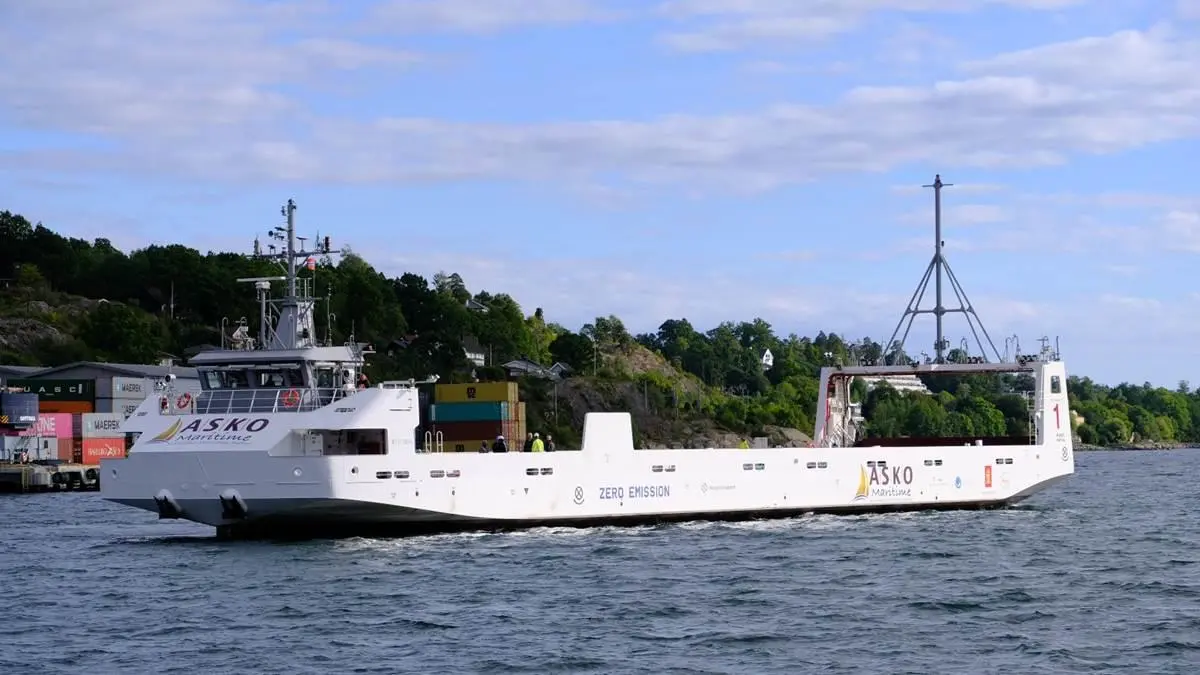
The 67m newbuilds will be deployed by ASKO Maritime to transport unaccompanied trailers and containers between Horten and Moss, as part of the parent grocery supplier group’s logistical chain. The official naming ceremony for the Marit and Therese took place at Moss this month, following delivery of the vessels by heavy-load carrier from Cochin Shipyard in India.
ASKO’s investment in waterborne transportation will considerably reduce its road miles and reliance on diesel trucks for goods movement between distribution centres and warehouses in the region, and the environmental impact of its activities will be lessened further by using battery-electric propulsion in the new shuttle carriers.
Designed by the Oslo consultancy Naval Dynamics, each has the bridge arranged forward and is laid out for 16 fully-loaded, standard EU trailers, stowed on the open deck with access over the ramp at the stern. For an initial period of up to two years, the freight ferries, variously also known as Sea Drones or AutoBarges, will be navigated and handled by an onboard crew. However, the intention is to subsequently switch over to wholly autonomous operation, utilising technology onboard and ashore provided by Kongsberg Maritime.
In each case, the main propulsion system consists of a single, 500kW Schottel EcoPeller, driven by an electric motor, fed from a battery bank with 1,846kWh capacity. Transits will be made at some eight to 10 knots, and mooring alongside and recharging will be effected automatically.
The SRE-type EcoPeller offers proven performance in generating maximum steering forces, benefiting both fuel efficiency and course stability. An electrically-powered Schottel PumpJet unit of 200kW is fitted at the bow, to serve not only as manoeuvring thruster and but also as take-home propulsion device.
Management of the Marit and Therese has been entrusted to Massterly, the joint venture between Kongsberg and the shipping company Wilhelmsen set up several years ago with the specific aim of undertaking the technical management and running of autonomous vessels.
Kongsberg Maritime has developed and supplied the systems for continuously unmanned vessel operation as defined by the Norwegian Maritime Authority, meaning that control must remain with a master relocated to the Remote Operations Centre(ROC) at Massterly’s headquarters in Lysaker, near Oslo. Connectivity between vessels and ROC has accordingly been a fundamental consideration, necessitating first-rate broadband coverage and equipment plus redundant systems.
Kongsberg Digital has also been involved in the project, implementing a hydrodynamic and visual simulator model to test and verify sailing routes across Oslo Fjord westward and eastward in various environmental and traffic conditions.
Once the autonomous concept has been proven, the bridge structure will be omitted in future newbuilds. ASKO Maritime holds options on third and fourth vessels of the class from Cochin Shipyard.
Related Articles
 ENERGY SAVING DEVICES
 LNG
LNG
 ALTERNATIVE FUELS & LUBRICANTS