



Rolls-Royce introduces new mtu propulsion solutions
The company is working on methanol engines and fuel cell systems for marine use, and marine diesel propulsion systems will gradually be released for sustainable fuels.
Methanol
Rolls-Royce Power Systems is initially developing methanol engines based on the mtu Series 4000 and will launch them on the market from 2026. The energy density of this fuel is high compared to other sustainable fuels, and its liquid state makes it easy to store and refuel at ambient temperatures. In addition to reduced complexity, the more attractive investment costs are another advantage of the methanol tank system.
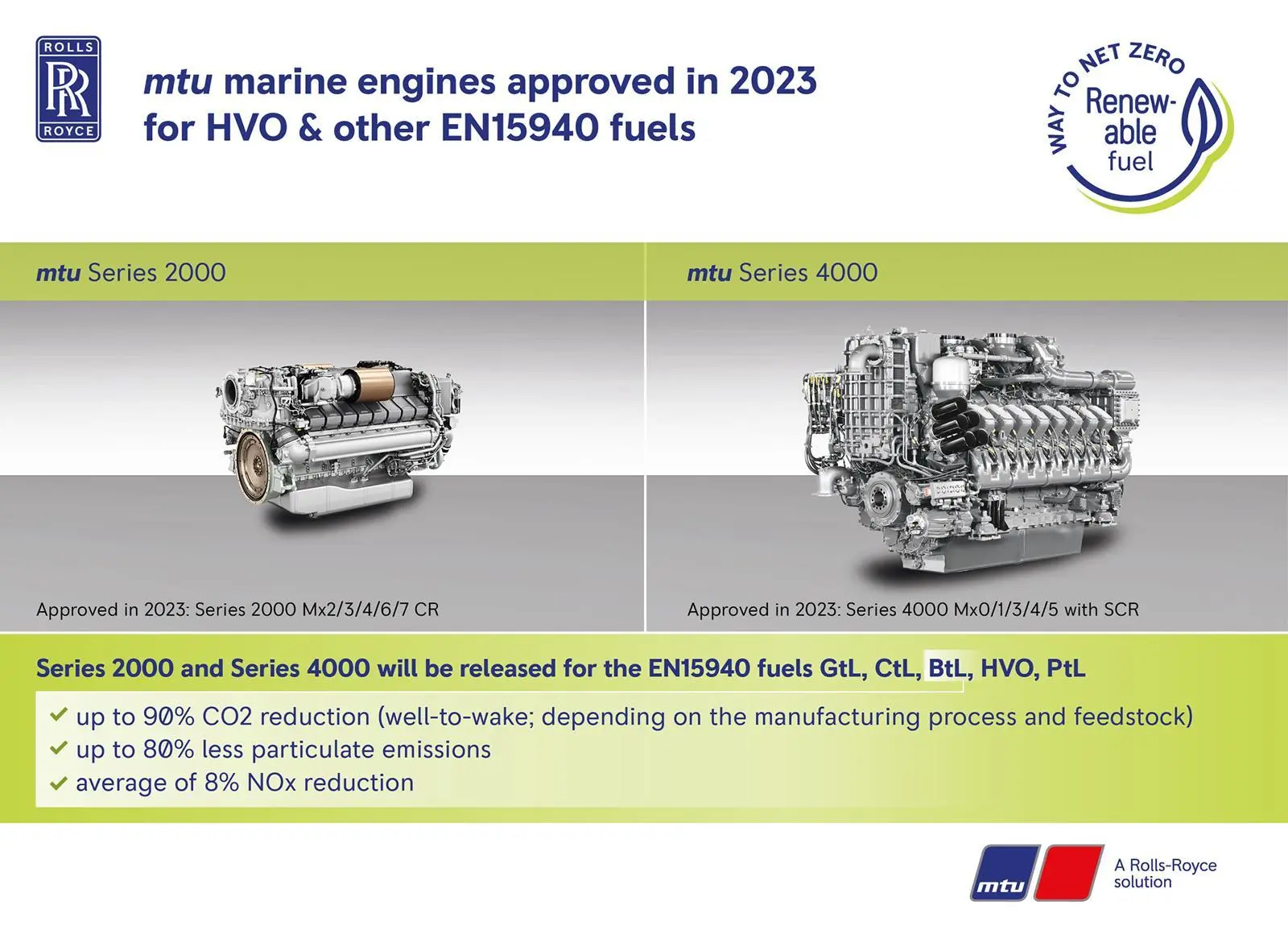
Following successful bench and field tests, the Rolls-Royce business unit Power Systems will gradually be approving its Series 2000 and Series 4000 mtu marine engines for EN15940 synthetic diesel fuels from the beginning of 2023.
These fuels include the sustainable fuels BtL (Biomass to Liquid), HVO (Hydrotreated Vegetable Oil/renewable diesel) and PtL (Power to Liquid) such as e-diesel. They can all replace conventional diesel fuel, which is made from fossil petroleum, without any adjustments in these engines. Last year Rolls-Royce pledged to prove that the Series 2000 and Series 4000, its most popular in-production engines, can be used with sustainable fuels. Rolls-Royce has already developed the mtu 2000 and 4000 series for IMO III.
Fuel Cells
Rolls-Royce Power Systems is already working on the development of fuel cell systems for marine applications and will launch its own mtu fuel cell systems for main propulsion and onboard power generation from 2028. Fuel cells powered by green methanol emit only small amounts of CO2 due to the required methanol reformer, but no more than was previously bound in the e-methanol and are thus operated in a CO2-neutral manner. Their low noise emissions and vibrations and their very high efficiency (approximately 50 – 60%) are considered further advantages for shipping. Due to its physical properties, the introduction of hydrogen as a fuel for ships still poses some challenges, for example with regard to infrastructure and on-board bunkering, says Rolls-Royce.
The mtu Hybrid portfolio offers flexible propulsion solutions for yachts, ferries, tugs and windfarm vessels. The system intelligently combines diesel engines with electric propulsion modules, batteries, gearboxes, control and monitoring systems and other electronic components to provide speed, comfort, efficiency and local emission-free cruising as required. The mtu Hybrid PropulsionPack is offered in a power range from 1,119 kW to 4,300 kW by the diesel engines plus 165 kW to 743 kW by the electric motors per powertrain. The maximum propulsion power is 10,000 kW per vessel. To ensure the optimum propulsion solution for each type of ship, Rolls-Royce offers a modular kit with standardized components.
IMO Tier III
Rolls-Royce is further developing its proven large marine engines of the mtu 1163 and 8000 series to comply with the IMO Tier III emissions directive. From 2025, the engines are to be available in all cylinder variants – 16 and 20V respectively – in the power range between 4,800 and 10,000 KW. They will allow entry into Emission Controlled Areas (ECA).
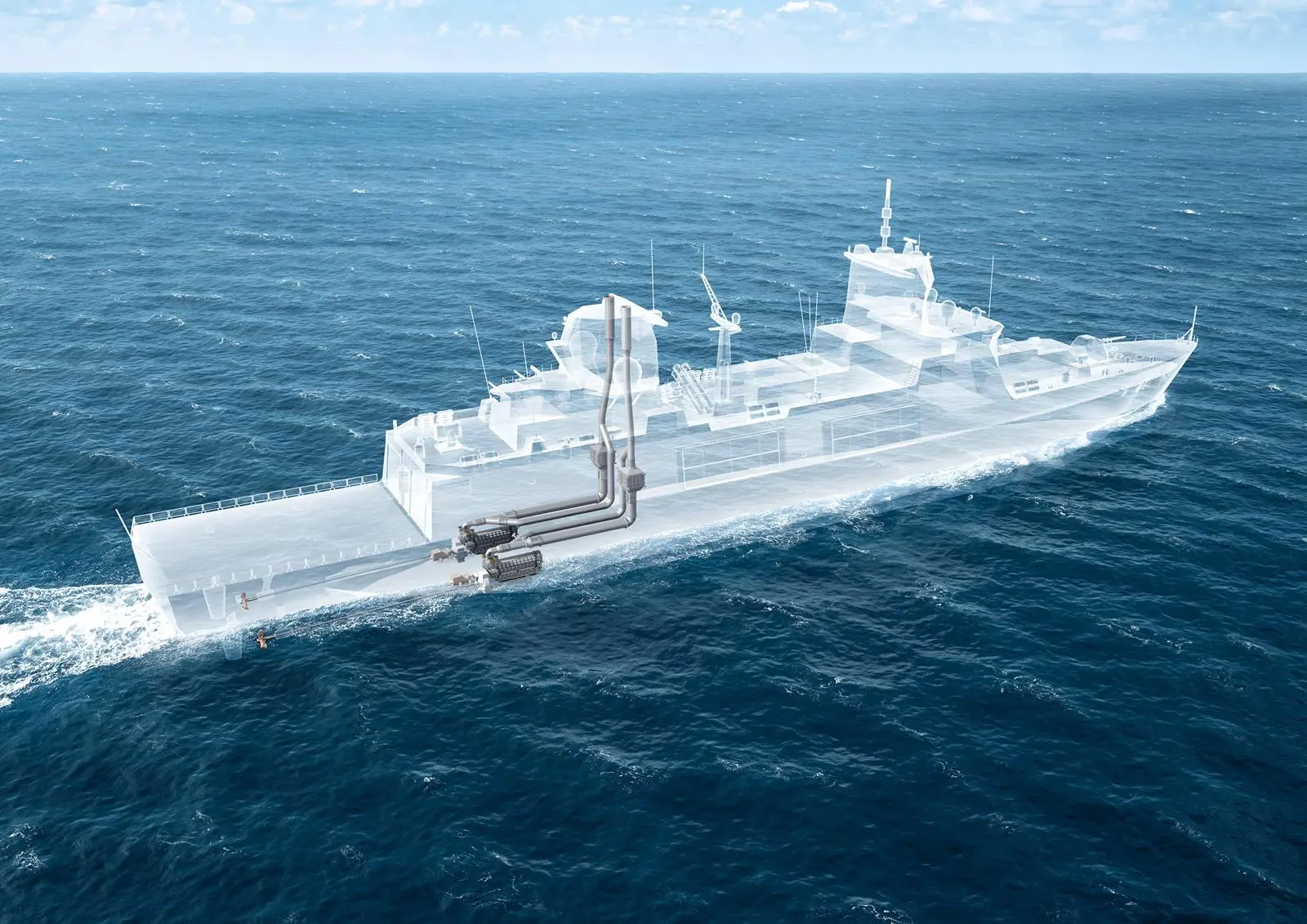
Rolls-Royce is developing the necessary exhaust gas aftertreatment with SCR system itself in order to be able to adapt it precisely to mtu engines and customer requirements. The company is also aiming to become an IMO emissions certificate holder which would significantly reduce the workload for shipyard customers. The engines are to be approved for operation with sustainable fuels (EN15940, e.g. HVO) in the course of 2025.
In developing the new engine variants, Rolls-Royce pays particular attention to maintaining a maximum of common parts to the current versions in order to simplify maintenance and logistics. The electronics of all new engines are brought up to date. The most important change compared to the previous engines for IMO II is the new exhaust gas aftrtreatment, the core component of which is an SCR system in which nitrogen oxide emissions are reduced by 75% compared to the IMO II limits. It is a closed system in which the emissions upstream and downstream of the SCR system are continuously measured. The system can be installed both horizontally and vertically and can thus be adapted to a wide variety of ship designs and layouts.
Rolls-Royce announced in 2021, as part of its sustainability program, that it would realign its product portfolio so that by 2030, new fuels and mtu technologies can save 35 percent greenhouse gas emissions compared to 2019.
Related Articles
 2-STROKE & 4-STROKE
 2-STROKE & 4-STROKE
 2-STROKE & 4-STROKE