



ROMANIAN YARD READIES UK CARGO DREDGER
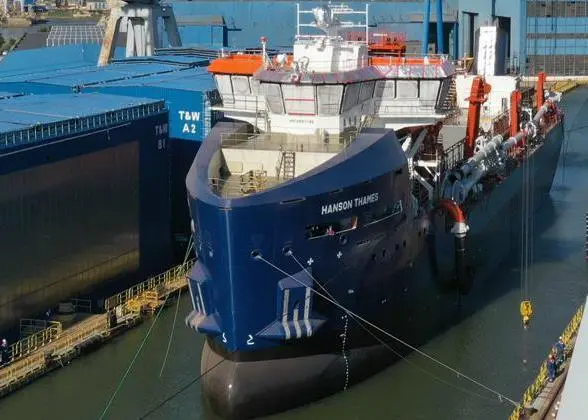
Set to join Southampton-based Hanson Marine next March, the 103m Hanson Thames blends high payload capacity with improved fuel consumption, reduced environmental impact and maintenance savings.
The state-of-the-art vessel represents the first newbuild investment in the fleet for 30 years, going back to the time when Hanson’s sea-dredged aggregates business was under the aegis of ARC Marine.
She will be used to extract aggregates in the English Channel and southern North Sea, using a dredge pump powered by a 1,400kW permanent-magnet electric motor with the capability to draw material from depths of up to 55m. Up to 6,800 tonnes of cargo will be transported on each trip from the licensed grounds offshore to coastal and river terminals in the UK and on the near-Continent.
Embodying Damen’s MAD (Marine Aggregate Dredge) 3500 design, a key criterion has been to ensure operational continuity and habitability under the heavy weather conditions regularly experienced off UK shores. A distinctive feature is the high enclosed bow, affording protection to deck equipment and crew, while the engineering of the equipment-intensive coastal ship addresses the fundamental, competitive importance of minimal downtime.
Shipbuilding contractor Damen Shipyards Group assigned construction to its Romanian subsidiary at Galati, from where Hanson Thames was launched in September. The Galati yard is one of the largest and most prolific production units in the Dutch company’s extensive international network.
The dredging outfit and screening plant was manufactured at Nijkerk in the Netherlands by the group’s affiliated specialist company Damen Dredging Equipment (DDE) and shipped via the port of Rotterdam to Galati.
The screening process is vital to controlling the required grain size of a hopper load. The installation in Damen’s MAD concept denotes a departure from conventional arrangements, with the aim of achieving improved loading efficiency, reduced maintenance, and lessened environmental disturbance.
Since all components in contact with aggregates suffer high rates of wear and tear, the new installation has been designed to offer greater durability through flow direction optimisation, selective wall thicknesses, and use of rubber linings for areas and components such as the loading chutes. In addition, the modular nature of certain elements facilitates rapid disassembly and exchange, a case in point being the claimed 15-minute dismounting time for the screening decks.
In addition, a substantially increased screening surface has been adopted so as to improve the quality of the material taken as cargo and reduce loading time. Furthermore, rejected spoil is no longer discharged over the side, but passed through the hull bottom, thereby reducing the plume characteristically created by a suction hopper dredger working offshore. The dry unloading system is also of Dutch origin, having been built by PLM Cranes.
Hanson Thames is fitted with two medium-speed engines of the Wartsila 26-series, and the preparation of the machinery for use with selective catalytic reduction (SCR) technology will secure IMO Tier III compliance as regards NOx emissions. For the intensive running profile that typifies the trade, the ship can will be required to make fully-laden passages from the dredging grounds to port at 12 knots, propulsive effect being delivered by twin Wartsila controllable pitch screws.
The well-proven 260mm-bore diesel ranks as the shortest and lowest engine in its class, and yields 340kW per cylinder at 1,000rpm and 24 bar mean effective pressure at maximum continuous output.
The enginei electronic fuel monitoring solution devised by UK firm Royston Diesel Power has been specified for Hanson Thames as part of a comprehensive suite of digital technologies. Functional integration of advanced, real-time information tools is expected to contribute to reduced fuel and maintenance costs. Towards this objective, the enginei system will provide the crew and shipowner with detailed, real-time engine performance data and other mission critical information.
Enginei uses Coriolis flow meters and sensors to accurately gauge engine fuel consumption, tracked against GPS data, voyage details and operational mode. The information is collected, processed, and relayed to bridge- and engine room-mounted touchscreen displays to enable the master and officers to adjust vessel speed and take actions to reduce fuel usage and emissions.
During sea trials, Royston will commission its Eco Speed software, devised to assist crew in identifying optimum vessel speeds for efficient fuel consumption across different operational modes. Eco Speed promises to be especially effective in transits to and from the dredging areas.
Hanson Marine currently supplies between 4.5m and 5m tonnes of aggregate per year to the UK, France and Belgium. The dredged sand and gravel is primarily used by the construction industry, including for ready-mixed concrete and concrete block making. Moreover, beach nourishment campaigns are fed from its licensed offshore grounds using third-party vessels that can pump ashore or ‘rainbow’ across the bow.
In 2017, Hanson had ordered two diesel-electric newbuilds from Barkmeijer Stroobos in the northern Netherlands, but the contracts were cancelled the following year as the Dutch yard descended into bankruptcy. Barkmeijer was subsequently restarted by Thecla Bodewes, which re-sold the first of the ships that had been intended for Hanson to a Dutch aggregates supplier, De Hoop Terneuzen. It is understood that the second newbuild exists as sections, and remains unsold.
Related Articles
 PROPULSION
 GENERAL NEWS
 HYDROGEN