



Rotterdam enumerates its hydrogen supply ambitions
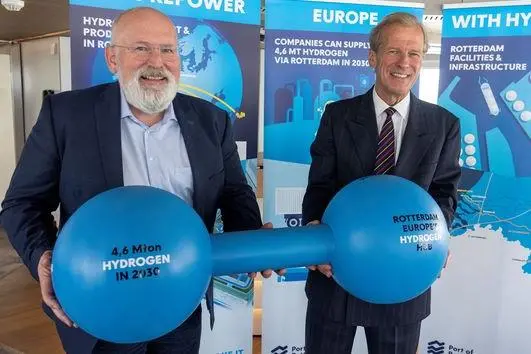
This figure is based on specific projects being worked on and realistic plans. It would result in a reduction of 46 million tonnes of CO2 emissions.
Several companies are working on concrete projects aimed at launching large-scale production of electrolytic hydrogen powered by North Sea wind power between 2024 and 2026. Together, all of the projects and plans would be good for 2.5 GW of electrolysis by 2030 and produce 0.25 Mt of green hydrogen. A project to produce low-carbon hydrogen from refinery gas is also underway. This would mean a total of 0.6 Mt of hydrogen could be produced locally by 2030.
According to the 70 parties, two preconditions are crucial to get this hydrogen economy underway. The first is hydrogen certification: green hydrogen imported from outside Europe has to be certified as green in Europe. Secondly, the financial gap between the use of renewable and low carbon hydrogen and its derivatives needs to be closed compared to their current CO2-emitting alternatives. As long as energy made from fossil fuels is cheaper than sustainably produced energy, the latter will not get the momentum required for achieving the European objectives.
The Authority notes that countries all over the world are preparing for new energy flows. Hydrogen made in Latin America or Australia, for instance, can be shipped to Rotterdam efficiently and on a large scale, processed and then be transported to the hinterland.
Included in the 70 companies are: Abu Dhabi Ports, Administración de los Puertos de Sines e del Algarve, AES Brasil, Air Liquide, Air Products, Aker Clean Hydrogen, Algeciras Port, Aramco, BP, CEPSA, Chariot, Chemelot, Covestro, Duisport, E.ON, Empresas Gasco, Eneco, Engie, Essent, Fisterra Energy, Fjarðabyggð Municipality, Gasunie, Global Energy Storage (GES), H2 Energy, HES, Horisont Energi, HTS group (RH2INE), Hüttenwerke Krupp Mannesmann (HKM), HyCC, Hychico, Hynewgen, Koole Terminals, Linde Gas, Maasvlakte Olie Terminal (MOT), Minenergia la Nueva Energia, Ministerio de Industria, Energia y Mineria, nceda, Net Zero Technology Centre, Nobian, Northland Power, OCI, Pecém Port, Port de Baie-Comeau, Port of A Coruña, Port of Cromarty Firth, Port Saint John, ProChile, Proton Ventures, PTC (RH2INE), Republic of Namibia, RH2INE, Rotterdam The Hague Airport, Rotterdam the Hague Innovation Airport, Rotterdam-Rijn Pijpleiding, RWE, Sasol, Shell, Source3 Energy, South Australian Department For Energy and Mining, STEAG GmbH, Tarafert, The Austria Energy Group, Theo Pouw (RH2INE), Thyssenkrupp, Trafigura, Uniper, Vopak, VTTI, Westenergie, City of Rotterdam, Provincie Zuid-Holland, and Port of Rotterdam.
Ports of Duisburg and Rotterdam intensify cooperation
Earlier this week, the port authorities of Rotterdam and Duisburg signed a Letter of Intent (LOI) to renew and expand their cooperation agreements to include initiatives relating to the energy transition. The LOI also includes plans investigate whether the ports can jointly take on the development of hydrogen hubs. Rotterdam as the future ‘hydrogen gateway’ to Europe and Duisport as the hub for Germany. Setting up a physical link between the two is therefore an obvious choice.
Related Articles
 ALTERNATIVE FUELS & LUBRICANTS
 ALTERNATIVE FUELS & LUBRICANTS
 ALTERNATIVE FUELS & LUBRICANTS