



Russia advances icebreaker strategy
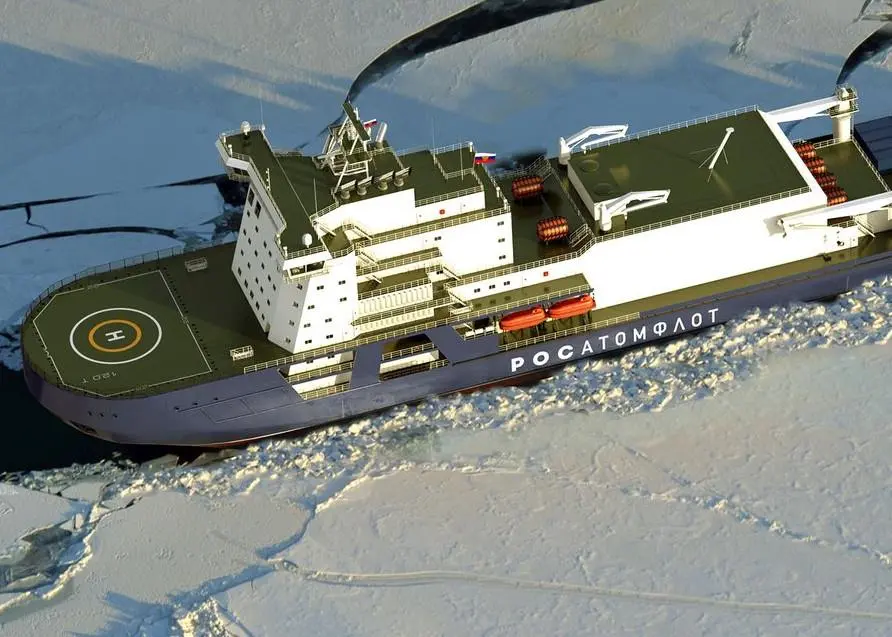
Presaging major investment in a new flotilla of LNG-fuelled icebreakers, Aker Arctic Technology of Finland has been contracted by Rosatomflot to undertake design work and model testing for a powerful class of line icebreaker to cover western areas of the NSR.
The vessel will have a 40MW power and propulsion installation, using dual-fuel prime movers, and will be deployed for year-round escort duties with commercial shipping primarily in the Kara Sea, Gulf of Ob and Yenisey River.
Rosatomflot, a division of the Rosatom State Atomic Energy Corporation, is contemplating a series of such newbuilds. These will replace ageing, nuclear-powered, shallow-draught icebreakers, and will provide coverage for increasing shipping activity associated with surging Russian Arctic energy export shipments. Rising usage of the NSR by international shipping for voyages between eastern Asia and northern Europe is also a driver of icebreaker investment strategy.
A key area of Aker Arctic’s technical investigations that will influence the final design will be icebreaker performance during escort assignments with the Yamalmax generation of LNG carriers, the largest gas tankers trading out of the Russian Arctic.
It is understood that the ARC 123 design forms the basis for the icebreaker evaluations. Main hull dimensions will be about 160m x 30m, and form, strength, power and propulsion will be determined by the requirement to ensure navigation through 2.5m-thick multi-year ice.
A logistical advantage of adopting a dual-fuel powering solution is the ready availability of LNG in the intended operating area, obtainable from the Sabetta terminal on the Yamal peninsula. The icebreaker would have an LNG fuel storage capacity sufficient for up to 30 days’ operation in the prevailing ice conditions. Autonomy in terms of endurance on LNG in such a harsh environment and remote region has been a key consideration.
Compared to previous LNG-fuelled icebreakers, Aker Arctic describes the nascent 40MW type as “a huge leap forward”. According to the company’s project manager Mika Hovilainen, “The new vessel design will have the same capabilities that could previously only be achieved with nuclear-powered icebreakers”. The power concentration will be in excess of that of the nuclear turbo-electric sisters Taymyr and Vaygach, delivered from Finland in 1988 and 1989, respectively.
Cargo volume on the NSR, currently amounting to around 10m tonnes per annum, is expected to rise steeply after 2020, buoyed by LNG and other energy exports. Modernisation of the icebreaker fleet is of vital economic and infrastructural significance, as three of the current nuclear vessels are due to be decommissioned between 2022 and 2026.
The renewal process is already under way, with three nuclear-powered, Arktika-class newbuilds due to be phased into service over a two-year period from mid 2019 to 2021. Further development and expansion is represented by plans for fourth and fifth Arktika-type vessels, and for up to five LNG-fuelled line icebreakers based on the concept now being drawn up by Aker Arctic.
Year-round navigation of the still more challenging eastern section of the NSR will require an even larger and more potent design, for which technical work has been in hand for a year or so. Constituting the Project 10510 initiative, and otherwise known as the Leader-type, these future behemoths of the Arctic escort fleet are foreseen for introduction from 2027 onwards.
Related Articles
 PROPULSION
 GENERAL NEWS
 HYDROGEN