



Sales of new electronic logbook to begin in October
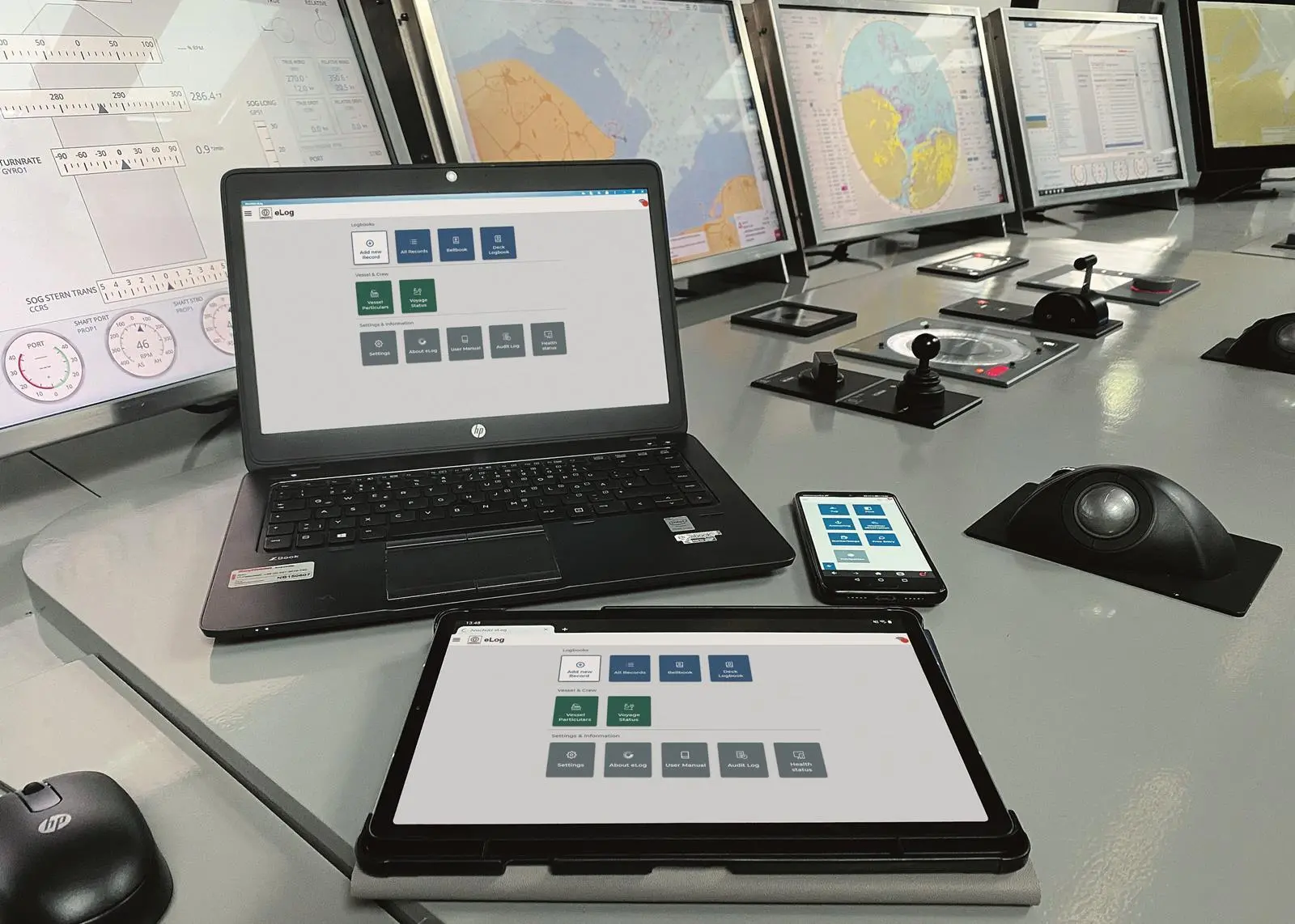
The development represents a significant step toward paperless shipping and improved efficiency of onboard processes, the company claims.
Featuring automatic data entry from navigation systems, such as the AIS or INS, at defined intervals, eLog also enables data input by crews via laptop or mobile devices, including approval workflows.
“Incomplete, incorrect or illegible logbooks are a thing of the past,” said Björn Schröder, product manager at Raytheon Anschütz. “We’ve innovated eLog to offer transparent and reliable documentation, based on the actual sensor data and plausibility checks.”
The eLog also uses blockchain technology to ensure secure, tamperproof digital archiving of data. The hardware requirements are minimal: the system’s small gateway computer simply requires a connection to AIS or INS to enable the automatic data entries, while a web browser application is needed for manual data inputs and data access,
Another advantage is that the eLog has a data interface to the cloud. “Taking traditional logbook data and making it digitally usable is often difficult and inefficient or even impossible,” Schröder said. “With the eLog, customers can access the data in real time through a generic, modern web interface from anywhere in the world. And it’s secure, because they can’t alter data.”
Supporting all traditional logbook entries, eLog is recognized as a full equivalent to a traditional logbook by several international leading flag states, including Germany.
In this first version, the eLog covers the deck logbook, the bell book and the noon report. Future extensions of the scope and use with further reports are already in planning.
“The eLog eliminates the cost and effort of paper logbook logistics, and it is a relief for the crew in stressful situations,” Schröder said. “It comes at low initial cost for setup and is then available under an annual subscription service. And it is manufacturer-independent, so that every customer can actually benefit.”
The eLog is type-approved under the ISO standard 21745:2019 ‘electronic record books for ships.’ Start of sales is expected for the end of October 2021.
Related Articles
 ENERGY SAVING DEVICES
 LNG
LNG
 ALTERNATIVE FUELS & LUBRICANTS