



Scrubber work highlights early 2016 activity
Two yards had major ship scrubber work to report. Pella Sietas Werft in Hamburg was expecting the 28,000dwt self-loading bulker Sandnes in early February, the yard’s Fridtjof Rohde told The Motorship. It is the last and smallest of four ships retro-fitted for HJH Ship Management since last year. Fridtjof said the two-week job involved the integration of 90 tons of piping, components and steelworks.
In December Pella Sietas delivered the 33,000dwt Bulknes and said that work had been finished a day and a half inside the scheduled two weeks. Bulknes, along with sisters Beltnes and Fitnes before it, were retro-fitted with single outlet Alfa Laval PureSOx hybrid scrubber systems. All the ships have MAK 8 M 43 engines and CAT auxiliaries and the retrofits are the first for Pella Sietas.
Alfa Laval said that regardless of whether open-loop, closed-loop or hybrid scrubbers are chosen, fuel cost savings with PureSOx were substantial. That apparently played a role for HJH which was quoted as saying operational costs were the main reason for the installations.
German Dry Docks (GDD) in Bremerhaven was also tackling new scrubber work in February – on two container feeder ships – after installing scrubbers last year and in 2014 on a series of 17,400 Spliethoff ConRos.
The latest job involves retrofitting Alfa Laval scrubbers in the 1025teu Condor and Corsar for Buss Shipping. Condor was arriving early February and Corsar mid February and each was staying 18 days, GDD said.
Alfa installation
They were being fitted with hybrid PureSOx 2.0 systems with multiple inlets, connecting the main engine and two auxiliaries to one U-design scrubber. In contrast to earlier systems with multiple inlets, the inlets now lead into a single scrubber jet section, an advance which will make the scrubbers even more compact, the makers said.
Christoph Meier, Buss Shipping Project Manager said the PureSOx solution was “well engineered and allowed a sophisticated integration of the scrubber system into our container feeder ships” adding that “custom construction let us avoid major modifications inside the vessel, which together with the pre-outfitting gave us a short installation time. All those factors contributed to a competitive price.”
Buss Shipping MD Torben Kölln said the scrubbers will also provide “emission compliance with maximum flexibility and fuel economy”.
The engineering of the Alfa Laval systems was handled by Buss and SDC Ship Design & Consult while detailed engineering was by GDD.
Buss Shipping, which operates some 20 feederships, said it was focusing “on the sustainable modernisation of its existing fleet”, an indication that further such retrofits could be under consideration.
At the end of February GDD was also docking the 10,000dwt museum cargo ship Cap San Diego for nearly a month for class renewal. Reports said the work was costing a million Euros with Berlin putting up €400,000 and the rest coming from donations.
The 23,500gt car carrier Thames Highway called at GDD for what local media said were extensive repairs after a collision with a quay wall in the port’s Kaiserhafen. Other recent repair callers have been Marineco Stingray and Reymar.
The Motorship asked GDD Managing Director Guido Försterling about the future of repair and conversion at GDD following the sale of neighbouring former associate Lloyd Werft Bremerhaven (LWB) to Genting Hong Kong last autumn. He said GDD strategy would be to continue to use the six-dock shared facility arrangement enjoyed until now by GDD and LWB.
Försterling added that keel block heights were being raised “in record time” to more than 3.4m to facilitate the docking of offshore ships over 10m length. Retrofit and repair facilities were being extended. So too was engineering and engine competence and GDD’s international network. The aim was to “grow as a yard to support customers on a global basis” Försterling told The Motorship.
The future of repair and conversion at LWB however, long one of Germany’s major repair facilities, remained unclear as The Motorship went to press given the announced switch to newbuilding for Genting. Some ships for GDD account have continued to use LWB docks in the interim for repair, refurbishment or maintenance. But among those for LWB have been the 19,800dwt product tankers Ginaldag and Bozdag and the 28,551gt cruise ship Boudicca, drydocked for “various engineering works, general refurbishment and interior/exterior painting”.
Polar preparations
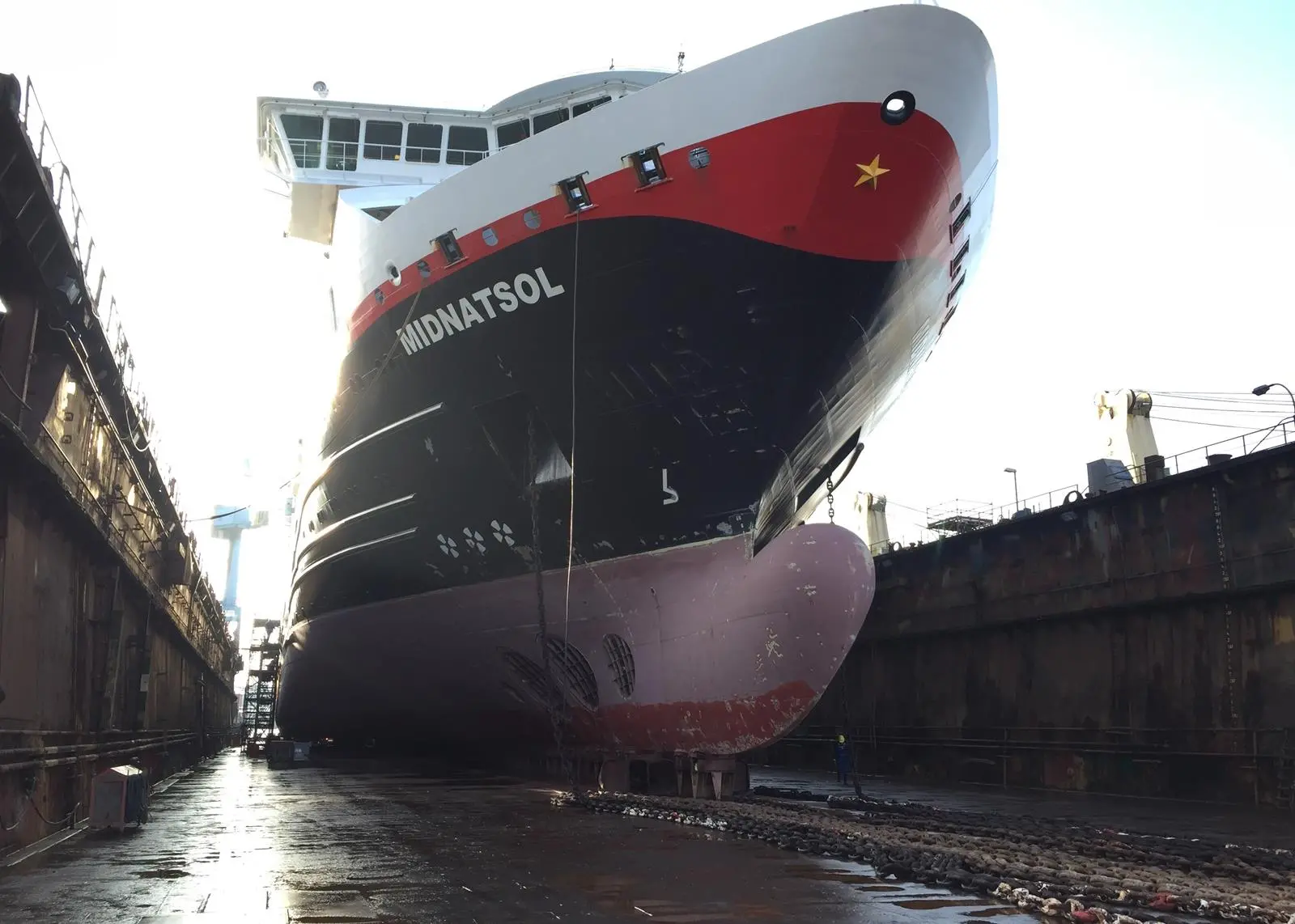
A busy Bremerhavener Dock (BREDO), now 20 years old, got the year off to a good start with what the yard’s Michael von Haefen called the “extensive conversion” of the 16,150gt Norwegian passenger ferry Midnatsol, to prepare it for Polar expedition cruises.
Two tender platforms were being installed and von Haefen said the azimuth drives were also being exchanged. A ballast water treatment plant was also being installed and waste and drinking water systems upgraded. Maintenance, class and conservation works were also on the docket for the ship’s 18 day stay, he said.
SAL’s 9,360dwt and 7,984dwt general cargo ships Grietje and Antje along with the 12,975dwt DP heavy-lifter Svenja docked for extensive overhaul, All three also underwent shaft sealing modification and class work, von Haefen reported. The 15,160dwt oil/chemical tanker Levana docked for conversion work on the Saacke LMB scrubber plant which BREDO installed in 2014.
BREDO managing director Dirk Harms told The Motorship: “We are satisfied with the order situation over the past year.” But he noted that “advance dock booking times tend to be very short these days”. In the past owners used to book three months in advance, now it was mainly just one month, he said. Yards had to be able to react flexibly, he declared.
Busy Nordic Yards echoed that. “Bookings just a month ahead or even shorter are nothing unusual”, a spokeswoman told this correspondent. “Some invitations to tender even stipulate seven days notice and there could be just a week between contract and the arrival of a ship at the yard”, she added.
The biggest ship overhauled of late has been the 18,468dwt icebreaking cargo ship Norilskiy Nickel, built by Nordic, which called at the group’s Wismar yard for class work and overhaul including its Azipod propulsion plant, hatches and cranes as well as coating.
Leaving Nordic’s Stralsund yard, the former Volkswerft, in February was Germany’s biggest SWATH ship – the 73m naval research vessel Planet. It has been there since last June for extensive class, repair and overhaul work.
Also leaving in February was the 46.3m naval oil recovery ship Bottsand. It is one of several smaller ships at the yard this New Year and typical of the specialist tonnage now giving valuable work to many German yards. Nordic told The Motorship Bottsand had been there a year after the original work scope was extended from main engines and gearing to include a range of other jobs.
Equipment maintenance work on the specialist 56m multipurpose naval auxiliary Kronsort and repair and overhaul of the 38.6m naval pollution control ship Knechtsand was due for completion by the end of March. Regular Spring maintenance work on a further 8-10 smaller vessels was upcoming, Meyer also reported.
LNG conversion pipeline
Completed in January in Stralsund was maintenance including Pump Jet work and class inspection on the powerful German 70m, 6,000hp multi-functional Arkona, which serves as a pollution control ship, icebreaker and emergency tug. At the other end of the spectrum, the two German sail training ships Greif and Gorch Fock also called at Volkswerft for regular repairs and overhaul. Gorch Fock was later also repaired by Elsflether Werft personnel at the BREDO yard in Bremerhaven after hitting a quayside in Wilhelmshaven.
Germany’s first two ferries with DF propulsion entered service last year and Reederei Wessels this year hopes to introduce the world’s first container feeder to be converted to LNG. Wessels said its 1,036teu feeder Wes Amelie will be converted at a German yard soon for operation from early December. It said that in selecting a ship for conversion, special attention had been placed on “engineering scalability” and development costs, which it said were considerably more than installing a scrubber.
The Type SSW 1000 Wes Amelie is one of many identical ships in service with Wessels and others in northern Europe and capable of similar refit. They are structurally identical and have the same conversion-capable 8L48/60 B MAN engines.
Wessels has collaborated for two years on the development with MAN Diesel & Turbo and TGE Marine Gas Engineering. MAN will provide the engineering and components while TGE will supply the tank and LNG peripherals. The as yet unnamed German yard will carry out the steel and pipe work.
Hamburg’s Blohm + Voss went into the new year with a surprisingly empty job list for January – but that was not expected to last for long. Spokesman Michael Brasse told The Motorship: “It’s true, the docks are a little empty in January”. He noted that the next big job already booked was the refurbishment of Queen Mary 2 in late May but added that “ships will come in the months up to then”. Brasse explained that negotiations were underway on new orders.
Seeing out the old year at the yard were the last of a regular mix of cruise and merchant customers. The 143,386dwt Russian crude oil tanker Nataly came in for 12 days of work covering docking, hull cleaning and painting, the renewal of Shaft Seals and valve overhaul. The 28,518gt cruise ship Albatros was docked and underwent class survey and hull cleaning and painting also lasting 12 days while the 18,627gt Saga Pearl 11 came for repairs as well as the usual drydocking.
Related Articles
 PROPULSION
 GENERAL NEWS
 HYDROGEN