



SHIPBUILDING TOUR-DE-FORCE ON MERSEYSIDE
UK shipbuilding’s technological, engineering, project management and integration capabilities continue to be primarily expressed in the naval domain, and at the highest end of the scale as in aircraft carriers and nuclear submarines. However, the completion of the polar research vessel Sir David Attenborough by diversified Merseyside company Cammell Laird underscores retained skills and business potential on the wider front.
While ranking as the largest civilian ship built in the UK for over 15 years, the greater industrial significance of the construction of the polar icebreaker lies in the technical complexity and capital intensity of the project.
The 129m Sir David Attenborough is one of the world’s most advanced vessels designed and equipped for multidisciplinary research in the polar regions. Commissioned by the Natural Environment Research Council (NERC), the ship is the core element in the government’s polar infrastructure investment programme aimed at keeping the UK in the vanguard of Antarctic and Arctic research.
Cammell Laird, which landed the contract in the face of stiff competition from yards in Singapore, Spain, South Korea and Norway, has been steadily restoring a shipbuilding role in conjunction with shiprepair, naval refitting, steel fabrication, section building and engineering activities. For the polar newbuild, the Birkenhead company assigned the scientific research and mapping technology package to Norway’s Kongsberg Maritime, the purchaser this year of Rolls-Royce Marine, entrusted with the design of the ship and supply of the propulsion equipment and main machinery. The concept design originated from UK consultancy Houlder.
The Sir David Attenborough will operate year-round, spending the austral summer in Antarctica carrying out research programmes and transporting personnel, supplies and equipment to the BAS research stations, and redeploying to the northernmost latitudes during the northern summer for Arctic research voyages. In addition to a crew of approximately 30, the vessel will accommodate up to 60 scientists and support personnel.
London-based Houlder worked with NERC and BAS through the vessel’s concept design phase and technical specification, and went on to act in a technical support capacity in the procurement process that selected Rolls-Royce Marine (now Kongsberg Maritime) and Cammell Laird as designer and constructor, respectively.
A full suite of sensors has been fitted to the underside of the hull at the forward end. An 18m casing incorporating ice windows forms part of the swath bathymetry system for ocean floor mapping, and a 9m blank casing has also been built on to meet any future requirement for additional scientific equipment.
The scientific equipment payload features remote operated vehicles (ROVs) and autonomous underwater vehicles (AUVs), to capture data from the deep ocean and under-ice inaccessible locations.
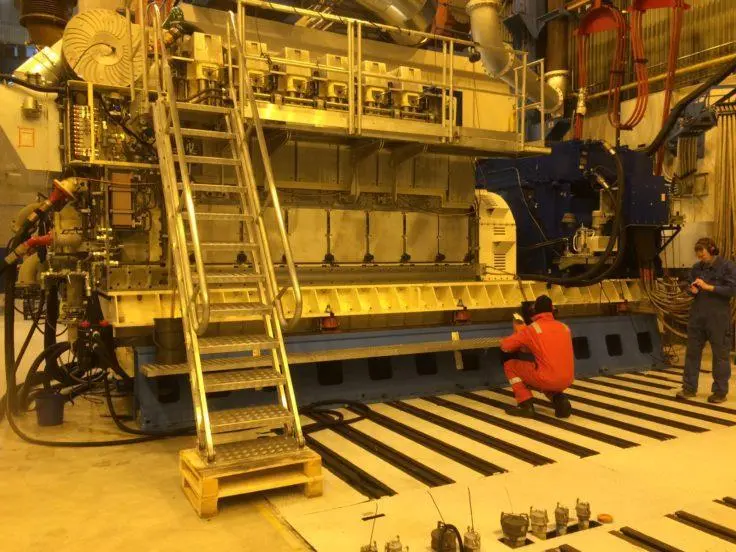
The four engines driving the gensets at the heart of the diesel-electric installation are of the B33:45 medium-speed series, manufactured by the Bergen division of Rolls-Royce Power Systems (which remains part of the Rolls-Royce Group). The plant comprises two nine-cylinder models of the B33:45 engine, each producing 5,400kW, plus two six-cylinder versions, yielding 3,600kW apiece, constituting a total power concentration of 18,000kW.
The engines are designed to run on ultra-low sulphur fuel oil, containing less than 0.1% sulphur, and exhaust lines are fitted with selective catalytic reduction (SCR) units, to ensure compliance with IMO Tier III controls on NOx emissions.
The vessel employs a twin-shaft, controllable pitch propeller, hybrid diesel-electric configuration. Each pair of nine- and six-cylinder diesel gensets drives two asynchronous propulsion motors mounted on each propeller shaftline. The arrangement confers substantial operating flexibility, engine and energy optimisation, and high levels of redundancy while covering icebreaking missions and all service modes.
Two banks of batteries, each rated at 2,500kW/500kWh, are connected to the main switchboard, providing for load smoothing and giving extra back-up in the event of a blackout.
The prime movers and 4.5m-diameter Kongsberg (ex Rolls-Royce) controllable pitch propellers will enable navigation through 1m-thick, first-year ice at three knots, and ensure that the ship can tow gear over the stern or side while making six to eight knots, and carry out acoustic surveys at up to 11 knots.
Tees White Gill vertical shaft thrusters of some 1,580kW, two in the foreship and two aft, were specified to meet the exacting manoeuvrability standards required at the ice shelf and elsewhere. From its North Skelton manufacturing site in the UK, Tees Components supplied four azimuthing thrusters of the 60T3S-QR model. Being flush with the hull plating, and thereby helping to achieve a smooth hull shape, the thrusters reduce turbulence, improving the accuracy of the data collected by the ship while meeting Lloyd’s Register’s DP2 class requirements.
Related Articles
 PROPULSION
 GENERAL NEWS
 HYDROGEN