



Ships can be fast, efficient – and ‘green’
Whilst a great deal of attention is being paid to making shipping ‘greener’, this has not stopped the development of fast ships, which seems like a contradiction. Ship owners may be sympathetic to the need to reduce emissions and the moves towards cleaner seas, but their approach tends to be based on a hard pragmatic appraisal of the requirements of modern shipping with the focus on economics. There are targets set by IMO that have to be met, but there are many situations where higher speeds can increase the viability of a route or even make it viable in the first place. So there is still a strong focus on speed in the shipping world, where exciting developments are still taking place.
When shipping operations are looked at in hard economic terms then higher speeds can become viable. The faster a ship travels the less time it will spend at sea and so it can carry more cargo or passengers over the same period of time, and thus earn more money. If a faster ship can make 12 voyages a year rather than 10 then this could be a viable option but the benefit in increased cargo has to be balanced against the increase in fuel costs. Judging by the increased speeds being used in some shipping operations the pendulum may be swinging towards rather than away from operating ships at higher speeds, but if the cost of fuel continues to rise this may not be a continuing trend.
The operating cost of shipping can be a delicate balance of viability and there is a strong focus on optimising hull designs for increased efficiency rather than just adding more power. An example of this is found in the recently launched Pacific Dawn, a 3,000 gt ship designed to handle project cargo. She is one of the fastest project cargo ships in her class with a service speed of 19 knots compared with an average for this type of ship of 12 to 14 knots.
This higher speed capability means that project cargoes can be delivered in 30% less time which results in a reduction of running costs per job as well as allowing more jobs to be handled in a year. For the owners and their clients it is a win, win situation. A similar rationale was followed in the design of the heavy lift project carrier Beluga Bremen where a speed of 17 knots is high for this type of vessel but it is one that makes economic sense for the ship owner particularly when the higher speed can be achieved more by refining the design than by increasing the power.
Large container shipping is perhaps the focus of higher speeds at sea. Today’s container shipping tends to operate at higher speeds than large passenger ships with 24 or 25 knots being commonplace. Here the high speeds can be justified by the high value cargoes but they have been made more viable with increases in the size of ships, which allows for a longer hull length that in turn makes the hull more efficient.
These large fast container ships are reaching the limit of what can be achieved with a single screw ships. Studies have shown that a single screw ship is more efficient that a twin screw vessel both in terms of propulsion efficiency and cost but for the high speeds demanded suitable engines are at the limit of what is available and propellers can be another limiting factor.
A single engine of over 100,000 bhp is physically a long engine so there is also the question of the amount of space within the hull that has to be taken up by the engine room. As far as propellers are concerned the current 9.8m diameter propellers are at the limit of what can be manufactured and so designers are turning more to the concept of a twin screw vessel where there are several advantages to offset any increase in cost. The smaller engines are well within the span of fully developed technology rather than close to the limits and the same goes for propeller design. Then again a twin screw vessel could have a reduced draft that could give access to certain ports otherwise not available so overall there does appear to be a move towards twin screw designs as container ships get ever larger. One aspect that does not seem to change is the demand for high speeds and there is discussion that even higher speeds could be demanded in the future and be feasible as the twin screw concept expands.
One of the most buoyant sectors of the shipping industry at present is LNG carriers and here we are also seeing high speeds from the new generation of ships. 20 or 21 knots LNG carriers are the norm now and there several reasons for this. One of course is the fact that the shorter the voyage the less boil-off gas that is generated but also the ship can undertake more voyages if the speed is higher. However perhaps the over-riding reason is the use of boil off gas as a fuel. A typical gas carrier may loose 4% to 6% of its cargo in boil-off and if this can all be used as fuel for the main engines then the dispersion of this boil-off gas does not become a problem. Like most shipping operations the viability can be a delicate balance but higher speeds appear to be the chosen solution.
The obvious way to use this gas is larger engines that allow the ship to go faster and there is a move away from the customary steam turbine propulsion on gas carriers towards dual-fuel gas/diesel engines. This move has been partially hastened by the problem of finding suitably qualified engineers for the steam engine installations.
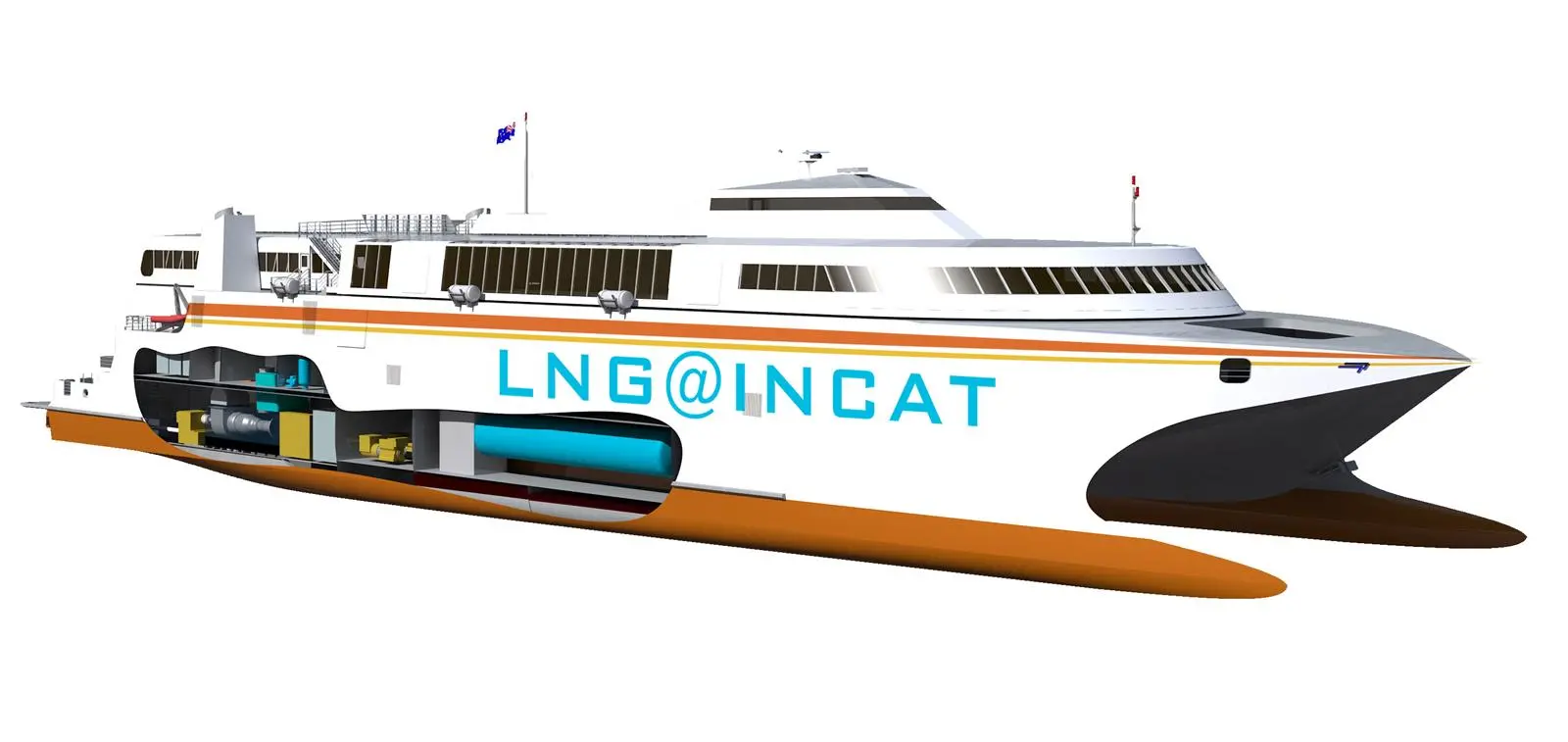
LNG has also hit the news in a different way with the announcement of the start of construction of a large wave piercer ferry that will use LNG as a fuel. There have been some smaller ferries in Norway that use LNG but Incat in Australia has a contract to build this large 99m ferry. The owners and the route involved have not been disclosed but the vessel will have a capacity for 1,000 passengers and 153 cars.
The power units will be a pair of GE Energy LM2500 gas turbines that have been modified so that they can run on gas or diesel fuel. The turbines will be connected to waterjets for propulsion and the LNG tanks will be mounted above the double bottom diesel tanks. Incat is claiming that this ferry will be the fastest environmentally friendly high speed ferry in the world and it is interesting to see the return of the so-called less efficient gas turbine propulsion in place of the normal high speed diesels.
A Chinese shipyard is also offering a gas turbine powered fast ferry, which, if it gets built will be the fastest large ferry in the world. Afai Shipyard has developed this 110m advanced wave piercer design in conjunction with Advanced Multihull Design of Australia. The gas turbines are the same LM2500 units proposed by Incat for its LNG ferry but the Chinese ferry will have four of these units totalling 84,000 kW to give a speed of over 60 knots. This ferry will have a range of 1,000 miles and, depending on the configuration, will be able to carry over 700 passengers as well as vehicles. Afai claims to offer one of the widest ranges of fast ferries from any builder, most of them capable of speeds of over 40 knots.
Australian builder Austal is also moving into the very high speed ferry market with the announcement that two of its latest deliveries have set records for the world’s fastest diesel powered ferries. These two 65m ships have achieved speeds of over 56 knots and they are designed to operate on the world’s longest fast ferry route, of 560 miles in the Arabian Gulf. The power units of these vehicle-carrying ferries are four 6,500 kW MTU V-20 diesels coupled to waterjets. These high speed diesel ferries demonstrate how higher speeds can make a particular route viable by reducing the transit time to around 4 hours.
Austal is close to delivering its largest catamaran to date, a 113m vessel for Nordic Ferry Services, demonstrating the increasing scale of modern fast ferries. This, the company’s largest catamaran, follows after Austal pioneered large trimaran ferry design with the 127m Benchijigua Express. The yard has built on its trimaran experience by recently gaining a contract from the US Navy to build the first of 10 projected trimaran warships. These military trimarans with be powered by a pair of LM2500 gas turbines and a pair of MTU V-20 8000 diesels all coupled to Wärtsilä waterjets.
Austal established a fast ferry shipyard in Mobile, USA, in a major commitment to the US market, and this yard will now be expanded to build the new trimarans. Trimarans have not found a great deal of favour in the fast ferry sector but this new US contract firmly establishes them in the military market. Austal US is currently building up to 10 103m fast catamaran vessels for the US military.
Australian yards dominate the large fast ferry sector and continue to advance the capabilities of these vessels. In Europe, Rodriquez in Italy is a major ferry builder and has focussed a lot of energy in developed fast monohull ferries as well as its traditional hydrofoils. However like most ferry builders Rodriquez offers a range of designs to cater for most needs.
The high speed sector continues to attract new designs and concepts but the challenge is to persuade operators to switch from established concepts into more revolutionary ideas. BMT Nigel Gee is still trying to find clients for its Pentamaran designs that feature vessels with five hulls, one on the centre line and two in line on each side. The Pentamaran offers high efficiency combined with good stability and it is perhaps the more complex structure that makes operators more cautious about investing in such concepts. However BMT Nigel Gee has developed designs for a fast landing craft for the British MoD that features what is called a tri-bow monohull design. Powered by triple MTU diesels this can reach speed of 28 knots with a full payload.
The interest in high speed craft over the past few years has seen a considerable number of innovative concepts proposed. The problem is that it is a major step from an idea on paper to the reality on the water and few operators are going to take that sort of financial gamble. This puts the current major designers and builders in a strong position and it has led to the revival and a fresh look at some of the original fast craft concepts.
Rodriquez, which pioneered many of the original hydrofoil developments, is taking a fresh look at hydrofoils and their application to fast craft, and is building a prototype using modern materials and design. SES Europe has transformed the hovercraft principle into a monohull hovercraft where the air cushion is contained within a rigid hull. Extensive testing of a 17m prototype has shown fuel savings of up to 45% compared with a conventional monohull. This is achieved without any loss of seaworthiness and while the current accent of the development is on fuel economy this can be equally well translated in to increased speed for a given power.
This hovercraft development highlights the way that green issues and performance go hand in hand. Increased efficiency is the focus of many developments in the shipping world and this can be translated into reduced fuel consumption for a given speed or increased speed for a given fuel consumption. Either way it is increased efficiency and this is what operators are looking for. In the fast ferry and fast craft sector it is innovative concepts such as wave piercers, trimarans and hovercraft that are demonstrating the increased efficiency. In the shipping sector there is a strong focus on improved hull design and propulsion systems to achieve the same ends. The regulators are playing their part by demanding more efficient and cleaner engines, which in some cases can lead to reduced fuel consumption.
So instead of going into decline in the search for reducing emissions, and in particular CO2, the fast shipping sector appears to be on the increase. Operators have the option of using increased efficiency to increase performance in order to optimise schedules rather than merely to operate ships at lower speeds. The technology that allows higher speeds without a heavy cost penalty has allowed a fresh look at schedules and route viability and appears to be creating a revival.
Related Articles
 PROPULSION
 GENERAL NEWS
 HYDROGEN