



So who says dual fuel is the latest trend?
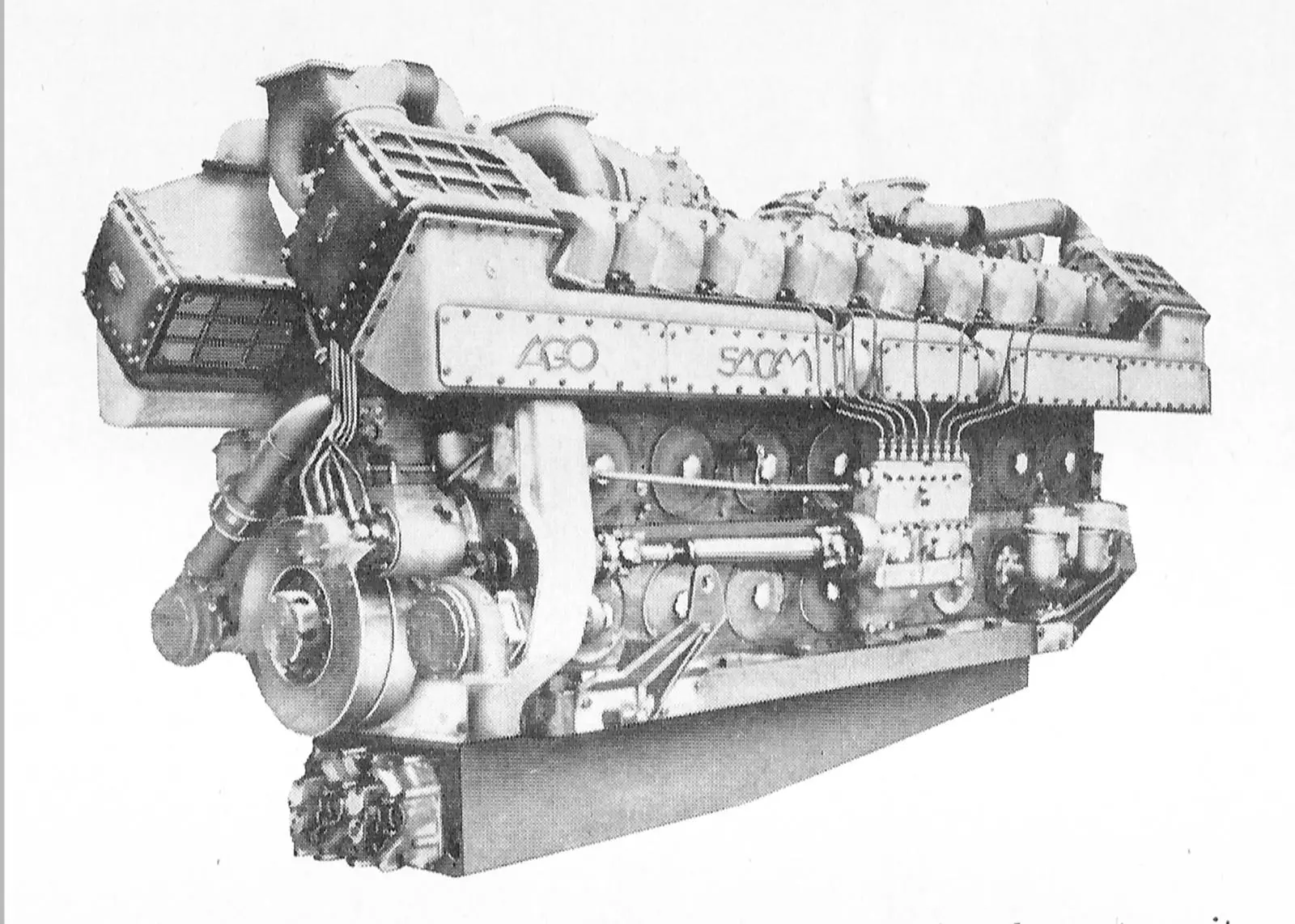
The engine in question was made by French company SACM of Mulhouse. Known as the type AGO-G, it was of 230mm bore and 220mm stroke, and available in naturally aspirated and turbocharged form, both in-line and vee configurations, with between six and 16 cylinders. The most powerful version, the turbocharged V16, developed 1,880bhp at 1,100rpm.
The dual fuel engine was based on SACM’s type MGO diesel-fuelled high speed unit, which was widely used in rail and industrial, as well as marine, applications. The major difference between the diesel and dual-fuel engines was the cylinder head, which for operation on gas or a combination of gas and oil, was of a simple design with single inlet and exhaust vales, rather than the four-valve heads used on the MGO. Modified injector pumps delivered a very small amount of diesel fuel at the end of each compression stroke which initiated combustion of the gas. A variable regulator allowed the operator to control the relative amounts of gas and diesel fuels without disturbing the governing of the engine. Different fuel-mixing arrangements were employed for turbocharged and non-turbocharged engines; in the latter the mixing was carried out by butterfly valves situated at the entry to the inlet manifold, turbocharged engines introducing the gas into the inlet tract of each cylinder via a control valve upstream of the inlet valve.
The engine could run on a variety of gaseous fuels as well as methane, but for some gases the required compression ratio was too low to ignite the pilot fuel, and then it was necessary to use spark ignition.
SACM saw the future for the marine dual-fuel engine in LPG tankers, where the boil-off gas for the cargo could be used as fuel, offering significant savings. The article in The Motor Ship noted that “with the increasing supply and demand for natural gases, the AGO-G series engines will find many… applications.”
So what became of SACM and its dual fuel engine? SACM was a multi-faceted company, parts of which formed the basis of other well-known names like Alstom and Alcatel. Its location, in Alsace which alternated between France and Germany, had made times interesting, to say the least, for the armaments and defence divisions. The engine division was the last survivor of the group, being taken over by Wärtsilä in 1993. It eventually closed in 1999, but not before becoming the Wärtsilä half of the short-lived Cummins-Wärtsilä joint venture. The foundry has been conserved, as part of the University of Haute Alsace. The dual fuel engine, like so many inventions ahead of their time, has been largely forgotten – maybe Wärtsilä can lay claim to an even longer gas-engine heritage.
Elsewhere in the magazine, the correspondents reported on a French-built LPG tanker for Chilean owners, though despite the existence of the SACM dual-fuel machinery it was powered by a conventionally-fuelled 1,400bhp MAN four-stroke engine. The cargo, being primarily butane, was not really suitable for propulsion use. The gas tanks were built at St Nazaire, a yard that would subsequently become well know for LNG carriers.
And the large-bore engine saga continued, the latest offering coming from The Netherlands, in the form of a Stork 12-cylinder unit of 85cm bore and 170cm stroke, with a maximum rating of 33,600bhp at 110rpm.
Related Articles
 50 YEARS AGO
 50 YEARS AGO
 50 YEARS AGO