



Star Rises Over The Baltic
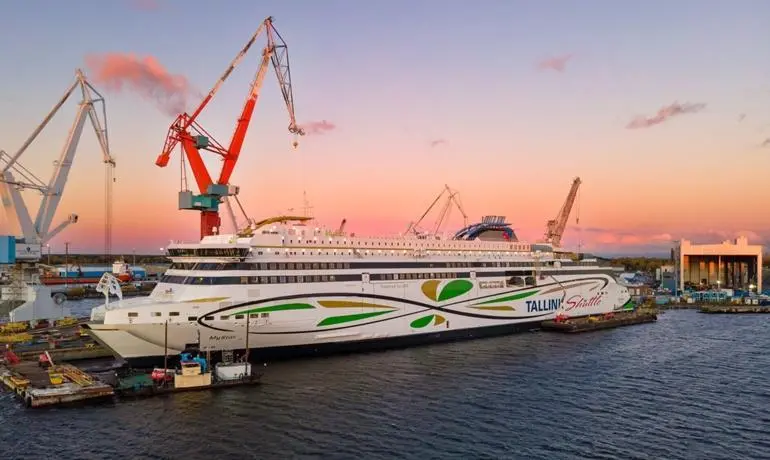
The 212m newbuild from Rauma Marine Constructions (RMC) was phased into service between Tallinn and Helsinki on 13 December, accommodating up to 2,800 passengers and providing approximately 3,200 linear metres of capacity for vehicles.
Representing a capital investment of around EUR250m ($265m), the build project reaffirms European capabilities in high-grade ferry production notwithstanding the emergence of the Chinese shipbuilding industry as the dominant force in the market segment over recent years. The 7 December delivery of MyStar, the largest vessel to date from RMC, was nevertheless much later than had originally been foreseen under the contract, due in no small part to the disruption wrought by the Covid pandemic.
The powerful dual fuel-electric power installation based on wide-bore MAN medium-speed engines and ABB electrotechnical technology, coupled with the nature of the hull lines and 1A ice class reinforcement, provide for rapid transits and year-round schedule-keeping on the Gulf of Finland, city-to-city shuttle operation.
At a contract value of about EUR7.5m ($8m), RMC assigned basic and detail design services related to the hull, machinery and electrical systems to Deltamarin. The work was carried out over an 18-month period at the consultancy’s offices in Finland and Poland.
MyStar builds on the template used for the Megastar, delivered nearly six years ago by Meyer Turku, and the new vessel’s running mate on the Tallin/Helsinki route. While the passenger capacity, main dimensions and speed are on a par with those of the earlier ship, the MyStar offers enhanced unit economy and reduced carbon footprint, with an increased ro-ro payload, all achieved using a lower power concentration.
MyStar is fitted with five eight-cylinder models of the high-efficiency (rather than high-power) version of MAN’s L51/60DF engine in the main genset aggregates. Each prime mover has a maximum output of 8,400kW, and is intended for firing on LNG as the regular fuel, with the versatility to switch to fuel oil or diesel or potentially to biogas as and when it becomes a viable option. Tallink’s selection of the 51/60DF was influenced by the engine type’s key performance strongpoints including load behaviour and pure gas starting. The advanced electrical propulsion system allows the ship to be operated energy-efficiently in all situations at speeds up to 27 knots.
The 42,000kW power concentration in the MyStar may be compared with the 45,600kW of the Wartsila-driven genset plant in the Megastar, comprising three 12V and two 6L engines of the 50DF dual-fuel series. The LNG fuel storage capacity in the new ferry is some 30% greater than that of the Megastar, meaning fewer bunkerings.
ABB software figures prominently in the ship’s operating setup bearing on energy usage and vessel functioning. The OCTOPUS optimisation software collects and transfers data from the vessel’s onboard systems to the proprietary Ability Marine Fleet Portal, providing remote monitoring and detailed performance analysis. Based on the insights, OCTOPUS acts as an advisory medium for the crew in making informed decisions as to the way the ship is run. The OCTOPUS arrangement on MyStar comprises five separate modules, Advanced Performance Monitoring, Dynamic Trim, Clean Hull, SFOC Monitoring and Powerplant Optimisation.
The investment in a shore-to-ship power link, obviating recourse to gensets to feed the shipboard net when alongside, forms part of the Twin Port 3 initiative, co-financed by the EU under the Connecting Europe Facility (CEF) programme provisions.
Within the overall vehicular capacity, freight can form the largest element of the load, given the availability of 1,900 linear metres for trucks and trailers. Bow bow and stern ro-ro access confers a drive-through configuration, with simultaneous two-level handling at the Tallinn and Helsinki terminals.
The need for rapid turnarounds is accentuated by the speed and relatively short duration of the sea transit. MyStar incorporates the Smart Car Deck solution, easing the everyday, routine work of ro-ro loading, and reducing waiting times and inconvenience for passengers with cars embarking and disembarking. The Smart Car Deck, applying automation and digitilisation technology, derives from a collaboration project between Tallink and the Tallinn Technical University (TalTech).
To maximise revenue generation, and especially that from Finnish passengers buying products at cheaper Estonian prices, record provision for onboard shopping was made on the Megastar. This feature, encapsulated in the Traveller Superstore on decks 7 and 8, is perpetuated in the MyStar.
MAIN PARTICULARS – MyStar
|
Length overall |
212.1m |
|
Length bp |
192.1m |
|
Breadth |
30.6m |
|
Draught |
7.1m |
|
Gross tonnage |
50,629t |
|
No. of decks |
12 |
|
Passenger capacity |
2,800 |
|
Ro-ro lane metres(freight/total) |
1,900/3,190 |
|
Cars |
750 |
|
Propulsion system |
LNG/diesel-electric |
|
Main generators |
5 x 8,400kW |
|
Speed |
27kts |
|
Ice Class |
1A |
|
Class |
Bureau Veritas |
|
Flag |
Estonia |
Related Articles
 PROPULSION
 GENERAL NEWS
 HYDROGEN