



Stena sets new benchmark in tanker design
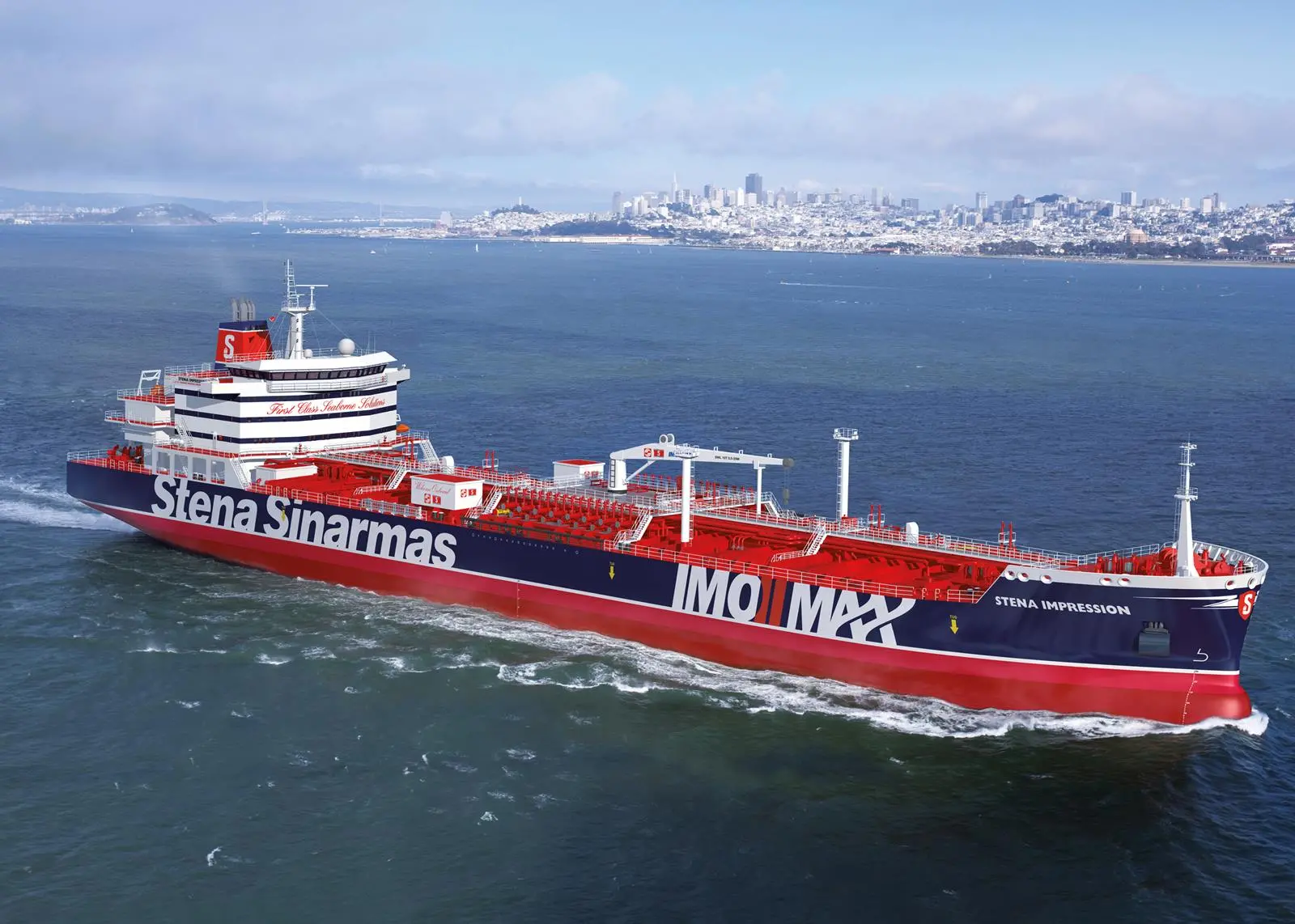
Giving first form to the IMOIIMAX class of chemical/product carrier, the 49,800dwt Stena Impression leads a US$400m series of ten newbuilds from Guangzhou Shipyard International (GSI) in China. The new breed has been conceived for the transport of vegetable oils, chemicals, and clean and dirty petroleum products, embodying parcel tanker-type capabilities that give increased scope for payload permutations and individual consignment sizes.
Quality, innovation and long-term thinking are hallmarks of Stena strategy, evident across the Swedish-owned group’s tanker, ro-ro, ferry and offshore interests. These tenets are amply expressed in the new-generation MR tanker design, devised by Stena Teknik in conjunction with the Chinese builder.
The IMOIIMAX programme involves a number of owners, the common thread being the Stena involvement, variously by way of Stena Bulk, listed company Concordia Maritime and joint venture Stena Weco. The design concept reflects Stena’s pursuit of the principle of more sustainable shipping, in conjunction with the development of a flexible design of tanker offering customers improved business solutions on a competitive basis.
The comprehensive technical approach to energy efficiency promises a 10-20% lower fuel consumption at service speed than comparable capacity vessels.
In fact, the IMOIIMAX is described by Stena as “probably the most efficient Eco MR tanker existing today”. The nature and extent of technical solutions adopted in the drive for a substantive advance in overall energy efficiency, and Stena’s characteristic emphasis on quality so as to confer competitive advantage and better ensure safety, service dependability and long-term asset value, has commanded a premium within the ship price of US$40m.
Aiming for leadership
The entire series will be commercially operated by Copenhagen-headquartered Stena Weco, the joint undertaking of Stena Bulk and Weco, part of the Danish group Dannebrog. The IMOIIMAX programme is testament to Stena Weco’s objective to become the market leader in the MR tanker segment. Weco has brought particular expertise in the transportation of palm oils, edible oils and caustic soda to the joint venture.
Stena Impression is jointly owned by Stena Bulk and the Indonesian company Golden Agri Resources (GAR), and the same pairing accounts for five of the nine newbuilds to come. Singapore Exchange-listed GAR is the world’s second largest palm oil producer, with huge plantations in Indonesia, and integrated operations there and in China focused on palm oil-based products. In fact, Stena Impression cut her teeth on a palm oil cargo for the US market.
Of the four other tankers, one each will be owned outright by Stena Bulk and Stena Weco, while two are for the Stena Group company Concordia Maritime, quoted on the Stockholm Exchange. The delivery schedule from the Guangzhou yard extends into 2017.
Protected by the mandatory double hull construction, the cargo section is divided by a centreline bulkhead and transverse bulkheads into nine pairs of tanks of an aggregate 54,000m3. The 16 cargo tanks and two slop tanks are uniform in size at 3,000m3, the filling restriction for tanks carrying IMO Type 2 products. Moreover, all tanks are designed to take any of the Type 2, Type 3 and petroleum products for which the vessel has been developed.
The relatively large number of moderately sized tanks, plus a minimum of eight double-valve segregations, affords considerable flexibility as to cargo ‘parcels’ and cargo combinations, fitting well with Stena Weco’s global logistic systems.
Instead of simpler, coated mild steel piping with flanged couplings, the cargo piping on the IMOIIMAX tankers is fabricated from stainless steel so as to comply with Federation of Oils, Seeds and Fats Association (FOSFA) recommendations and the chemical trade.
The cargo tanks of a vessel engaged in the oil and petrochemical product trades are fundamental to her value and ability to efficiently trade across the market with different cargoes. Besides the operating flexibility conferred through informed investments in tank configuration, tank coatings and handling systems, a critical objective in formulating the technical specification for the cargo section is to ensure that the vessel will not run the risk of incurring product contamination and rejection and associated costs when changing cargoes.
Moreover, tank coatings must serve not only to protect cargo against contamination but also guard the substrate of the tank against corrosive elements. The coating has to be able to provide resistance to the diverse and constantly changing nature of the products being transported.
Tank protection
For each of the IMOIIMAX class, Jotun was contracted to supply its top-of-the-range Tankguard Special Ultra coating for application throughout the cargo section. Being a novolac epoxy, offering the most extensive resistance list including methanol, the coating system has a higher degree of cross-linking and is accordingly more flexible in carrying products at elevated temperatures. The treated tank surface also facilitates cleaning between cargoes, a very important factor in promoting rapid turnarounds and ship productivity.
A three-coat application, each coat being of 100-micron thickness, was specified for the Stena Impression series. Typical cargoes for which the phenolic epoxy has been formulated include benzene, bio diesel, caustic soda, coconut oil, ethylene glycol, FFA(free fatty acid), MTBE(methyl tert-butyl ether), palm oil, soyabean oil, sunflower oil, tallow, toluene, urea ammonium, nitrate solution, xylene and methanol.
The handling system is based on 18 Alfa Laval Framo deepwell pumps, rated at 375m3 per hour apiece, rendering a high outturn capacity with flexibility in cargo circulation. The Scanjet tank cleaning system also contributes to rapid turnarounds, enabling four tanks to be washed simultaneously, using heated as well as cold sea and fresh water.
A nitrogen-based inert gas system (IGS) is fitted in each tank. Clean nitrogen instead of inert flue gas, as conventionally used, meets the criteria for reduced time between discharge and loading due to faster tank cleaning. This dispenses with the need to carry nitrogen bottles for purging and/or cargo tank padding. Moreover, Stena Bulk contends that a nitrogen generator system is more fuel efficient than a traditional inert gas generator.
As will be the case with the subsequent nine newbuilds, Stena Impression has three Scanjet SC30T-type tank cleaning machines with two-metre long pipes in each cargo tank, making for a total shipset of 54 single-nozzle units. The fully programmable outfit meets multiple cleaning needs, including pre-wash cycles.
The permanent lubrication means an oil-free drive unit and the patented magnetic transmission ensures that there is no penetration between the drive unit and turbine, eliminating any accidental leakage into the cargo. The drive can be serviced or replaced without exposing the tank to the atmosphere.
By virtue of the nature of the Scanjet tank cleaning system, the raft of Lloyds’ Register class notations accorded Stena Impression has been augmented by the society’s descriptive note ‘Effective Tank Cleaning’ (ETC). The arrangement of the cleaning machines minimises shadow areas, contributing to cleaning effectiveness and reduced times between discharge and loading.
Propulsion efficiency
As the keystone in the bid to secure efficient performance across the operating profile, the MAN 6S50ME-B9.3 main engine incorporates low-load optimisation and has a specified maximum continuous rating (SMCR) of 7,211kW. This may be compared to the design’s nominal MCR of 10,680kW in L1 layout. The tanker’s relatively modest power output, in conjunction with the refined hull lines, assures a design speed of 14.5 knots.
Through the use of an auto-tuning system, the combustion process in each of the engine’s six cylinders is continuously auto-controlled for optimal running in all conditions.
Hydrodynamics are enhanced by a Hub Vortex Absorbing Fin, designed to recover energy from the swirling water immediately abaft the propeller. Stena Weco’s data presentation for the IMOIIMAX lists a service fuel oil consumption rate of 28 tonnes per day.
A further, but more unusual measure in the drive for overall energy efficiency is denoted by the nomination of four MAN auxiliaries part-load optimised (PLO) for running at 65% load. Specific fuel oil consumption is approximately 5g/kWh lower than the standard version of the engines employed, which are six-cylinder models of the L23/30H Mark 2 type. Each delivers approximately 990kWe at 900rpm. The PLO feature is a new option which MAN is offering for all small-bore, four-stroke, medium-speed marine auxiliary engines.
Supplied by the Aalborg division of Alfa Laval, two oil-fired boilers provide flexibility and redundancy in serving the varied needs of a tanker carrying heated cargoes. The vessel is additionally equipped with an Alfa Laval Aalborg exhaust gas, multi-inlet composite boiler. This recovers energy from the auxiliaries as well as from the main engine. The unit also has an oil-fired section for use in port, obviating the need to run the auxiliary boilers.
Stena Impression has an integrated bridge system that allows access to all essential navigation information from centralised workstations. System components include two radars, three ECDIS sets, conning display, two gyrocompasses, autopilot, two differential GPS units, Navtex, speed log, AIS and echo sounder.
The streamlined superstructure means that the IMOIIMAX is less affected by wind resistance than similar vessels. The script across the front–“First Class Seaborne Solutions”–encapsulates the business culture and design philosophy that permeates Stena’s shipping interests.
Manning and technical husbandry of all ten vessels has been assigned to Northern Marine, Stena’s Glasgow-based shipmanagement specialist. The link to the UK is reinforced in the case of Stena Impression and five of her future consorts through registry in London under the Red Ensign, with the four other newbuilds to be Bahamas-flagged.
Table 1: IMOIIMAX newbuilding programme
|
Name |
Delivery |
Owner |
Registry |
|
Stena Impression |
2015 |
Stena Bulk/GAR |
UK/London |
|
Stena Image |
2015 |
Concordia Maritime |
Bermuda/Hamilton |
|
Stena Imperial |
2015 |
Stena Bulk/GAR |
UK/London |
|
Stena Important |
2015 |
Concordia Maritime |
Bermuda/Hamilton |
|
Stena Imperative |
2015 |
Stena Bulk |
Bermuda/Hamilton |
|
StenaWeco Impulse |
2016 |
Stena Weco |
Bermuda/Hamilton |
|
Stena Imagination |
2016 |
Stena Bulk/GAR |
UK/London |
|
Stena Immortal |
2016 |
Stena Bulk/GAR |
UK/London |
|
Stena Immaculate |
2016 |
Stena Bulk/GAR |
UK/London |
|
Stena Impeccable |
2017 |
Stena Bulk/GAR |
UK/London |
PRINCIPAL PARTICULARS – STENA IMPRESSION
|
Length overall |
183.20m |
|
Length b.p. |
178.50m |
|
Breadth, moulded |
32.26m |
|
Depth, moulded |
18.20m |
|
Draught, design |
11.00m |
|
Draught, scantling |
12.90m |
|
Deadweight, maximum |
49,776t |
|
Gross tonnage |
29,666t |
|
Cargo tanks |
16 + 2 slop |
|
Cargo volume |
54,000m3 |
|
Main engine |
MAN 6S50ME-B9.3 |
|
Speed, design |
14.5knots |
|
Auxiliaries, power |
4 x 1,000kW |
|
Class |
Lloyd’s Register |
|
Class notations |
+100A1, Double hull oil tanker and chemical tanker, Ship Type 2, CSR, ESP, ShipRight(CM, ACS[B]), *IWS, LI, ECO(BWT, EEDI, IHM, TC, VECS), SPM4LR, +LMC, UMS, IGS |
|
Flag |
U.K. |
Related Articles
 PROPULSION
 GENERAL NEWS
 HYDROGEN