



Study calls for WAPS standards
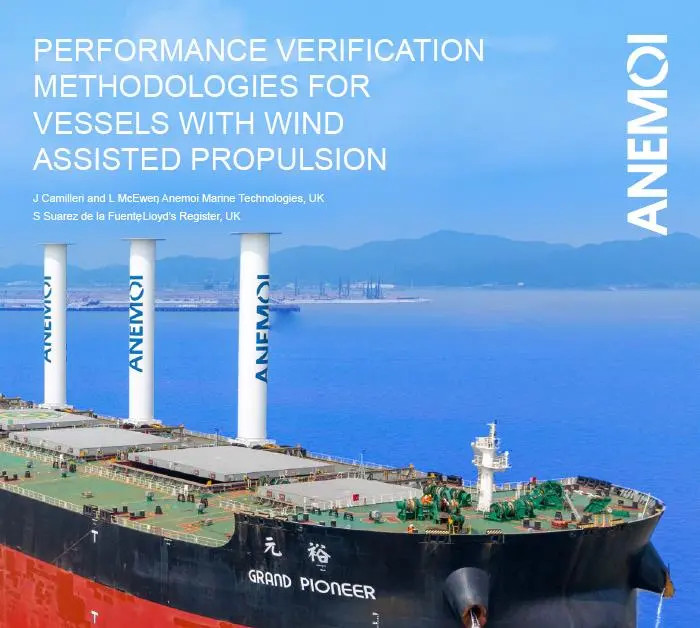
The paper evaluates how Anemoi’s in-service performance and forecasting model calibration methodology fits alongside two established frameworks: the guidelines developed by the International Towing Tank Conference and the recommended practice for in-service testing published by DNV.
“Accurate measurement and prediction of the real savings made by vessels using WAPS is essential for giving confidence to ship owners and operators who want to harness wind energy to reduce environmental impact and fuel costs,” said Luke McEwen, technical director at Anemoi.
“With our verification process and our new efforts pointing to the potential convergence of methodologies, Anemoi is helping guide the standardisation efforts needed to ensure this market flourishes.”
According to the research, operators and technology providers currently rely on several different approaches to assess wind-propulsion performance, making it difficult to compare results or build robust business cases for vessel owners considering installation.
READ MORE: Wind propulsion gains shipping ground
The analysis concludes that the three methodologies are complementary. The ITTC framework focuses on short-term verification through controlled sea trials, while DNV’s recommended practice evaluates long-term in-service performance. Anemoi’s verification process, meanwhile, links operational measurements with predictive modelling to estimate potential fuel savings.
By combining the strengths of each framework, the paper suggests the industry could move toward a more integrated and standardised approach to performance verification.
Anemoi’s methodology, verified by Lloyd’s Register in 2025, involves measuring vessel data with wind-propulsion systems switched on and off during normal operations, enabling calibrated predictions of fuel savings.
The research was presented at the RINA Wind Propulsion 2026 conference in February.
Related Articles
 ENERGY SAVING DEVICES
 ENERGY SAVING DEVICES
 AMMONIA