



System solutions for economical welding
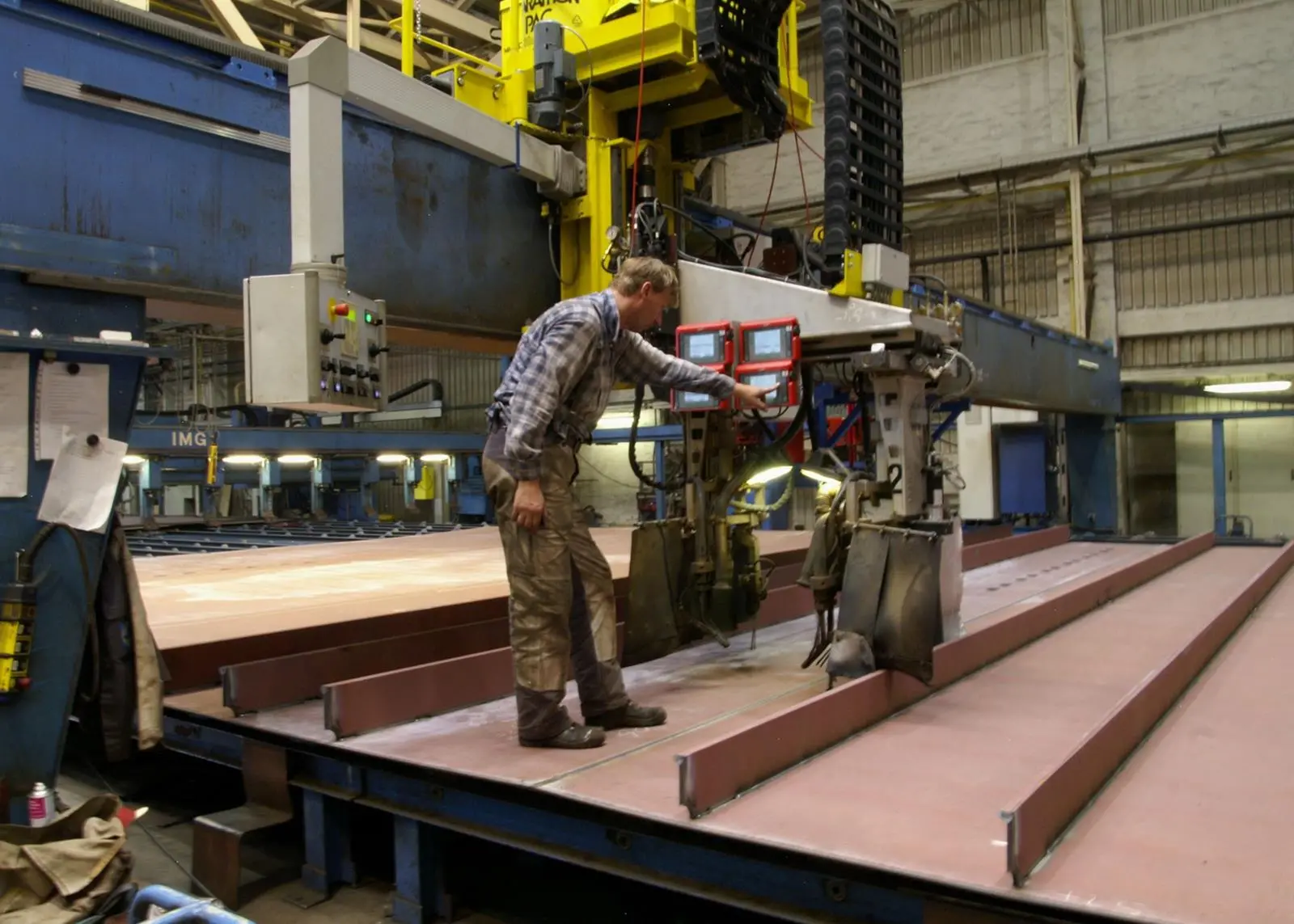
System solutions specifically geared to the needs of the shipbuilding sector calls for system performance, i.e. interplay of functionality, efficiency and reliability. Digital welding processes have brought about great improvements in economical and technical fields. Gas metal arc (GMA) welding systems covers everything from steel and its alloys to aluminium and other metals.
Being in contact with seawater, ship hulls are mainly made from Grade A steel. For less aggressive environments, Grade B, D, and E steels are commonly used. High-strength steels such as A 32, E36 or E 40 are typical in welded constructions. High-temperature steels are suitable for steam and pressure boilers; heat-treated fine-grained structural steels and nickel-alloy steels meet the requirements for high toughness at low temperatures; and austenitic steels are the material of choice for cargo tanks. Plate thicknesses range between 4mm and 40mm.
Steel pipework may have wall thicknesses of as much as 25mm, and are usually made of high-strength steel; unalloyed grades are sufficient for normal thermal loading, while enhanced thermal loads call for alloyed grades. As with the hull, ambient conditions influence the material choice: high-strength alloyed steels with manganese, molybdenum and/or chromium for high toughness, and nickel-alloy or austenitic steels for low temperatures. High-alloy steel pipess can be found on cargo tanks and pressure boilers. Slide-bearing rudder components are made of high-alloy steel, as are the wetted parts of chemical tankers and all ship components needing to withstand corrosive attack. The most frequently welded non-ferrous metals are aluminium and its alloys, in both cast, rolled and drawn forms. These are used for hulls of lightweight craft, and in ships’funnels, superstructures or pipework. Other non-ferrous materials include Invar (36% Ni), copper and its alloys and nickel alloys. Used in construction of LNG/LPG carriers, and pressure lines for heat exchangers.
Steel, being the predominant material, requires a variety of solutions, dictated by the technical and economic aspects or user-specific requirements. Although the fabrication of ship panels has some of the features of series production, the assembly operations – especially those inside the hull structure – are still entirely manual in nature. Ambient conditions are different in each case, particularly when working outdoors. The maritime environment can severely test both man and machine.
Most steel joins in shipbuilding are manually welded. Fronius, VarioStar, VarioSynergic, TransSynergic and TransPulsSynergic MIG/MAG systems feature innovations such as the TransSteel digital microprocessor-controlled inverter power source. The name derives from Steel Transfer Technology, and allows users performing metal-active gas (MAG) welding to concentrate on essential workflow. Intuitive operator functions and wirefeed, ergonomically shaped torch and rugged housing are designed for steel welding, as is the stable arc. Users can choose either rutile, basic or metal powder flux-cored wire or solid wire. For shipyard use, Fronius has developed ‘Steel Prime’ – to facilitate welding over primer coatings – ‘Steel Root’ for gap-bridging ability and roots, and ‘Steel Dynamic’ for deep penetration and small included angles. Sensitive components are protected against dust by a filter.
A special Yard version of TransSteel is programmed for joining standard to high-alloy steels, with the usual filler metals and types of gas, flux-cored wires and electrodes. The VR 5000 Yard wirefeeder has a ‘sleigh’ dragging base on one side and a built-in gas-flow regulator; it is detachable, and designed for mobile deployment or for use in hard-to-access locations. The operator can switch over to MMA operation at the push of a button.
When welding aluminium, formation of oxide skin during the fusion process must be prevented, otherwise this would hinder or stop the arc process. Additionally aluminium has nearly twice the thermal elongation of steel, and thermal conductivity three or four times higher.
For high-grade aluminium weld-seams Fronius proposes its TransPuls Synergic MIG-ARC series, with characteristics suited to most commonly used alloys and filler metals.
For several aluminium welding applications in shipbuilding, tungsten inert-gas (TIG) welding is often used. The digital MagicWave series with ActiveWave technology provides a stable arc with low noise emissions, combined with lightweight.
Tandem welding – a high-performance process in which two wire electrodes melt simultaneously into a single weld-pool under a shielding-gas atmosphere. – is used to boost productivity and efficiency. The TimeTwin Digital system uses two wires, one following the other, so that the second arc improves dilution in the fluid pool, reducing fusion defects and porosity. On small fillet welds of 3mm to 4mm, it permits a doubling of welding speeds. During multi-pass welds, when the torch path reverses direction at the end of the seam, the control system automatically switches over the leading and trailing wire electrodes, enhancing start-up and crater-filling , and shortening cycle times. The welding system comprises two TransPuls Synergic GMA systems, operating at high welding speeds to keep thermal input relatively low.
The laser-hybrid process is suitable for joining both steel and aluminium, particularly when long seams with great welding depth and solid joins are required. A combination of the digital GMA process and a laser beam, as with the Fronius-developed LaserHybrid process, offers speeds two to three times higher than GMA welding alone. The laser beam delivers concentrated thermal input, great weld penetration depth and high speed. The GMA process which follows the laser provides good gap-bridging ability and simple weld-seam preparation. Because the laser’s typically high power requirements are limited to the deep-weld effect, the hybrid process is less expensive with less distortion and spatter.
Overlay welding is used for heavily stressed surfaces or repairing damaged areas. In both cases, the overlaid material enters into a metallurgically intimate intermixture with the base metal. ‘Cladding’ deposits a higher-grade layer onto the base metal. ‘Cconditioning’, used mainly in repair work, involves like-on-like overlaying. Cladding high-alloy steel onto less expensive low-alloy steel saves materials and cost, and is used for protection in aggressive environments or for sealing faces and slide-bearing surfaces. A typical application is the overlaying of weld filler metal (S-CU 6100 and S-CU 6327 to DIN EN 14640) onto the copper alloys of ship propellers.
To overcome the distortion resulting from one-sided warming with conventional GMA overlay welding, Fronius has developed the CMT (cold metal transfer) process with reduced heat input. CMT has proved suitable for cladding-applications, where, because less melting of the base metal is involved, the purity of the applied high-grade material can be preserved.
Because shipbuilding is not a production-line application, robotic methods are not normally viable. Instead, intelligent mechanisation solutions for reproducible travel paths, as in panel-production and pipework-mounting, can be applied. Using battery-powered traversing units, the GMA process can be mechanically applied to longitudinal fillet welds in the horizontal-vertical and vertical positions, and with integrated oscillation. These appliances can be combined with the TransSteel Yard and a conventional manual welding torch. Program buttons for the travel path, for segment welding and for crater filling provide flexibility and convenience.
For pipework fabrication and mounting, requiring single- to multi-pass circumferential seams, orbital welding systems suitable for steel, CrNi and Cu materials can be used in conjunction with intelligent control systems and power sources, coupled with weld-data monitoring, to achieve process reliability and good results.
Shipbuilding everywhere is undergoing great change, driven by the need for greater efficiency in building large cargo vessels, and by the demand for cruise ships. The market is being further transformed by the large numbers of diverse specialised vessels needed in the offshore field. These market demands create the need for well-thought-out weld processes. Welding equipment manufacturers need to foster this growth trend from both the technical and business angles, in an ecologically sustainable manner. In welding, it is system solutions that dictate the overall direction and application, and this, in turn, leads to comprehensive, integrated offerings.
Related Articles
 PROPULSION
 GENERAL NEWS
 HYDROGEN