



Taking engine control that bit further
Early enthusiasts predicted an ‘autonomy stairway’, stepping neatly from intelligent systems to remote control, and onward to unmanned ships. Others weren’t convinced, and believed that after a flush of interest, it would all be quietly dropped. Instead, diverse elements appear to be growing roots into mainstream operations – and these are intersecting with another relative newcomer: batteries.
Short-hop autonomous vessels will likely be electrical “as it’s a good solution for mitigating the requirements for maintenance, and improving the robustness of the propulsion solution”, says Bjorn Johan Vartdal of DNV GL. However, there are practical limits to how far batteries can propel even a modestly sized cargo vessel.
It leaves short-sea shipping between a rock and a hard place. On one hand their duty cycles generally don’t allow picking up an easy recharge, but these ships still spend “a lot more time” in restricted-emission, coastal areas than long haul vessels, points out Eero Lehtovaara of ABB. And, of course, air pollution is a particularly sensitive subject for city ports.
Therefore, many short-sea ships will likely choose a battery and combustion engine pairing, allowing limited emission-free running with enough onboard grunt for higher-power operations. But, as Lehtovaara points out, “both two-stroke engines and four-stroke gensets will continue to need attention”.
Moreover, as Vartdal comments, hybrids are “very advanced, coupled systems”. In short, out goes the relatively simple topology of either batteries or combustion engines: in come a number of multilayered problems…. Unsurprisingly, “there can be reliability issues”, adds Vartdal.
All this has a knock-on effect on what’s being asked of the crew. “Along with combined energy sources, new fuels and new types of system, there will be a requirement for new skill sets,” he says. “It would be difficult to have expertise onboard for each discipline, but you could have a spread of competencies onshore.”
This is the pathway explored by the ROMAS (remote operation of machinery and automation systems) project, a partnership including Høglund Automation, Fjord1, the Norwegian Maritime Authority and DNV GL. It’s taken a modern dual-fuel, hybrid ro-ro ferry operating on the 35-minute crossing between Molde and Vestnes, and simply moved the engine control room ashore. This, claims Vartdal’s colleague, Steinar Låg, results in operations which “can be implemented with a safety level the same, or better, than today”.
The Engine Control Centre (ECC) at Fjord1’s office in Molde sees the role of chief engineer being taken by an operator with monitoring and control oversight of all the onboard propulsion and auxiliary machinery – though, says Vartdal, “it’s been arranged so you see more from the control centre than from a typical engine room”. He explains there’s been an upgrade from Høglund’s existing integrated automation system (IAS), with “additional sensors, advanced alarms, closed-circuit television surveillance, cameras to show navigation and so on”.
The array is very high tech, but the support goes one step further. Augmented Reality (AR) glasses are fast becoming cheaper, better, and more readily available. As Vartdal relates, “the onshore control centre will have the same visual image as the onboard crew member, so you can guide them, ‘look at this, check that’…”
There are more advantages to this than just convenient working patterns. Although this pilot initially controls just one vessel, it is designed to handle three at once: the idea is that if there are simultaneous issues the on-duty engineer can call for assistance.
Not only could this make the work more collaborative “but the quality of the response does depend on a breadth of experience, something that can be missing from a long-term position onboard a single ship”, Vartdal explains. “However, if you are attending multiple vessels, you get a range of challenges, and that grows both competence and confidence.”
So, what of the onboard crew? While there are requirements for ro-ro ferry manning levels that leave the overall crew numbers on the Fannefjord ferry unchanged, Låg explains the engineering role is being replaced by that of a “multiskilled seafarer”. However, if applied to cargo vessels, (which have different requirements), this system could reduce the overall onboard personnel.
COMMUNICATIONS
However, communication is the big stumbling block. The Fannefjord route is only about 15km and within range for 4G signals, but many short-sea ships will be looking at longer routes. And there, “connectivity might be more of a challenge”, admits Vartdal. “You need a far more robust communication system than you’d normally have onboard.”
When out of 4G range, it’s down to satellites – and there are issues. It’s not distance: “Latency causes far more trouble for autonomous navigation,” he explains. A short lag isn’t usually critical when it comes to the engine room as machinery data loads are fairly low. Further, if a system needs to shut down very quickly, it will be flagged up and initiated onboard.
“While delay is not such a big problem, losing connectivity completely is,” underlines Vartdal. It’s a conundrum: there are mitigation strategies for many potentially damaging, but identifiable incidents – however, it’s much harder to deal with a blank screen.
Risk mitigation therefore involves “procedural” fallback, he explains. A wide range of normal and abnormal operations, conditions and scenarios have been mapped out during the ROMAS project, establishing a division of responsibility between the engine control centres and onboard crew, says Låg.
But what does this mean for longer runs or those just falling outside 4G range? Well, until the communication systems are completely robust, it does mean that the crew will need to be able to go it alone, as any signal loss will hand over engine room command from the shore to the onboard personnel. So if there’s any chance at all that the ‘multiskilled seafarer’ will have to take control, they’d better be trained for it.
While it is possible to utilise transmitter posts, “you don’t want to have to put up dedicated data connection points along all the routes”, says Vartdal. However, he adds that time will likely solve the issue: “As connectivity gets more developed, it will probably gain an increase in reliability.”
Despite this, “we will see remote engine rooms relatively soon”, predicts Vartdal, “most are unmanned a lot of the time, so we are just moving control a bit further away”.
ONBOARD SUPPORT
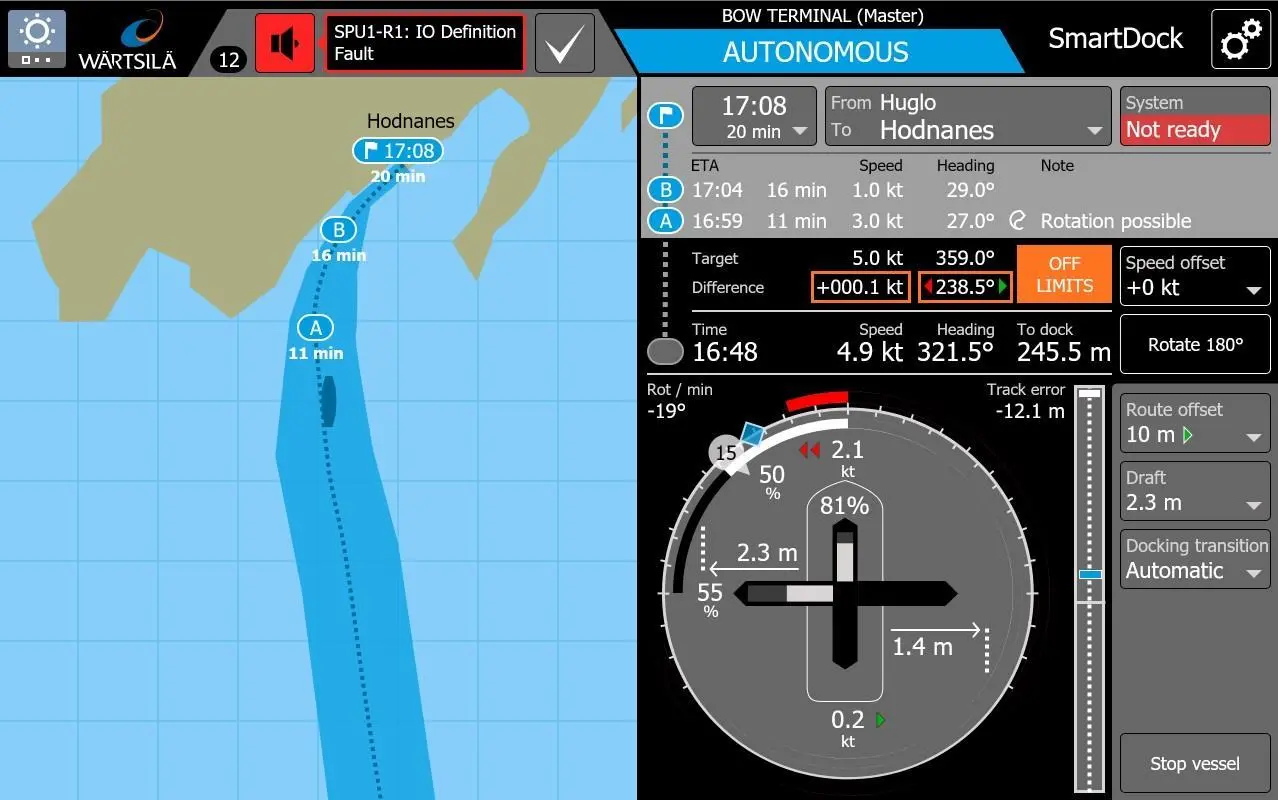
There is another option that doesn’t require shoreside connectivity, as the ‘brain’ is onboard. Wärtsilä’s SmartDock is, despite its name, more than a berthing system as it can kick in during transit, taking over thrusters and other engine room functions along with the navigation. At heart it’s a dynamic positioning spin-off, says Thomas Pedersen: “We’ve been delivering offshore DP systems for years, so that’s given us the base capability we need to move a ship from pier to pier.”
Having said that, there have been changes to the sensors and controller logic; there are complex hydrodynamic aspects from proximity to the quayside, effects that don’t turn up in offshore applications.
However, it’s worth noting this isn’t autonomy as such, as it’s more about tracking points through a (robust) mixture of GPS and LiDAR.
Interestingly, while the automatic navigation will enable safer manoeuvring as it frees the crew up to concentrate on situational awareness, arguably its biggest effect is on the power plant.
Maintaining efficiency across the characteristically long, shallow water approaches of short-hop and short-sea operations can require extended, minute acceleration control. So, automating the transit could do more than iron out the distinctions between new and experienced drivers, as it also promises something far more valuable: power predictability.
“Maritime applications, more than any other industry, have a very wide range in how a battery is used,” says Ben Gully of LAVLE. “The primary challenge is to make sure the ship’s high-level control system is able to optimise how much and when it charges and discharges the battery.”
It can get tricky: there can be differences of opinion between the automated systems. Vartdal explains: “For example, the engine sends out a power demand, but the battery wants to protect itself… if these don’t agree, it can result in a shutdown.”
As Gully points out, “predictability enables better design and control” of the onboard energy topology, a significant benefit for advanced hybrids.
Therefore, transit automation should give engineers, yards, and system integrators firmer numbers to work with, closing at least some of the loop on what can be lengthy, iterative plant development.
It will also make for more consistent operational parameters – and lower the risk of a power outage.
So, while it can’t account for dynamic environments, voyage automation could begin to narrow output estimations for each mode or phase, promising clearer oversight, greater safety… and a longer plant life.
Related Articles
 ENERGY SAVING DEVICES
 LNG
LNG
 ALTERNATIVE FUELS & LUBRICANTS