



TANKERS AND BULKERS TARGETED FOR SAILS, SOLAR AND ONBOARD CO2 CAPTURE
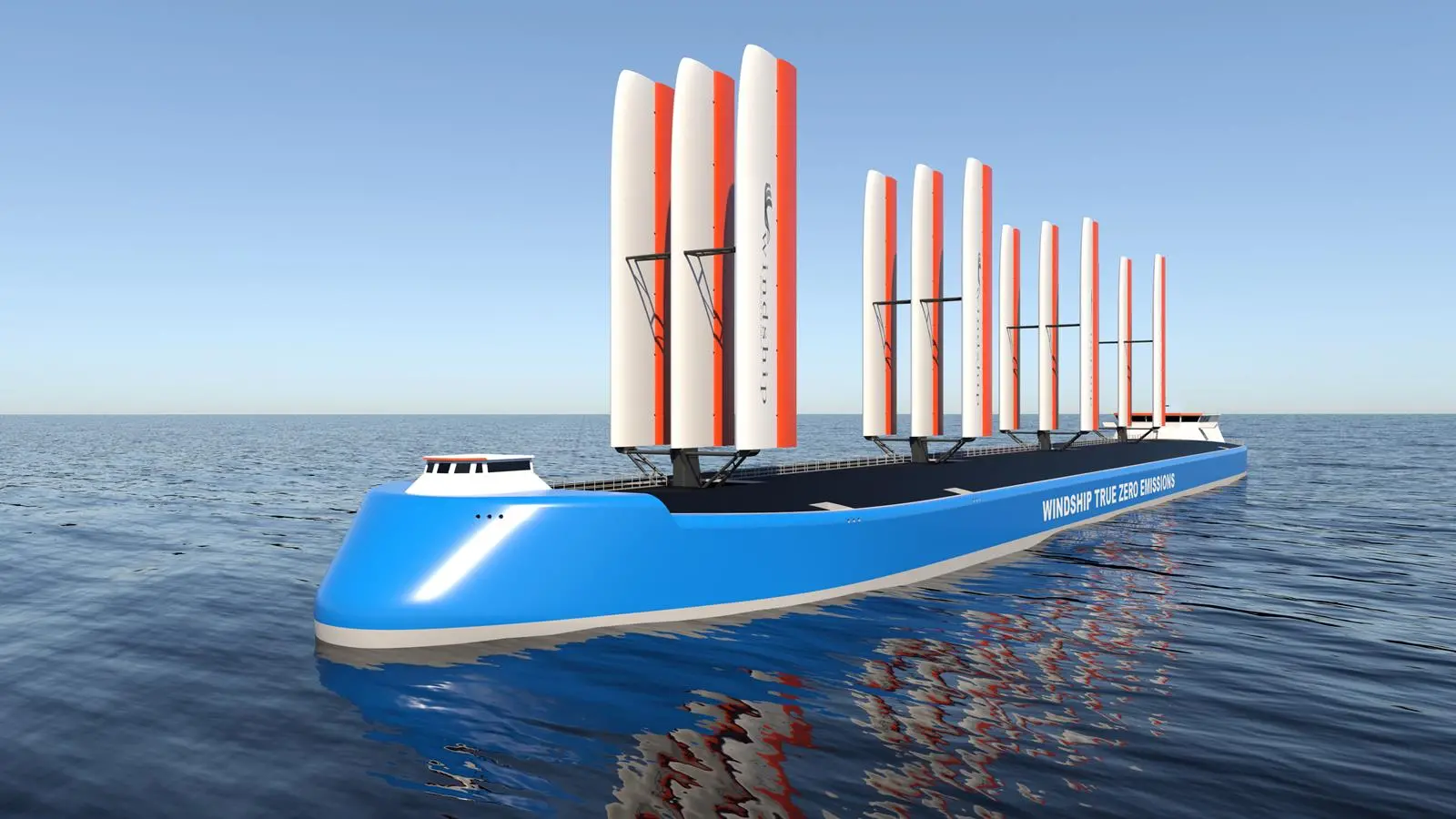
Development began on the Windship Technology solution eight years ago as an auxiliary wind power system. The result was a rig controlling a three-wing foil set either 36 or 48 metres in height, depending on the size of the ship. Then the company gathered other fuel-saving technologies, which, along with slow steaming, are anticipated to achieve up to 80% in fuel savings for the targeted vessel types.
Computational Fluid Dynamic (CFD) work completed by Cape Horn Engineering, along with a hull hydrodynamics evaluation performed the Wolfson Unit of the University of Southampton, have verified the fuel-savings. The CFD work has been further verified at the wind tunnel at Southampton University, and a Wolfson Unit report was released in March this year summarised performance predictions for a 125,000dwt vessel with two different combinations of rigs.
“It has been confirmed that an appropriately rigged commercial vessel will achieve savings of fuel and corresponding emissions at a conservative 30% per annum via the rigs alone,” says Simon Rogers, Technical Director at Windship Technology.
Zero emission ambition
But the company is aiming at zero emissions, and Rogers is now leading the development of a 115,000dwt tanker ship design which will include onboard CO2 capture from the four 2MW generators needed for the vessel’s diesel-electric propulsion system.
“We always knew that the rigs would be the bedrock from which the whole-ship design could be developed. What we now know for sure is that we have the best practical solution for commercial bulk carrier companies that wish to take their climate commitments seriously. The rigs are lower in height with vastly more thrust than single-masted technology. Combined with our whole ship design, Windship Technology can eliminate CO2, NOx, SOx and particulate matter to “True Zero” through incorporating large solar arrays, carbon capture, optimised hull shapes and specialised weather routing software into the overall design package.”
The electrical drivetrain runs with over 96% efficiency, says Rogers, who aims to future-proof propulsion train and bunker fuel choices for shipowners so that they don’t have to worry about the timing of upcoming CO2 regulations. “The details may change over the coming years, and the danger is if you order a ship right now for a particular solution, in five or 10 years’ time, that ship might become a distressed asset. If you can make the big jump in one day, you don’t have to worry about all the details of the different regulations coming in over time.”
Diesel-electric flexibility
Explaining that the design will likely involve the use of MDO, Rogers says: “Fossil fuels are a fantastic form of energy, there’s no question. It’s about finding a way to reduce their use and eliminate the CO2 content in those fuels, and that what we’ve done. The other nice thing about going with an existing fossil fuel is the supply chain is established and in place, and we’re not trying to design a new infrastructure.” He notes, though, that as technology changes, the design will be flexible enough to enable the change out of generators or the incorporation of new fuels.
He says diesel-electric power allows the flexibility in power generation required for the optimal use of wind power. “Our ship requires 4,500 kilowatts for 11 knots of ship speed, but the proportion provided by the engines will be variable. Half of that’s going to be unnecessary a lot of the time due to the wind propulsion. You have to have a flexible and holistic approach to it. You have to start on a new sheet of paper,” says Rogers.
He says that many competitors optimise their aerofoil systems for vessel speeds of 10 knots, but he feels that is too slow. “The average speed for tankers and bulkers is about 12.1, 12.2 knots, and we’re looking at slowing down to about 11 knots. That gives us a big efficiency gain, but it does mean technology is more significant.”
DC bus technology opens up the potential for other power sources, he says, and 6,000 square meters of solar panels on deck will realistically provide about half a megawatt of power on average over 24 hours. Solar panels operate at about 20% efficiency to give about 200 watts per square metre. Energy storage could be incorporated into the design in the future, and a controllable pitch propeller is a likely choice for the tanker design to achieve optimal performance given the large thrust contribution from the wind rigs.
Aerodynamic Optimisation
Aerodynamic performance optimisation of the aerofoils was completed by Cape Horn Engineering in Britain. Dr.-Ing. Rodrigo Azcueta, Managing Director of Cape Horn Engineering, said: “Our CFD analysis gives understanding and also quantifies the link between the geometry of the wing and the driving force produced. Our studies provide accurate data of how the wings will perform in real conditions and how to improve the design. It is mainly based on the detailed analysis of the driving and side forces generated by each wing configuration. The other forces and moment generated by the airflow on the wings are also computed. By varying some shape and ratio parameters, such as the section’s profile, section’s thickness to chord ratio, main wing to flap chord ratio and wings separation, we can optimise the design to increase the performance.”
Azcueta continues: “A multitude of wing assembly shape configurations were analysed in varying wind conditions. In total, almost 1,000 high-fidelity CFD simulations were performed and analysed. The simulations were used to set up force models needed to describe the vessel’s hydrodynamic and aerodynamic behaviour. Operating conditions for the wind propulsion technology devices were apparent wind angle and speed, wind shear and wind gradient (variation of wind speed and direction with height above the water surface), and angle of attack of the wings and its flaps. These simulations were extremely valuable for improving the geometries of the wing assembly.”
A double-digit percentage gain in aerodynamic performance was achieved by changing some parameters of the geometry. “Some selected simulation points were compared and validated with the wind tunnel testing, as well as with previous CFD analysis provided by Lloyds Register. Experts from the Wolfson Unit (University of Southampton) were also involved in the analysis of the CFD results. Extreme wind load cases were delivered to structural experts from Gurit for assuring optimum weight and safety of the structures,” said Azcueta.
Looking ahead
Windship Technology’s patents for the aerofoil technology cover over 30 countries. The 48-metre rig is stowable on deck, and its composite structure is borne out of technology and design from the wind turbine industry to achieve reliability and longevity of more than 25 years. Plans are in the pipeline for a 60-metre rig for 250,000dwt vessels. At this size, they would be too big to hinge and stow on deck.
“The nice thing about our technology is it is scalable,” says Rogers. “You’ve got flexibility. It really is about looking at each ship individually and coming up with the best solution.”
The company’s first full-scale 36-metre rig is yet to be built, and the first installation is planned to be a retrofit, followed by a newbuild, dedicated zero-emission ship. DNV is assessing the whole-ship design with a view to classifying emission reductions, safety and operability. Per Marius Berrefjord, Senior Vice President at DNV, commented: “We will work closely with the project team in a fully transparent manner as we now initiate the work to establish a simulation model that will help us verify the GHG emission reduction capability of the technology. We are also preparing for a HAZID that shall verify the safety and operability of ships with Windship Technology installed.
“These activities will be followed by further verification activities as the project moves forward. Windship is supplying information in a fully transparent manner, and DNV will ensure a thorough verification process. We are looking forward to dive deeper into the very interesting technology presented by Windship.”
Windship Technology is currently engaging with interested parties from both the shipping industry and investment circles and expects positive news in the next few months. In March, the company confirmed the appointment of Graham Harvey as CEO with the remit to commercialise the technology. “This is British innovation at its finest, thinking globally and solving one of the world’s great challenges of our time,” said Harvey.
Related Articles
 PROPULSION
 GENERAL NEWS
 HYDROGEN