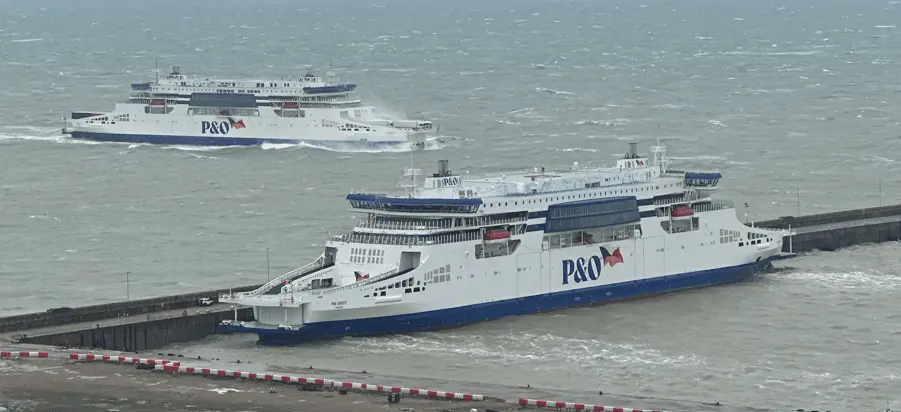
Technology fusion on cross channel route
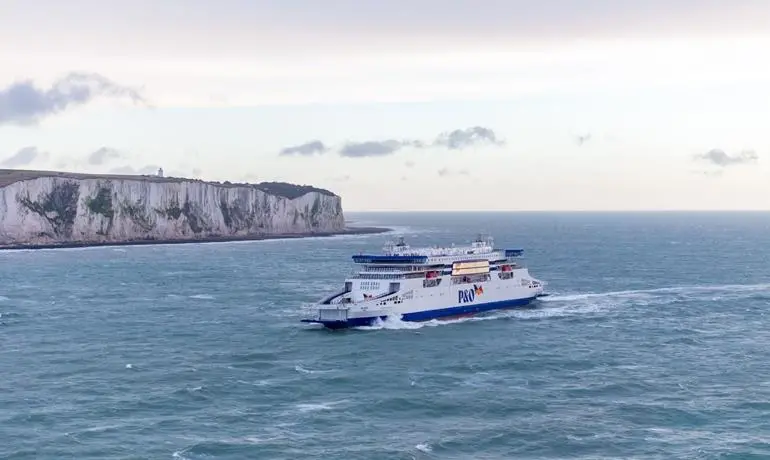
P&O Liberte arrived in Dover harbour on March 1 after an extraordinary 45-day voyage from China, circumnavigating the Cape of Good Hope. This extended journey was necessitated due to escalating tensions and hostilities in the Red Sea and Suez regions, and set a new endurance standard for a double-ended ship. Tailored to the heaviest-trafficked crossing on the English Channel, a new generation of ro-pax vessels commissioned by P&O Ferries incorporates a blend of technologies impacting on cost efficiency, service level, and environmental compatibility.
The 230m P&O Liberte made her commercial debut in March on the Dover/Calais run, the shortest ferry link between the UK and continental Europe, joining sistership P&O Pioneer. The latter had put down a new marker for the industry on service entry last June as the world’s largest double-ender, also distinguished through the combination of a diesel-electric power and propulsion system with one of the most extensive battery installations ever specified in a sea-going application, offering an energy bank of 8.8MWh capacity.
The pair had been ordered from Guangzhou Shipyard International in September 2019 at a total price of EUR260m(around $277m), based on a design developed by the shipowner in conjunction with Danish consultancy OSK-ShipTech.
While tailored in terms of hydrodynamics and configuration to specific, year-round operating requirements on the narrowest stretch of the English Channel, the Fusion Class is notable for its marriage of innovative technologies. P&O made the decision to focus on energy storage at scale rather than look to energy transition by way of LNG dual-fuel prime movers, thereby radically departing from the status quo in newbuild projects.
Compared to the 30 year-old ferries replaced by the newbuilds, the new sisters’ hybrid capacity provides for a 40% cut in fuel usage and carbon emissions on the company’s flagship route. Furthermore, the modular concept allows for future modifications and retrofits in keeping with the ultimate goal of zero-emission operation, including facilitating the accommodation of extra batteries and supplanting of generator capacity as and when the requisite shore charging infrastructure becomes available.
The adoption of a double-ended configuration with two bridges, removing the need for the ship to go about(turn) in port, has reduced overall manoeuvring time on each sailing. Given the intensity of the Dover/Calais sailing schedule, the cumulative impact on fuel consumption over a year is considerable.
While on a par in beam with the two 2011-built Spirit-class vessels already deployed on the Dover/Calais route, P&O Liberte and P&O Pioneer are nearly 17m longer at 230m overall and are similarly equipped for double-level ro-ro access and egress at both UK and French terminals. This ensures expeditious handling of the intensive, all-year trade in commercial vehicles carried on the two freight decks, with a capacity equating to some 2,600 linear metres. An upper vehicle deck provides space for 182 cars, vans and camper vans, catering to the peaks in holiday travel.
Turnaround performance is reported to have matched the expectations that underpinned the business case for the new ferries. For example, full discharge of around 140 heavy goods vehicles and 200 cars has been accomplished in as little as 10 minutes.
The provision for 1,500 passengers on the Fusion Class is 500 less than on the Spirit of Britain and Spirit of France, but more attention has been given to the layout and facilities to enhance the passenger experience. Each of the new ships has 1,550m2 of outside deck area for passengers, and double-height windows on the port and starboard sides amidships along deck 8 and 9 afford panoramic views of both the French and English coastlines, including the White Cliffs of Dover.
In the interests of through-life operating costs, the ferries have been designed and equipped to allow adjustments in the extent of passenger facilities available. For instance, during periods of reduced demand, such as winter months or off-peak sailings, up to two-thirds of the passenger spaces can be temporarily closed. The ‘intelligent’ power management system software turns off lighting and ventilation in unused areas during these periods.
The revolutionary Fusion ro-pax employs a main power installation based on four 10,625kVA generator sets driven by 16-cylinder Wartsila 31-series, medium-speed diesel engines individually rated at 9,600kW, feeding twin, 7.5MW Azipod electric azimuthing propulsion units at each end of the hull.
The open-water, compact DO-type pods ensure the exacting level of manoeuvrability needed to ensure handling precision, safety and swift turnarounds along with course stability and a maximum speed in excess of 20 knots for crossings of one of the world’s busiest seaways, sailing across a fast tidal current and often with a strong wind abeam. The 17.6-knot design service speed can be achieved using just two gensets.
The maximised encapsulation of power for thrust, and responsiveness of the system, is also geared to ensuring the ability of the ship to be worked independently on and off the berth, without call on tug assistance, in the high wind conditions often experienced at the Channel ports.
The main engines are fired on ultra low-sulphur fuel and incorporate two-stage turbocharging, rendered through ABB’s Power2 system, cutting fuel usage and NOx emissions by around 5% and 60%, respectively.
The battery system has been sized so as to give the flexibility and fuel- and emission-saving benefits in providing full electrical power for harbour manoeuvring and port turnarounds, and affords a load-levelling function in support of the main machinery. The ESS comprises a total of 1,160 lithium-ion batteries, supplied by XALT Energy and housed in four battery rooms and amounting to a capacity of 8,816kWh.
By having the first hybrid vessels on the route, P&O has gained a competitive advantage over other operators for the next few years. The preparation for running in zero-emission mode, and for maximising a future shore power infrastructure, are well-aligned to new and prospective European emissions legislation. With P&O Ferries awaiting installation of plug-in facilities at Dover and Calais to enable full-electric, zero-emission operations , the original option in the contract with Guangzhou Shipyard for third and fourth Fusion vessels has not been exercised.
Introduction of the P&O Liberte followed the company’s announcement that it had cut almost 50,000t of carbon emissions from its operations around the UK in 2023.
Signal factors influencing the major reduction in carbon footprint were the opening of a dedicated Fleet Support Centre for Fuel and Energy Efficiency drawing on related onboard SmartShip technology and fuel meters, coupled with the debut of the first of the newbuilds, P&O Pioneer and the phasing-out of the oldest vessels. After a fleet-wide 7% reduction in fuel consumption last year, a further 5% is anticipated in 2024.