



TENSION IN THE GERMAN MARITIME CHAIN
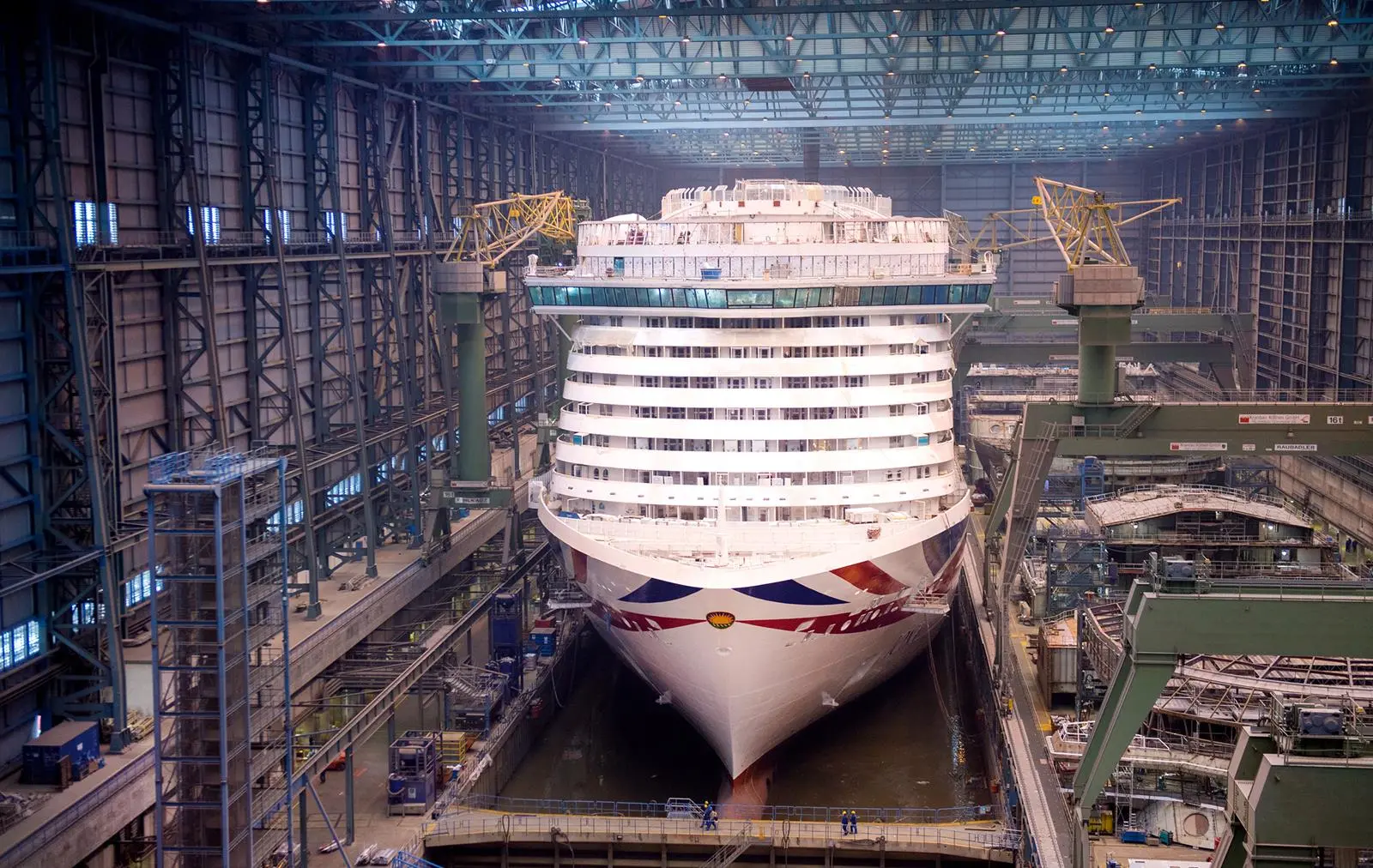
Although German shipyards at large face great uncertainty, a prestigious new order from Japan shines a light on the industry’s strengths in terms of technical capabilities, project management skills, contractual performance and supplier network. Meyer Werft, whose Papenburg fully-enclosed ‘ship factory’ is the jewel in the crown of the country’s commercial shipbuilding sector, will construct a 229m medium-sized cruise vessel for Tokyo-based NYK Group.
For sure, as the prototype of a much smaller vessel than the behemoths which have underpinned Meyer Group output for the past number of years, carrying no option on sisterships to yield cost benefits in repeat or serial production, the project for the 51,950gt newbuild represents something of a shift in business strategy.
However, the new assignment retains the factor of technological sophistication common to the Papenburg product line, and the deal has considerable significance as the first cruiseship contract to have been awarded worldwide since the outbreak of the Covid-19 pandemic. It is also highly significant as a German success in the Far East shipowning market.
Arranged for 744 passengers, the vessel will raise the bar in the Japanese premium luxury segment, and the technological level will be referenced by a dual-fuel power and propulsion installation, dynamic positioning, cold-ironing, hydrodynamic tailoring to planned routes, and a raft of measures to protect those aboard against infectious diseases.
Re-assertion of German competitiveness in the field is also a blow to a revived bid by Japanese shipbuilding to re-enter the cruiseship sector, drawing on lessons learnt from previous participation in the international market that resulted in heavy losses.
On scheduled delivery from Meyer in 2025, the newbuild will be allocated to the contractual owner’s subsidiary NYK Cruises, under the Asuka brand. Targeted at the national market, Asuka Cruises currently deploys the slightly larger Asuka II, at 240m and 50,444gt. Completed by Mitsubishi Heavy Industries in 1990 as the Crystal Harmony for the formerly NYK-owned Crystal Cruises (now part of Genting Hong Kong), the vessel was transferred to Asuka in 2006 and given her present name.
Financing for the new ship will be procured through investment firm Anchor Ship Partners, which has had a 50% stake in NYK Cruises since 2019. Asuka III, whether or not that will be her appellation, will have about 85% of the passenger capacity of Asuka II, while retaining a similar crew complement. Every cabin will have its own balcony.
The prime movers to be adopted will offer the flexibility to run on LNG, gas oil with a maximum sulphur content of 0.1%, or 0.5% low-sulphur fuel. The nomination of dynamic positioning to control the main podded propulsor(s) and bow thrusters is intended to obviate the need for anchoring and the associated risk of disturbing or damaging the sea floor.
Notwithstanding an orderbook at Papenburg extending into 2025, and the boost to confidence arising from the NYK award, the market havoc wrought by Covid has meant that the paucity of new work intake will see yard utilisation remain at a restrained level unless more orders can be attracted. The shipbuilding complex is designed for an annual construction volume of 420,000gt.
The latest completion, at the end of March, was Royal Caribbean’s 169,000gt, 4,210 passenger-capacity Odyssey of the Seas, the fifth representative of a class that took first form in January 2013 with the launch of the Quantum of the Seas. Features of the 347m Quantum generation include podded electric propulsion drives, hybrid scrubbers and SCR catalytic converters, optimised hydrodynamics, and ‘intelligent’ heat recovery, plus the signature, 90m-high observation gondola.
The shipyard is investing in new solutions in a bid to further raise its technological standing in cruise vessels, and expressions of these efforts include research into fuel cell systems and other innovations to pave the way to emission-free passengerships. In the face of the pandemic, Meyer Werft bolstered recruitment and training last September, taking on 65 new trainees and students for 16 different fields. The apprenticeship scheme is to be expanded in 2021 with trainees for the role of production technologists, emphasising a stated belief in “the importance of new young specialists to the company’s future”.
In Mecklenburg-Vorpommern, Meyer’s Neptun Werft recently delivered the final two 135m inland waterway cruise vessels booked by Viking River Cruises. The cooperation with the specialist operator has yielded 65 newbuilds under the Longships designation since 2010.
The two latest deliveries are distinguished by a hybrid propulsion system. Previously, a total of five engines for power generation have been fitted in vessels of the Longships series, including an auxiliary diesel and an emergency genset. The two latter units have been replaced by banks of batteries in the latest pair, ensuring blackout cover and enabling peak-shaving, allowing the three engines to be run in the optimal load range.
Through its concentration on river cruisers and on the fabrication of fully-equipped, floating engine room (FERU) modules supplied for cruiseship production at Papenburg and Finnish subsidiary Meyer Turku, Neptun Werft has suffered the full force of the market hiatus inflicted by the pandemic. So as to be able to immediately respond to fresh opportunities with Viking once the situation improves, the Rostock builder reports that it is “working intensively on new innovative concepts for low-emission and environmentally-friendly river cruise ships of the future.” In the meantime, adjustments to the size of the payroll are in prospect.
The earlier, seemingly inexorable rise of cruise shipping and its demand trajectory had motivated Genting Hong Kong, part of the Malaysian-owned Genting Group, to enter the shipbuilding business in 2017 through the purchase of yards at Wismar, Warnemunde and Stralsund and creation therefrom of MV Werften.
Following the laying down at MV Werften of a huge fleet modernisation and expansion programme for Genting’s various cruise brands, German shipbuilding assumed added dimension and clout in the global passengership construction stakes. However, last year’s market collapse has led to crisis at MV Werften. Negotiations between management, the works councils and trade union IG Metall have been intensified so as to achieve a restructuring plan, presaging a large-scale reduction in personnel, meeting with conditions for receiving a federal rescue package. Last October, the group had been awarded an initial bridging loan from Germany’s Federal Economic Stability Fund to cover ongoing operational costs while a broader economic assessment could be undertaken.
One of the positive developments for the industry has been the restoration of activity at Flensburger Schiffbau-Gesellschaft (FSG), a world leader in the design and construction of ro-pax and ro-ro freight vessels, and possessing a long track record in other types.
Brought out of what was described as “self administered” insolvency in 2020 by Lars Windhorst’s Tennor Holding, production at Flensburg has recommenced with an order for another example of the yard’s successful RoRo 4100 trailership design. The latest, 210m newbuild has been configured to load 4,007 lane-metres of wheeled freight on four decks and is due to be commissioned by April 2022.
Contractual party IVP Ship Invest, associated with the shipyard’s owner, is discussing potential charter arrangements and has an option on a further such vessel. These assignments, however, may be seen as an interim phase in FSG’s climb-back, as a new course is to be pursued for the shipyard. The goal is diversification, embracing specialised sectors of the commercial market plus naval vessel construction. In the latter context, the appointment at the outset of March 2021 of a head of engineering with Blohm+Voss and thyssenkrupp Marine Systems’ experience is pertinent. Moreover, corporate strategy also foresees a more comprehensive business approach that embraces lifecycle planning for a ship at the newbuild development stage.
Located on a tributary of the Elbe downstream of Hamburg, the Pella Sietas yard has a Russian capital project in hand, by way of a 120m, ARC7 class Arctic icebreaker for Rosmorport. The EUR100 million (US$117.6m) newbuild, due in 2023, will serve shipping in northern polar seas in ice temperatures down to minus 40degC, with the capability to navigate through ice up to 2.5m in thickness.
Formerly J.J.Sietas Schiffswerft, which was renowned for high-volume output of ‘paragrapher’ short-sea vessels and small containerships, the yard was purchased in 2014 by Russian interests.
While consolidation has taken place in German naval shipbuilding, a foreign organisation, in the shape of the Damen Group of the Netherlands, has been entrusted with the German Navy’s next generation of frigates. The Dutch company has teamed with Blohm+Voss, part of the Luerssen Group, for the programme and vows to have most of the production work undertaken in the Federal Republic. Nonetheless, it denotes a move away from wholesale reliance by the authorities on the national industrial ecosystem.
At the same time, promises have been made that plans for renewal of government agency fleets will be brought forward to the prospective benefit of home yards’ workload. Federal Government support for the country’s wider maritime network is also implicit in further commitments to state-sponsored R&D, and in funding for vessel conversions to alternative fuel usage and more environmentally-friendly drives.
Related Articles
 PROPULSION
 GENERAL NEWS
 HYDROGEN