



The appliance of condition and predictive-based maintenance to cargo handling
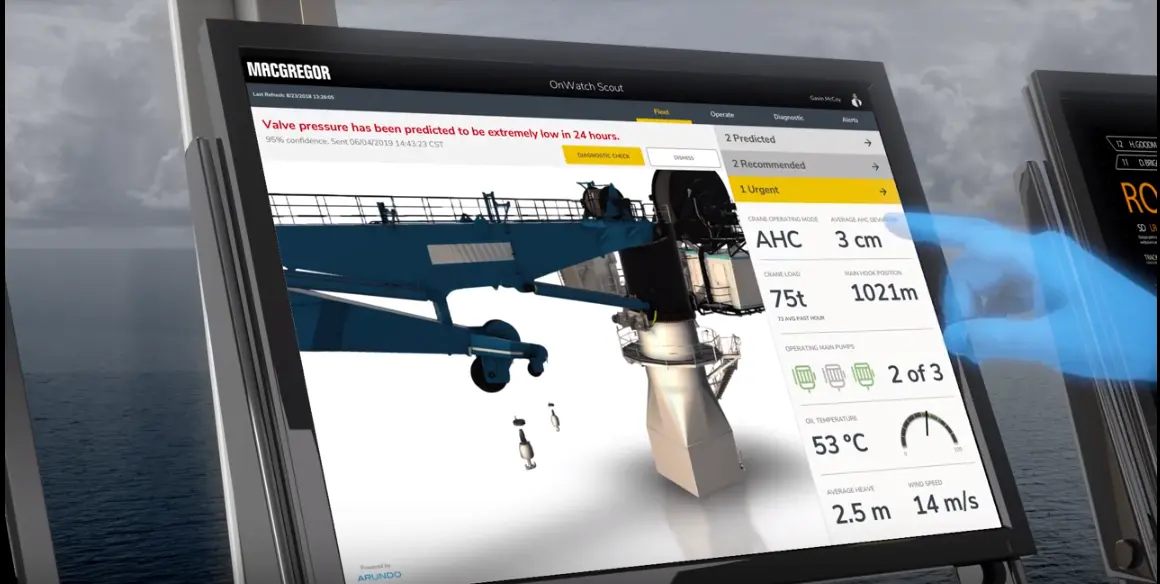
Speaking in December, following the recent introduction of MacGregor’s OnWatch Scout condition monitoring service for cargo handling cranes, Dennis Mol was very happy to discuss the transformative possibilities offered by digitalisation and other technological innovations for the shipping industry. “Digitalisation will shape the industry. We will have a new toolbox of technologies including AI, robotics, drone technology and machine learning,” Mol continued.
The new areas of technology are matched by MacGregor’s own digital agenda, which is concentrated in four main areas: predict, safeguard, optimise and automate.
Mol emphasised that such a vision was all well and good, but delivery is the key. “These services need to offer tangible benefits for the customer. That is the MacGregor way,” Mol added.
The development of a predictive maintenance solution for cargo handling cranes was just one of three development priorities for MacGregor in 2019. The other solutions were the Breakbulk Optimiser, which tailors optimisation algorithms for breakbulk stowage on ships, and C-How simulation services, which seek to use simulation software in a training and advice applications.
The OnWatch Scout solution applies machine learning to sensor data to support a predictive maintenance solution.
Cargo handling cranes represent a high-value, complex set of machinery in which machine learning could be deployed. The cranes feature over 500 mission-critical alarms, with over 290 individual related spare parts. The complexity of performing ‘time-based’ service on an individual crane – which requires up to 270 separate sets of retrievable documentation, and up to 540 ‘fix-me’ steps and visuals – means that shifting to a use and condition based monitoring schedule offers immediate efficiencies via the ‘myMacGregor’ customer portal.
Mol noted that by developing algorithms that can predict when certain machinery requires maintenance, using condition and use data with monitoring performance, the OnWatch Scout solution was expected to reduce unscheduled downtime. “Research has shown that estimated 40-50% of expected outages could be avoided simply by applying predictive maintenance techniques,” Mol noted.
The service will be offered in new sales of cranes and can also be easily retrofitted to MacGregor’s 5,000 cranes already in service. The data is always owned by the customer and protocols are tested and approved according to the latest data security standards.
While the OnWatch Scout solution was available as a standalone solution, MacGregor is also working on a second stage of the digital-led service.
MacGregor has signed a collaboration agreement with Kongsberg Digital for the data from OnWatch Scout to be transmitted to the Kognifai platform, in a cost-effective and secure way. Trials of this service will be conducted on cargo and load handling cranes installed on a number of pilot merchant and offshore vessels.
“This represents a deepening of our existing relationship. Next to our own data solution on board, we will work with Kongsberg to ensure that customers using the Kognifai platform are seamlessly connected to OnWatchScout crane information.
Besides OnWatchScout, Mol noted that the company itself had a full pipeline of new product development ideas that could be developed. However, Mol preferred to take a highly focused customer led development approach. One of the key criteria was that it had deliver actionable insight for customers.
MacGregor was also working on two other digital solutions during the course of 2019. C-How simulation services are a digital twin suite able to rise to the challenge of how to manage crew training for maintenance without occupying equipment or travelling on board.
“We know that the safety requirement to deliver and document crew training is a growing challenge facing ship operators in many segments of the market,” Mol said.
We had developed a similar training package for offshore operators, and it was a relatively straightforward process to extend the digital training concept to the merchant and roro sectors.
The training simulation environment is provided as part of MacGregor’s maintenance package and enables crew members to learn how to solve problems as much as possible themselves.
The third product launched is the Breakbulk Optimiser, to help customers improve efficiency by optimising carrying capacity by 5-15% using stowage algorithms which take size, weights, construction and route into the calculation. More importantly, the commercial window has been expanded to take in extra cargo loading.
Related Articles
 ENERGY SAVING DEVICES
 LNG
LNG
 ALTERNATIVE FUELS & LUBRICANTS