



The Future is Electric – Let us safeguard it
The fundamental role played by electrical power quality (PQ) and EMC in the operational integrity and safety of all vessels, irrespective of type or class, was discussed in the first article (High Frequency Harmonics and Marine Power Quality) in the December issue of The Motorship. This will not decrease in importance as more electric and hybrid vessels come into service in the future.
The number of PQ and EMC problems on vessels was mentioned previously and raises questions about how shipowners can mitigate some of the existing and new technical challenges. Questions about whether marine power quality and EMC should be an SOLAS (Safety of Life at Sea) issue lie outside the scope of this article, as they would require a separate article.
Continuous PQ monitoring
Some five years after the 2011 MAIB report (cruise vessel 11kV harmonic filter capacitor explosion) IACS implemented harmonic voltage (Uthd) monitoring for vessels with electric propulsion and harmonic filters (UR E24). Passive harmonic filters (LV or MV) can be problematic if not monitored or maintained correctly. There is some uncertainty as to whether vessels with active filters must comply with this rule.
Figure 1 illustrates a comprehensive system providing cycle by cycle monitoring of all aspects of power quality. However, IACS UR E24 only stipulates harmonic voltage distortion (Uthd) monitoring at the point of common coupling (PCC); the main switchboard(s). Uthd monitoring alone is meaningless.
The PCC only approach is not valid for vessels which also have significant non-linear loads downstream (e.g. retrofitted multiple VFDs on cruise vessels) or on vessels with no electrical propulsion but significant non-linear loads. The vessels subjected to Harmonic Solutions Marine PQ surveys over the last 8-9 years, where the voltage distortion was well above the 8% Uthd rule limit (i.e. 32%-106% above), mainly utilised 24 pulse synchronous and cycloconverter drives. The excessive voltage distortions (Uthd) were due to i) the harmonic currents drawn by the converters ii) the switching voltage harmonics of the power devices and iii) the line notching. The frequency spectrums extended to over 10kHz on some vessels.
At present, vessels with multi-pulse main propulsion drives are exempt from UR E24. This illustrates that IACS are (rightly) concerned with preventing capacitor explosions.
Harmonics are one aspect of marine PQ. There are many others which can affect operational integrity and safety. Continuous PQ monitoring plays a crucial part and should be installed or all vessels, irrespective of the type of electric propulsion and/or on conventional vessels with a significant auxiliary drive loads with monitoring both at the PCC and at switchboard level where auxiliary drives are fed from. Conventional PQ recorders can be utilised or the more sophisticated cycle by cycle devices measuring harmonic voltages/currents to 30kHz (500th harmonic), capturing every cycle and over 5500 PQ parameters. Cycle by cycle recorders are also an important aid to detecting impending failures (Fig 2).
Whether employed on PCC or distributed PQ monitoring, both conventional and cycle by cycle PQ systems offer the option of remote monitoring. Shipowners, for example, can monitor their vessels from anywhere in the world by their own staff or via contracted PQ expert third parties who can assume the responsibility for PQ.
PQ issues on existing vessels
Excessive Background Uthd
On vessels with electrical propulsion and/or a large percentage of electric drive loads, the problem is often not the Uthd (total harmonic voltage distortion) produced by the loads downstream but the excessive Uthd due to the main propulsion (or other large) drive loads connected to the power system. This causes serious problems for operation and reliability of sensitive loads downstream, not only on commercial vessels but also on warships. However, as with EMI, it is not always possible, financially, physically or technically, to treat the main propulsion Uthd at source. Other more affordable fixes therefore must be applied.
One non-invasive method of resolving the problem is to utilise ‘sensorless’ active filters in parallel with the respective transformer secondaries to harmonically isolate the source Uthd from the sensitive loads as shown (Fig 3). This example, a luxury yacht, experienced severe problems on 440V supplies when the 24 pulse propulsion drives were running. The installation of two 200A sensorless active filters reduced the Uthd at 440V from 13.4% to around 2% as shown. This solution has been applied successfully, including to warships, cruise vessels and drilling rigs.
General harmonic applications
In applications for conventional active filters (e.g. mitigate large numbers retrofitted VFDs) it is important to optimise the rating and cost of active filter. Therefore at least 3% AC line or DC bus reactance is required in each VFD drive. Without the additional reactance, the harmonic current drawn from the filter will increase significantly (compared to without the filter), adversely affecting performance and possibility overloading the filter. Unfortunately, active filter suppliers rarely inform customers of this important requirement.
High quality, series passive filters can offer excellent performance (<5% Ithd) for individual LV drives up to 2500kW (e.g. thrusters). However, less expensive than active filters, passive filters are not always suitable for multi-drive applications, mainly due to reactive power issues. Active front end AFE VFDs at light load have similar issues due to the capacitors in the L-C-L filter.
The decision as to whether passive or active filters are the better solution depends on the application where performance, cost, physical size/weight and maintainability are all are considerations. Detailed PQ measurements should be always carried beforehand.
Common Mode Voltage
Common mode voltage (and current) is a clear and present danger to marine and offshore sectors. It is an unwanted by-product of AC PWM VFDs, inadequately covered in marine classification societies rules or practices. It is usually not meaningful measured during sea trials or during the retrofitting of VFDs yet the use of PWM VFDs as main propulsion drives is increasing, as are the serious problems due to common mode voltage and accompanying current (CMC).
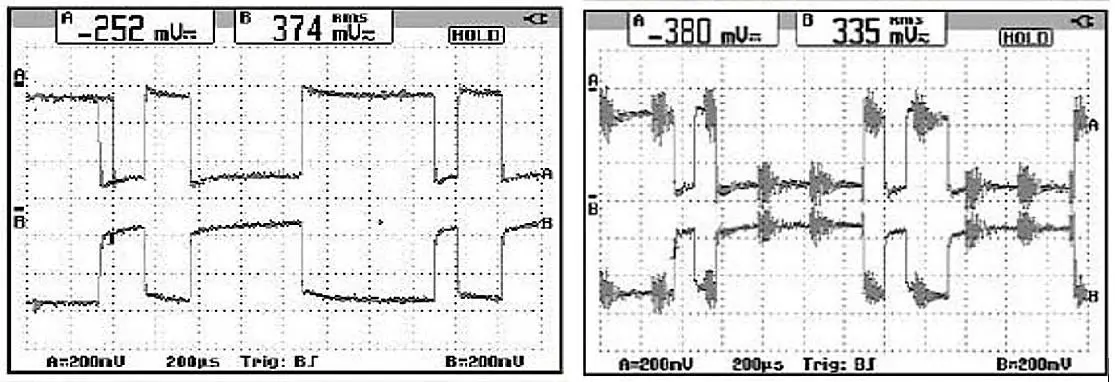
There are two aspects of CMV; one is the disruptive effect of the voltage (at high frequencies) on susceptible equipment connected to the same ground (i.e. the hull). The example in Fig 4 shows a marine fire alarm and suppression system. The lefthand trend, shows no VFDs running, while the righthand trend shows VFDs running and resultant spurious fire alarms.
CMV can similarly affect control, navigation, computers, measurement and communication systems. We have also evidence of CMV effecting IGBT firing and VFD failure on PWM main propulsion drives.
The other effect of CMV effects both VFD fed motors and fixed speed motors. In the previous editorial (December 2019), I highlighted fixed speed 6.6kV EExd motors on LNG carriers being destroyed by common mode voltage/current. An NDE insulated bearing is often recommended as the only solution by marine classification societies. These do not resolve the problem; they just move it to the DE and/or load bearing if a metal coupling. High frequency current micro-arcing in bearings in a hazardous area is highly dangerous.
Common mode voltage (between each phase and ground) can occurs if VFDs are not installed in strict compliance with EMC recommendations (i.e. special VFD cables, EMC glanding and grounding). MV (3.3kV to 11kV) VFDs, increasingly used for main propulsion drives were supposed to drastically reduce CMV. Vessels, including the LNG carriers subject to EExd motor bearing failures mentioned, the Royal Navy’s Type 45 destroyers and vessels which all have multi-level VFDs suggest otherwise.
At present, often the only viable solution is to isolate the affected equipment from the CMV. More guidance must be provided in the rules regarding the avoidance of CMV, including decelerations by manufacturers, the correct testing by a competent body during sea trails, after retrofitting on VFDs, or as part of a PQ audit.
Output LV VFD filters and other options are available to reduce the conducted emissions but are not a substitute for correct installation of VFDs and motors. Active common mode filters are being developed but demand from shipowners and others is lacking. Many consultants and designers are not necessarily fully competent on marine PQ and EMC.
Conclusions
There are many challenges ahead into the future to ensure safety and success. Education, training and equipment are required for ship’s staff to allow them to recognise and resolve PQ issues. Specialist marine PQ consultants and experts can assist shipowners and others in these matters. The marine electric future demands no less.
Related Articles
 ENERGY SAVING DEVICES
 LNG
LNG
 ALTERNATIVE FUELS & LUBRICANTS