



The future of factory ships
However the real story of factory ships goes back over 1,000 years with vessels moored in mid-stream of rivers, which were fitted with paddle wheels to provide power used to grind corn. Many water wheels on shore have survived the passage of time, but these first ‘factory ships’ only survived in the form of drawings.
So a factory ships can be defined as a vessel where some sort of industrial process takes place as opposed to ships used solely to transport goods. The whaling ships have largely died out but there is a revival as countries such as Japan look again at whaling. Fish factory ships in one form or another continue, and are used to process fish in more remote areas where the catching vessels would have a long voyage to port – in Alaska, for example.
Other factory ships have been developed for specific industries, particularly forprocesses that can only take place at sea. One example of this is a ship concept developed for the recovery of bromides from sea water, with ships operating in locations with clean sea water of the correct chemical composition. There may be a case for more ships of this type for the recovery of chemicals from sea water as land based supplies dry up.
The offshore oil industry has been a major user of floating process plants because it can be more effective to locate the processing at the source rather than on shore, or because it can be easier to get permission for the processing to take place at sea rather than on land. A development of this is seen in ship-based processing plants to handle LNG imports, where land-based plants my be perceived as hazardous.
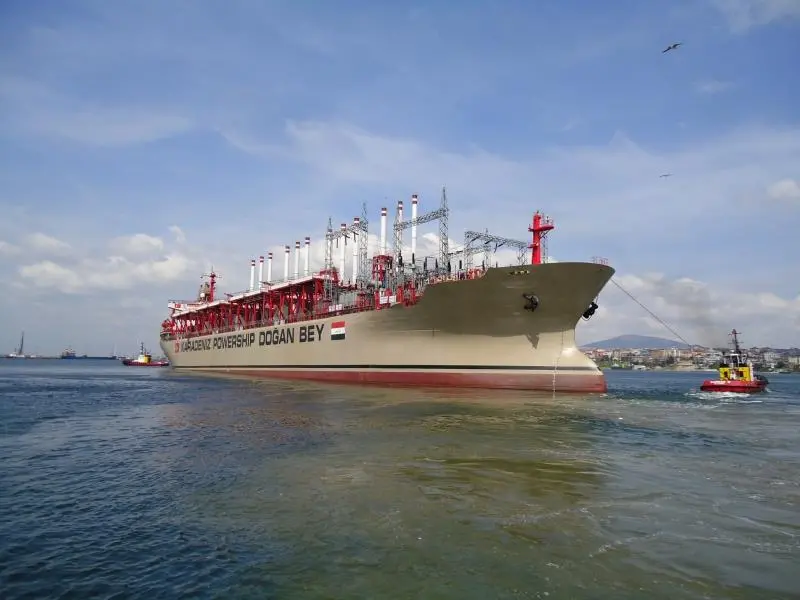
Power generation is becoming a major application for floating plants, partly because it can be expedient to have a floating plant to cope with an increase in electricity demand but also because the floating plant can be constructed in a much shorter time scale. With floating plant the construction work can be started while the necessary permits and infrastructure are being developed, for land based plant nothing can happen until the permits are obtained, which can make a time difference of several years.
Most of these floating power plants are based on barge pontoons because they are simple and cheap to construct and the plant will not have to withstand the rigours of the open sea when in operation. However new floating power plants developed for use in Indonesia are based on bulk carrier hulls, a system that allows even quicker construction and one which allows the vessel to sail to her destination under her own steam. Such a conversion provides accommodation for the crew and has its own power and domestic services. Some such ships have been converted at the Sedef shipyard in Turkey, for operation on heavy fuel oil or gas.
Another advantage of floating power plants is that they can be easily moved to a new location, with only shore connections and a berth needing to be provided at the new location. The Russians are building nuclear power plants using this concept with the nuclear power coming from tried and tested reactors used on the icebreaker fleet. These plants, which are destined for remote locations along Russia’s northern coastline, can also be used to provide heat and fresh water, the latter from desalination plants. Mounted on 21,000tonne barges, they can produce 70 MW of electric power or 300 MW of heat.
Factories where materials are processed in remote areas are an expanding sector. In Brazil a paper factory was established back in 1981 in a remote area on the banks of the Amazon by floating in the barge-mounted factory and its associated power station, all elements of which were constructed at IHI in Japan. This vessel was designed to be used as a permanent feature, being floated into a specially-constructed dock which was then drained, leaving the barge mounted on piles.
More recently a barge-mounted plant to produce wood veneer has been established in the Ivory Coast. This barge was originally built in 1975 for operation in Cameroon and was later moved to its current location, demonstrating the flexibility of floating factories to be relocated as required by the availability of raw materials and the production processes.
An indication of a future use for floating factories comes from a study carried out by Innovia Technology on behalf of the brewers SAB Miller. Faced with the uncertainties facing the brewing industry in the years ahead, Innovia has proposed a floating brewery, on a ship, which would allow the plant to be moved to new locations as markets expanded or contracted. Such a floating brewery would allow for rapid entry into new markets where there may not be the infrastructure available for a land-based plant. It would further expedite deliveries of raw materials as they could be brought by water. The project is envisaged as a fully self-contained plant with its own desalination and power generating equipment. This concept could appeal to many industries, and could well point to the future of mobile factories that can be relocated to cope with political instability of to meet new market requirements.
LNG re-gasification is an area where floating units have already been established, and with considerable potential for growth. Energy consulting firm Douglas-Westwood estimates that this could be an $8.5 billion industry by 2015, with floating units costing perhaps one third of land based plant and taking half the time to construct.
Desalination and wind and tide energy plants offer further areas of growth in the floating factory sector. In Greece a floating desalination plant has been developed as an un-manned unit with power coming from a wind generator supplemented by solar power. This unit produces up to 70m3 of fresh water per day, and it is estimated that the payback time for this unit could be three years. In Sweden a floating unit has been developed that can produce electrical power from both wind turbines and underwater current turbines. It seems that these modern floating current turbines are the modern equivalent of the paddle wheel mills of 1,000 years ago.
In a fast changing world where politics and climate change, as well as depletion of raw materials, could discourage investment in fixed land based plant, the concept of flexible floating factories has growing appeal. This could bring useful work to shipyards in the future, and builders such as STX are currently offering a selection of floating power plant designs.
Related Articles
 PROPULSION
 GENERAL NEWS
 HYDROGEN