



The world’s most powerful icebreaker
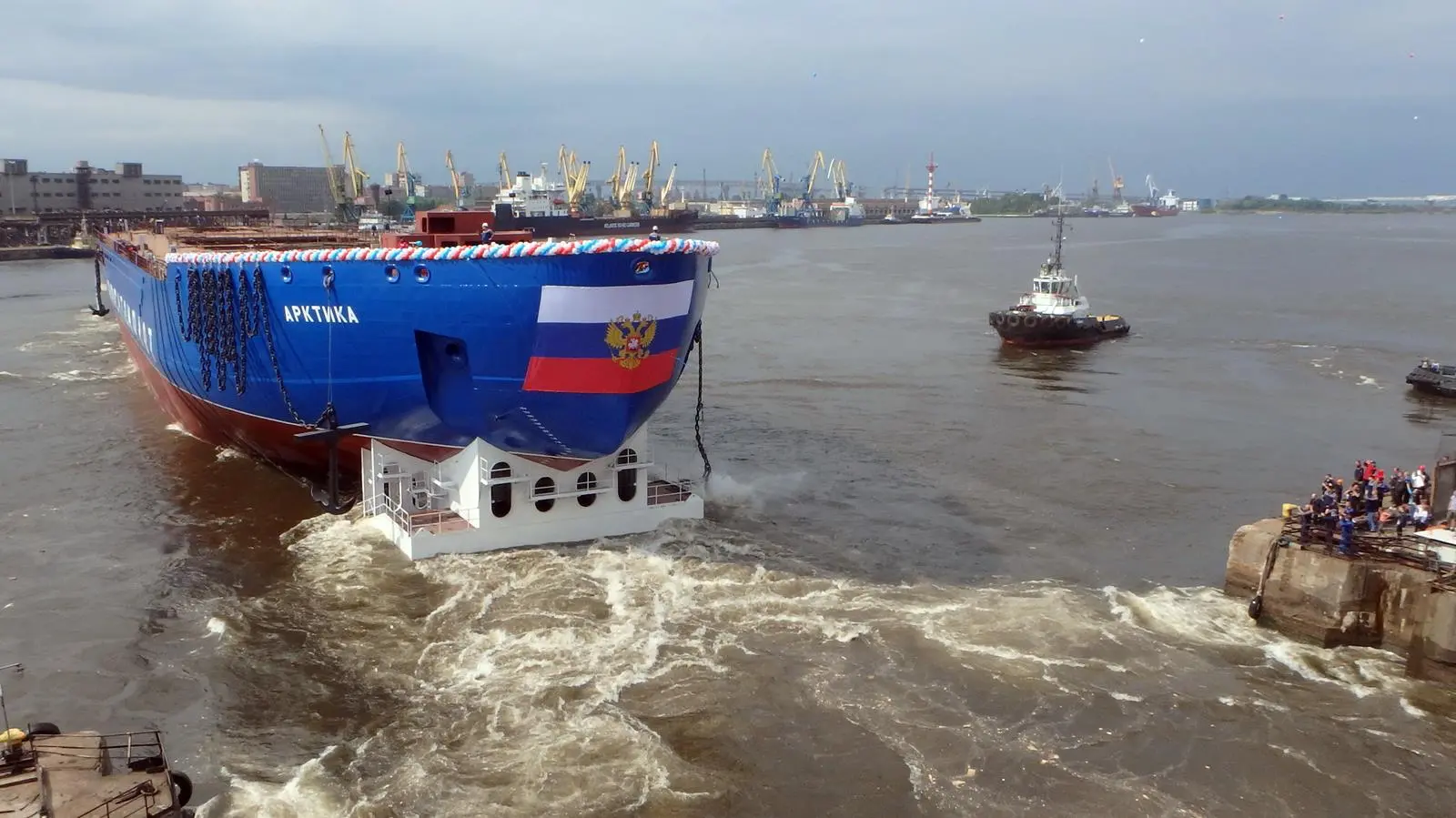
The new icebreaker was launched at the Baltiysky Zavod shipyard in St Petersburg, the lead vessel of Project 22220 and built to the order of the Rosatom Corp. The Arktika is scheduled for completion in December next year and, along with a further two icebreakers of the same design, the Siberia and the Urals, will be operated by FSUE Atomflot.
The Arktika is being built to the Russian Maritime Register of Shipping class with the class notation ÐM Icebreaker 9 [2] AUT2-ICS EPP. The society is the only one to have civil nuclear-powered ships on its register.
Russia has a long experience of building and operating nuclear icebreakers, but the Arktika is a completely new design. A key feature will be its ability to vary its draft from its normal 10.5m to 8.5m so that the ship can operate both in the deep waters of the Western Arctic – such as the Barents, Pechora and Kara Seas – and in the shallow waters of river estuaries such as the mouth of the Yenisey River and in the Gulf of Ob. With the highest Arctic class, Icebreaker 9, this 60MW vessel will be capable of continuously steaming ahead breaking heavy ice of up to 2.8 m thick.
PANAMAX MATCH
The Arktika is 173.3m in length with a beam of 34m making it the largest icebreaker ever built. This beam has been selected to match that of Panamax bulk carriers so that it can cut a channel wide enough for these ships to navigate. The displacement of the ship is 33,540 tonnes and it will be operated with a crew of seventy-five. The hull features the conventional cutaway icebreaker bow allowing the ship to ride up over the ice and use its weight to cut a path through.
The Arktika will be powered by two RITM-200 reactors of 175MW, developed by OKBM Afrikantov. This nuclear system was developed specially for this ship and it is claimed to be half the weight of earlier ship-mounted reactors, making it also more compact and able to be constructed of cheaper materials. A new feature of the RITM-200 reactors is that the associated steam generators are now contained within them, again reducing the space requirements.
The steam from the reactor drives two steam turbines coupled to 36,000kW AC generators. These in turn supply the power to the three 20,000kW electric motors that power the three propeller shafts. With the three-shaft layout the vessel has the option of economical operation on just the central shaft when operating in open waters. All three shafts are fitted with controllable pitch propellers to allow the thrust to be optimised for the wide variety of operating scenarios encountered in icebreaking operations. The whole propulsion system has been developed by TSNII Set, part of the Krylov State Research Centre. Two smaller 2000kW generators are diesel powered.
POLLUTION MINIMSED
The ship’s hull, mechanism, equipment and systems comply with MARPOL 73/78 and Northern Sea Route sewage and waste pollution prevention requirements as well as the latest requirements for Arctic navigation. The use of nuclear power is also claimed to reduce the possibilities of Arctic pollution because it minimises the amount of oil fuel that has to be carried on board.
The main advantages of using nuclear power for this icebreaker are found in the new compact design of the reactor, which allows for the huge installed power to be realised in a practical way. Under normal operation there are no emissions from the ship, which can operate without re-fuelling for several years. There is no requirement to carry stocks of fuel on board, thus increasing the payload. The ship is designed to be self-sufficient for over one year, maximising its availability, The service life of the ship is estimated at around 40 years.
This multipurpose new generation of nuclear ice-breaker is designated to assist in the independent pilotage of vessels, including large capacity vessels, and the leading of ice convoys in the western region of the Arctic year round. It can also assist in creating channels through the ice in shallow water areas where it can maintain navigation at loading terminals. The ship is equipped for towing of vessels and other floating devices, providing assistance to vessels and undertaking salvage operations in both ice conditions and in ice-free waters.
At full power the icebreaker can make a channel at a continuous speed of about 1.5-2 knots in ice up to 2.8m thick, and can tackle ice ridges of considerably greater thickness. The capabilities of the Arktika and its sister ships open up the possibility of maintaining navigation through the Northern Arctic route for much of the year.
The Baltiysky Zavod shipyard specialises in construction of large ships, ice class vessels with both nuclear and diesel-electric propulsion plants, nuclear floating energy units and floating distilling plants. In addition to the construction of the three Arktika class icebreakers the yard currently has under construction a 25MW diesel electric icebreaker and the world’s first floating nuclear power unit, which will provide both heat and electrical power to remote Arctic regions.
Related Articles
 PROPULSION
 GENERAL NEWS
 HYDROGEN