



TOUGH CRITERIA FOR BOTHNIAN FERRY
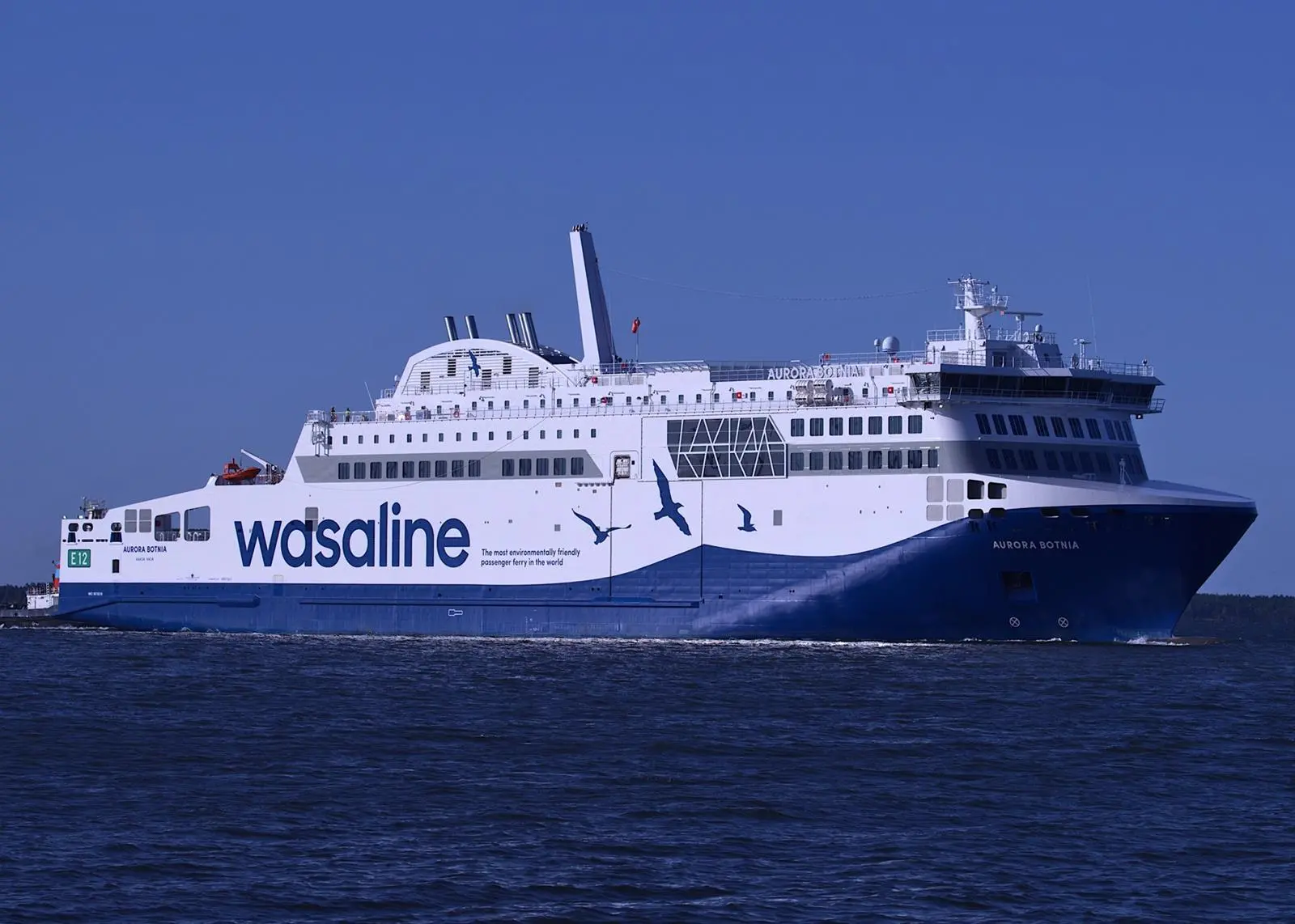
The 150m Aurora Botnia will maintain Kvarken Link’s Wasaline service connecting Vaasa in Finland with the Swedish port of Umea, claimed to be the world’s northernmost year-round ferry operation. Exacting winter ice conditions coupled with the ecological sensitivity of the waters that the vessel will ply, encompassing the Kvarken World Heritage Site, set demanding design and engineering criteria.
The hybrid power generation system and podded electric propulsion has been largely crafted within the Finnish maritime cluster, and the Vaasa region especially, in accordance with 1A Super ice class to achieve the requisite environmental standard, efficiency, long-term durability, and vessel availability. The arrangements feature multiple dual-fuel prime movers and a substantial energy storage system.
Following completion by re-emergent Finnish shipbuilder Rauma Marine Constructions (RMC), Aurora Botnia sailed up the coast to Vaasa for her formal christening on 25 August. The delivery date had been postponed on two occasions, largely reflecting the challenging nature of the project, with its innovative blend of technologies.
The vessel is certificated for 800 passengers and laid out with 1,500 lane-metres for cars and freight. It is intended that the one-off ship will run primarily on LNG, complemented and augmented by batteries at various points in the operating profile, and that the fuel mix will include liquefied biogas in the near future. At that point, the ferry’s CO2 emissions are expected to be half those of a conventionally-powered vessel, with up to 40% lower fuel costs.
Kvarken Link and its management subsidiary NLC Ferry are jointly owned by the city of Vaasa and the municipality of Umea, and Wasaline is the marketing name. The build contract was signed in January 2019, and the project has cost EUR120 million (US$141m). Hitherto served by the 1981-built Wasa Express, the Wasaline route traverses the Gulf of Bothnia’s narrow, Kvarken region, separating the inner part of the gulf (Bay of Bothnia) from the southern section (Bothnian Sea).
Power generation for the new ship’s two 5.8MW Azipod electric propulsors and other consumers is achieved using four aggregates driven by dual-fuel variants of Wartsila’s award-winning 31-series medium-speed engine. The machinery is capable of ingesting biofuel as well as LNG, which will be bunkered at Vaasa. The azimuthing propulsion units have been designed to Polar Code 6 criteria.
The 2.3MWh energy storage system is based on batteries made by the Swiss company Leclanche, providing zero-emission power for port stays and manoeuvring and fulfilling a peak-shaving role, saving on generator usage. The ferry uses Danfoss AC drives, designed and manufactured by the company’s plant in Vaasa, to control the main power grid and electric motors, and the DC connection of the batteries to the propulsion system.
The eight-cylinder, vee-type W31DF engines, which have a nominal rated power of 4,800kW at a crankshaft speed of 750rpm, employ common-rail injection and two-stage turbocharging. These formed part of an extensive Wartsila contract that included two LNG storage tanks, fuel supply and control systems, manoeuvring thrusters fore and aft, automation, catalysators, and Nacos Platinum navigation outfit.
In the course of her regular operation, the vessel will be linked to Wartsila’s Smart Technology Hub ashore, allowing real-time monitoring of vessel performance and contributing to both owner and vendor’s bid for ‘sustainability’. As a result, she will thereby act as an R&D platform and technology demonstrator.
PRINCIPAL PARTICULARS
Aurora Botnia
|
Length overall |
150.0m |
|
Length bp |
137.5m |
|
Breadth, moulded |
26.0m |
|
Depth |
8.9m |
|
Draught, design |
6.1m |
|
Gross tonnage |
24,036t |
|
Deadweight, design |
3,500t |
|
Passenger capacity |
800 |
|
Passenger cabins |
68 |
|
Ro-ro capacity |
1,500 lane-m |
|
Propulsion system |
Dual fuel-electric hybrid |
|
Main generator engines |
4 x Wartsila 8V31DF |
|
Propulsion motors |
2 x 5,800kW |
|
Manoeuvring thrusters |
2 x 1,500kW |
|
Battery capacity |
2.3MWh |
|
Speed |
20kts |
|
Class |
DNV |
|
Flag |
Finnish |
Related Articles
 PROPULSION
 GENERAL NEWS
 HYDROGEN