



Unique Ro-Ro For Space Programme
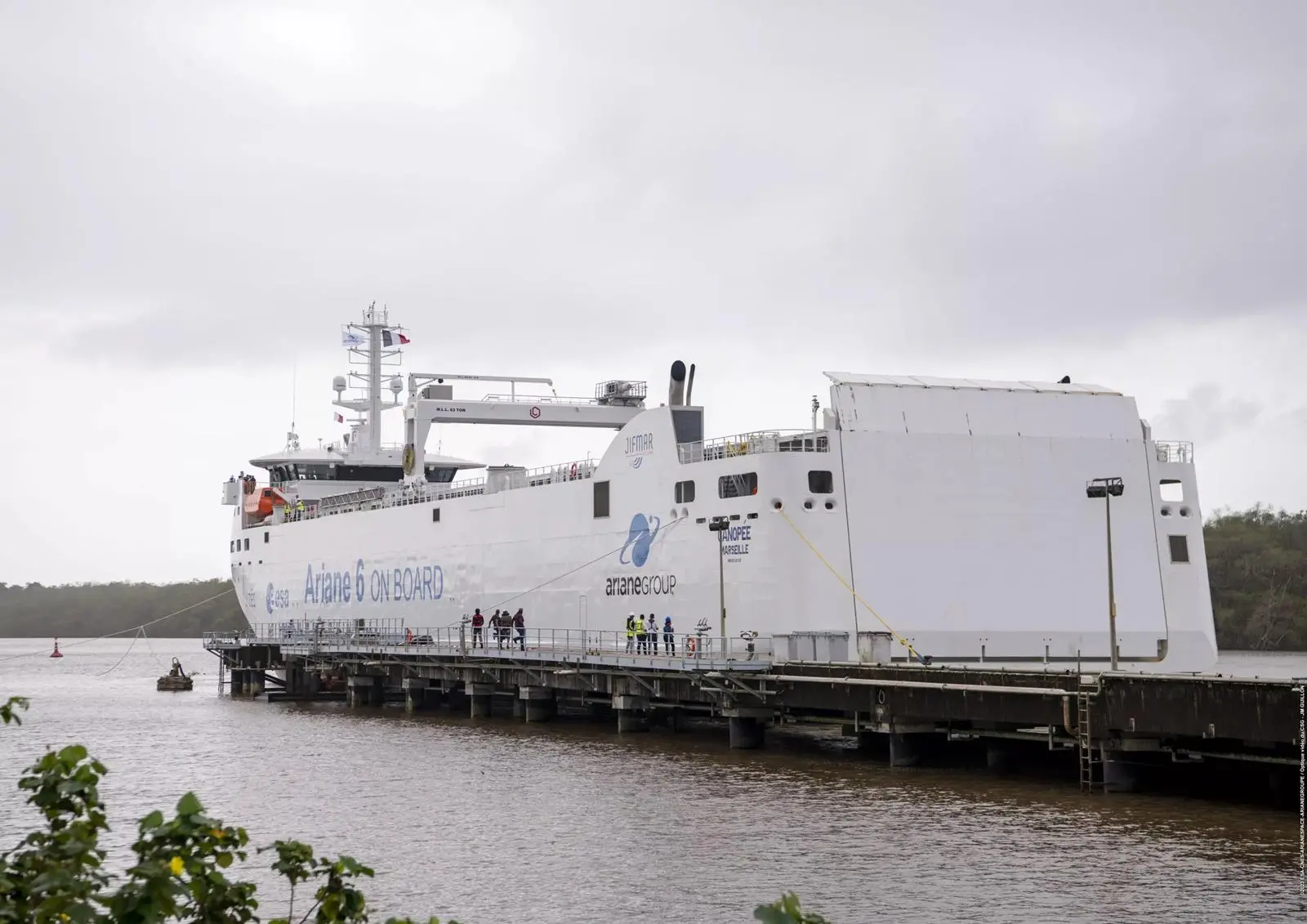
The voyage from Rotterdam to French Guiana, with arrival in Pariacabo harbour during mid-January, marked the culmination of extended sea trials and qualification of the vessel’s intended regular shipping route and port infrastructure. The return leg to Europe was expected to provide further key data for future voyages.
The 10,670gt ro-ro has been designed and constructed to carry large, indivisible and fragile loads on behalf of ArianeGroup for the Centre Spatial Guyanais (CSG—Guiana Space Centre), an assignment entailing not only through-year ocean transits but also navigation of the shallow Kourou River to the Pariacabo terminal.
The French ship is of added technical distinction through the preparation for fitting with an auxiliary sail propulsion system, to augment and complement her twin main medium-speed diesels, thereby imbuing a hybrid power arrangement. It is anticipated that the use of Canopée will ultimately cut the costs of shipping Ariane rocket components by up to 50%.
The vessel is set to transport the inaugural flight Ariane 6 launcher during the forthcoming summer, to be followed by shipments of launchers currently being integrated at Ariane Group’s sites in France and Germany. By that time, the ship is due to have been equipped with four AYRO automated wingsails.
Canopée was ordered by French marine contractor Jifmar Offshore Services from Neptune Marine of the Netherlands, which assigned hull construction and initial outfitting to Partner Shipyards of Szczecin, Poland. Final work was effected by Neptune at its Hardinxveld-Giessendam premises, located on the Dutch river network upstream of Rotterdam. Under a 15-year commitment to Ariane Group, the vessel’s operation and commercial management is the responsibility of Alizés, the joint venture of Jifmar and the Nantes low-carbon shipping consultancy Zephyr & Borée.
The project draws on technological input from VPLP Design, the French consultancy and originator of the wingsail concept launched on the trimaran USA 17 in the bid for the 2010 America’s Cup. VPLP advanced the sail-assisted cargo ship’s design under contract to, and in cooperation with, the Alizes partnership, to fulfil the performance criteria stipulated by ArianeGroup for the Ariane 6 transport logistics. Canopee will load components of the sixth-generation Ariane launcher in Bremen, Rotterdam, Le Havre, Bordeaux and Livorno.
In the design process, VPLP paid particular attention to the aerodynamics of the foreship section so as to facilitate air flow and integration of the prospective wingsail array, as well as to overall aerodynamic trim so as to obviate overmuch drift or helm angle under sail. Other areas of close investigation included propeller settings and vessel speed when in sail-assist mode. The speed facet reflected VPLP’s consideration that fully automated and optimised wingsails when used in conjunction with a conventional propulsion system promised a 30% reduction in CO2 emissions at low speed, and 20% at full speed.
With bridge and superstructure arranged forward, all cargo loading and unloading is undertaken across the 200t stern axial ramp. Handling and positioning of components on the 1,590m2 main deck is facilitated by a 60t gantry, and payload scope is enhanced by a freedom from headroom restrictions in open-hold conditions. A removable mezzanine deck of 305m2 gives extra flexibility as to cargo intake, as does the possibility to use 655m2 of lower hold, tanktop stowage space.
Wärtsilä’s ubiquitous 320mm-bore medium-speed engine series was selected to provide main propulsion, by way of two 6L32 diesels rated at 3,480kW apiece. These are geared down to drive twin controllable pitch propellers, abaft of which are high-angle (60deg) balance-type rudders. Manoeuvring at berth and in the restricted fairway of the Kourou River is assisted by a pair of 450kW bow tunnel thrusters from Wärtsilä’s FT150H range.
The auxiliary outfit comprises two main gensets driven by Scania Dl-13 diesels of 300kW, with electrical power while under way efficiently engendered by two 500kW shaft alternators. To obviate environmental impact while in port, provision has been made to obtain electricity from the landside grid via connections on each side of the ship at the bunkering point.
The four 30m-high, reefable AYRO Oceanwings will be installed in 2 x 2 configuration on each side of the ship. With sufficient wind force and suitable direction, it will be possible to shut down one of, or potentially both, the main engines and feather the propeller(s). To further reduce fuel consumption and carbon footprint, the Canopée will also be equipped with a weather routing system supplied by the French firm D-Ice Engineering and conceived to optimise wind energy.
Under contract to Neptune, the Dutch firm Groot Ship Design (GSD) supplied naval architectural and engineering consultancy relating to the steel construction and information for processing the plates and profiles. Given the ship’s capability to carry outsized items of freight in the hold without the use of hatch covers, GSD’s experience in open-top vessel design was salient to the newbuild’s development.
As to the commercial deal, Neptune is no stranger to Jifmar, having built many of the latter’s fleet of dynamic-positioning, multi-purpose work vessels.
MAIN PARTICULARS – Canopée
| Length overall | 121.0m |
|---|---|
|
Length bp |
118.2m |
|
Breadth, moulded |
22.0m |
|
Depth |
7.1m |
|
Draught, maximum |
5.0m |
|
Draught, minimum |
3.8m |
|
Air draught, maximum |
49.5m |
|
Gross tonnage |
10,670t |
|
Deadweight |
4,700t |
|
Cargo deck area, maximum |
2,550m2 |
|
Ro-ro ramp capacity |
200t |
|
Main deck gantry |
60t |
|
Main engine power |
2 x 3,480kW |
|
Speed |
17kts |
|
Sails |
4 x 363m2 |
|
Bow thrusters |
2 x 450kW |
|
Main gensets |
2 x 300kW |
|
Shaft alternators |
2 x 500kW |
|
Shore connection(each side) |
400kW |
|
Class |
Bureau Veritas |
|
Class notations |
1+ Hull, + MACH, Ro-ro cargo ship, Unrestricted navigation, +AUTUMS, MONSHAFT, COMF-NOISE 3, COMF-VIB 3 |
|
Flag |
France(RIF) |
|
Berths |
21 |
Related Articles
 ENERGY SAVING DEVICES
 ENERGY SAVING DEVICES
 AMMONIA