



US shipbuilding needs global collaboration

The US is taking the revitalization of its shipbuilding seriously. In response, two key pieces of US policy have been developed. Firstly, the Shipbuilding and Harbor Infrastructure for Prosperity and Security (SHIPS) for America Act. The bill was introduced in December 2024 and updated in April 2025. It remains to be seen if it will be passed into law, but it does have bipartisan support.
The SHIPS for America Act sets out the creation of a Strategic Commercial Fleet Program, which aims to increase the US-flagged international fleet by 250 ships in 10 years and facilitate the development of a fleet of domestically built vessels that are commercially and competitively operated.
Secondly, also in April 2025, President Trump signed an executive order – “Restoring America’s Maritime Dominance” – which demands a government-wide Maritime Action Plan (MAP) by November 5th, 2025. This core policy directive aims to expand the maritime industrial base, spanning shipbuilding, repair and components.
As well as shipyard infrastructure, the plan recognizes the significance of a well-trained and well-funded domestic maritime workforce. So, how will the US set out to achieve these ambitious shipbuilding and shipping targets?
Collaborating with South Korea
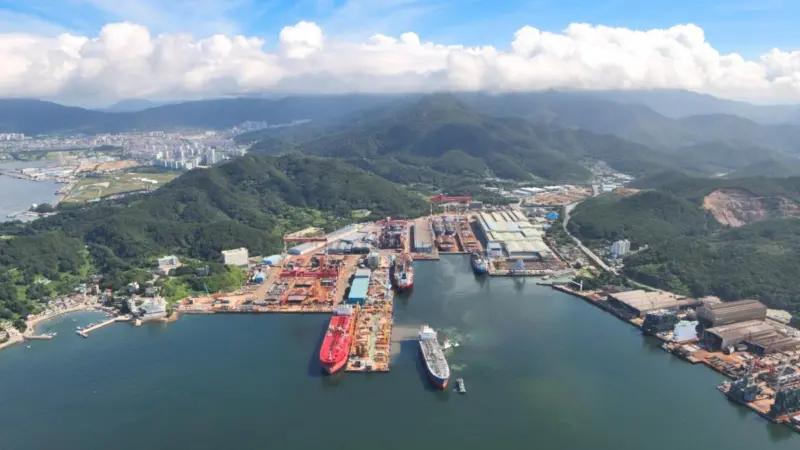
To revitalize its shipyards, the US is collaborating with South Korean shipyards – with South Korea agreeing to invest $150bn into helping the US build vessels, HD Hyundai Heavy Industries recently hosting US and local officials at its headquarters in Ulsan, and the South Korean shipbuilder also currently being in talks with multiple companies about buying a US shipyard.
Shipbuilding in Asia is huge and growing. According to Clarksons Global Shipbuilding Review, 2024 saw the largest order intake in 17 years. Shipyard output increased by 13%, with South Korea’s output increasing by 22% and it achieving 28% market share by Compensated Gross Tonnage (CGT), meanwhile China’s output was up 18% compared to 2023 and its market share was 53%.
Working with South Korea’s major shipbuilding companies is a logical next step because they are known to produce high-tech, high-value, and best-in-class vessels on a massive scale. US officials have also already publicly stated how impressed they are by the digitalization and efficiency of the nation’s shipyards.
South Korean shipyard digitalization and efficiency, in part, results from decades of strong collaboration with international partners. NAPA, for example, has supported Korean shipbuilders in maintaining a competitive edge – including HD Hyundai Heavy Industries, Hanwha Ocean, and Samsung Heavy Industries, as well as supporting classification societies like the Korean Register.
Developing digital shipyards
A strong example of how digitalization has embedded itself in Korean shipyards’ strategies is HD Hyundai Heavy Industries, the world’s largest shipyard. In 2016, it adopted NAPA Steel to help modernize its hull structure basic design process. This shift from traditional 2D drawing-based methods to an integrated 3D modelling approach has allowed shipyards to optimize ship design and building processes.
In practice, this digital evolution allows naval architects to harness advanced 3D models and data to significantly improve design accuracy, efficiency, and collaboration. Accuracy is supported by having domain and discipline-specific digital tools, but that are still seamlessly integrated through the design phases. This offers digital continuity from concept to detail design using 3D models without compromising on the ship’s specific needs.
From an efficiency standpoint, this technology enables more design iterations in a shorter period, reduces the risk of errors in the downstream design phase, manages data effectively, and creates a single source of truth for critical project information. This data quality, consistency and continuity helps the yard achieve lower costs, shorter schedules, and higher quality in larger and more complex projects. Essentially, it helps to ensure projects are delivered on time and on budget.
Digitalization done right can also help to break down silos and facilitate collaboration between the thousands of people involved in ship design and building processes – including shipowners, shipyards, naval architects, engineers, academia, and class societies. To be effective, it is critical that shipyards select a comprehensive set of interoperable digital tools that are specially optimized for shipbuilding and part of a consistent digital ecosystem. The wrong tools will only cause fragmentation and duplication of effort.
Simulating green options
This consistent 3D model can also be the basis for a ship’s design analysis digital twin, which can then be used to simulate the vessel’s future performance, fuel consumption, GHG emissions, strength & stability parameters, and hydrodynamic profile, as well as testing design variations and different operational profiles – all before construction even begins. Access to these insights supports decision-making right from the outset of a project.
Being able to simulate design variations is especially powerful when considering alternative fuels or energy-saving devices for a vessel. Wind-assisted propulsion systems are one technology that, to maximize performance and safety, a clear view of the ship’s hydrodynamics and unique operating profile is required. With NAPA Operational Simulation, for example, powered by historical and current data on wind speed and direction, wave height, and swell, users can test technology performance in the real weather and sea conditions the ship will face.
As regulations like the EU Emissions Trading System (EU ETS) and IMO Net-Zero Framework add costs to emissions, access to these digital design tools can reduce lifecycle costs. Shipowners can accurately weigh up the CAPEX of a wind system with the OPEX that the vessel will save on its voyages through fuel and emissions reductions.
This removes ‘guess work’, highlights the best designs supported by data, and gives shipowners more confidence about how their ships will perform in real life.
With this analysis and simulation digital twin, naval architects and engineers can also follow a vessel for its entire design life, further streamlining design processes. This single source of truth can ensure any information on upgrades, refits, or reclassifications that may occur remains with the vessel in its 3D model.
Overcoming recruitment challenges
Efficiency through digitalization is also vital for the US to grow its shipbuilding capacity without immediate access to a large, appropriately trained maritime workforce. For smaller shipyards, where skilled labor shortages hit hardest, this is especially important. Digital manufacturing can, for example, enable shipyards to create a digital replica of their production facilities to simulate and optimize workflows, manufacturing processes, and outputs – ensuring efficient use of scarce resources.
In Japan and Korea, attracting new talent to the shipbuilding industry has been difficult amid rapid population declines and they have turned to digitalization to help. In South Korea, the problem has been particularly acute since newbuilding work resumed after the lifting of COVID restrictions, but the situation has its roots in the layoffs that followed the 2014 market downturn, when the workforce was halved from some 203,000 workers to around 92,000.
Digital technology can help alleviate recruitment challenges on two fronts: by removing duplicated tasks to enable engineers and naval architects to maximize their productivity, and by making the sector more attractive to younger generations. Plus, with the rapid evolution of artificial intelligence, the potential of data and digitalization to increase efficiency and add even more value is huge.
Connecting the dots
In conclusion, the US is taking the revitalization of its shipbuilding seriously with several key policy objectives. It is positive to see officials recognize the importance of collaborating with South Korea too. However, it is also essential that US shipbuilding companies do not overlook the fact that South Korean shipbuilding is underpinned by global collaboration on digitalization. Embracing digitalization has allowed shipbuilders to unlock efficiencies and capabilities that are critical to delivering shipbuilding projects on time, on budget, and at scale today.
If the US adopts the same close collaboration, its shipyards, policymakers and shipowners can join a global community of fellow shipbuilders and designers. This community has already identified barriers to shipbuilding growth and developed digital solutions together. Continuous feedback from leading shipbuilding companies in South Korea and beyond has led to the development of new capabilities and the refinement of processes. This legacy can provide the US with proven value while requiring relatively low implementation effort.
Essentially, to achieve shipbuilding growth and its policy targets, the US is wise to follow South Korea’s example: embracing the digital shipyard revolution, with the use of digital tools specifically built and optimized for the complexity of multi-disciplinary shipbuilding, to streamline production and build high-quality vessels. Adopting the South Korean model would be a win-win for US shipbuilding.
Related Articles
 PROPULSION
 GENERAL NEWS
 HYDROGEN